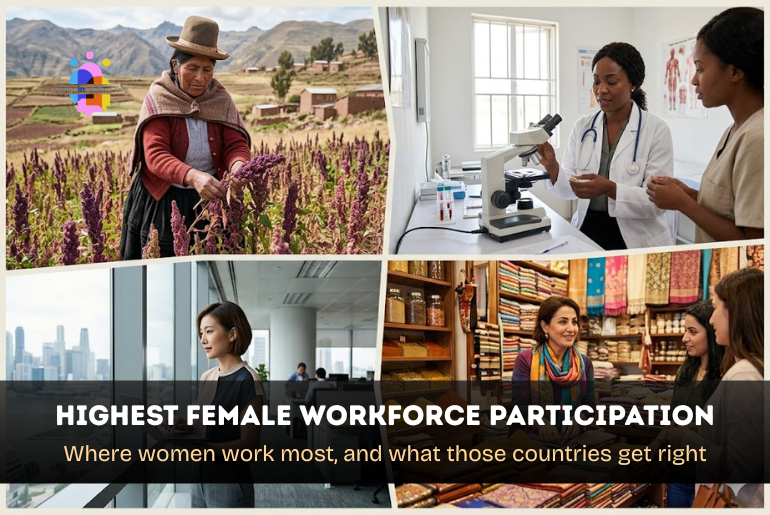
The highest female workforce participation is often treated as a clean indicator of progress. It is not. The indicator tells us something important, but not everything. A high female labour force participation rate can reflect strong childcare, family-friendly work, equal opportunity, and supportive labour laws. It can also reflect necessity, informality, and survival-driven work in low-income economies.
The World Bank’s female labour force participation data, based on ILO modelled estimates, show exactly this split. It shows that the highest rates are often found in either very poor or very rich countries, while many middle-income countries sit far lower.
This article takes that complexity seriously. It looks at countries with very high female workforce participation from a global perspective, explains what they are doing right, and also names what their numbers do not tell us. The aim is not to romanticise high participation. It is to understand what truly helps women enter, remain in, and grow through work.
We also link this discussion back to our earlier Changeincontent analysis on female workforce participation goals, because participation without job quality, safety, and real advancement is still an incomplete win.
What “highest female workforce participation” really means
The female labour force participation rate measures the share of women who are either employed or actively seeking work. That sounds straightforward, but interpretation is not.
Experts note that women’s participation tends to be high in the poorest economies. That is where agriculture and low-paid informal work dominate. At the same time, it is lower in many middle-income economies, and higher again in some rich economies with strong care infrastructure and labour protections.
So a country can rank highly for very different reasons.
In one place, women are working because the system supports them. In another, women are working because the household economy would collapse without their labour. That is why this article does not just list countries. It explains the model behind each one.
Highest female workforce participation: The countries that currently sit at the top
The highest female labour force participation rates in 2024 were seen in Madagascar (82.56%), Solomon Islands (82.44%), Nigeria (80.71%), Tanzania (80.16%), and Burundi (79.86%). Other high-ranking countries included Mozambique (78.12%), North Korea (77.69%), Uganda (76.5%), Benin (74.32%), and Cambodia (73.96%). (Source: The Global Economy)
At the same time, among OECD and other high-income economies, the strongest performers include Iceland, New Zealand, the Netherlands, Switzerland, and Estonia. Each of these combines relatively high female participation with more formal labour-market structures. (Source: The Global Economy)
That gives us two very different clusters to learn from.
1. Madagascar: High participation, but largely driven by necessity
Madagascar has one of the highest female labour force participation rates in the world at 82.56%. But this is not a Scandinavian-style equality story. It is a reminder that when economies are heavily agrarian, and household survival depends on women’s work, participation numbers can be high even when women’s jobs remain informal, underpaid, and insecure.
The policy lesson from Madagascar is not that high participation alone is enough. It is that women’s labour is already central in many economies, and development policy must stop treating it as supplementary.
2. Solomon Islands: Community work, agriculture, and invisible labour
At 82.44%, Solomon Islands also ranks near the top globally. Women’s work there is strongly tied to agriculture, fisheries, and community-linked economic activity. That is another case where labour force participation is high, but much of that work may not translate into formal income security or upward mobility.
The lesson here is that governments and development actors must not confuse high participation with decent work. The real task is to move women from labour visibility to economic power.
3. Nigeria: Women work at scale, but job quality remains the real question
Nigeria’s female labour force participation rate stands at 80.71%. Women play a major role in small businesses, trade, agriculture, and informal services. What Nigeria’s case tells us is that entrepreneurship and informal work can sustain high participation. However, the absence of formal protections, credit depth, and social security can still leave women economically exposed.
The lesson for businesses and governments is simple: participation rises faster when women gain access to trade and self-employment, but inclusion becomes meaningful only when finance, infrastructure, and protection support those pathways.
4. Tanzania and Burundi: When women’s work is essential but undervalued
Tanzania (80.16%) and Burundi (79.86%) both feature near the top of the global list. Their numbers reinforce the same important caution. In lower-income settings, women’s economic participation often reflects the fact that subsistence, agriculture, and household survival require constant labour input from women.
That is why the countries with the highest female workforce participation cannot all be held up as role models in the same way. They are evidence that women’s work is indispensable. But they also show why quality of work, wages, safety, and access to assets matter just as much as participation itself.
Highest female workforce participation in richer economies: The countries worth studying closely
If low-income countries reveal how essential women’s work already is, high-income countries show what support systems can do when governments and employers decide women’s participation is a structural priority rather than a cultural afterthought.
1. Iceland: The strongest high-income benchmark
Iceland remains one of the world’s clearest examples of a high-income economy. Its 2024 female labour force participation rate is 70.29%, the highest in the OECD ranking surfaced through that series, while Switzerland’s 2026 summary of the PwC Women in Work Index reports Iceland’s female participation rate at 85.1% under a different OECD-focused methodology.
Both datasets place Iceland at or near the top among rich economies. What explains that performance is not magic? It is a long-term ecosystem of generous parental leave, high-quality childcare, and a family-friendly work culture.
What Iceland gets right is not just encouraging women to work. It reduces the cost of working. That is the real lesson for other countries. Women’s participation rises when care systems, leave systems, and workplace design reduce the penalty of combining work and family life.
2. New Zealand: Strong participation, but with attention to underutilisation
New Zealand’s female labour force participation rate was 66.5% as of June 2025, according to the country’s Ministry for Women. That number places it among the high performers in advanced economies.
What makes New Zealand worth studying is that the official discussion does not stop at participation. It also tracks underutilisation, flexible work, and the gendered impact of caring responsibilities. That is a more honest model.
New Zealand shows that high participation is important, but governments also need to ask whether women are getting enough hours, enough progression, and fair-quality work.
3. The Netherlands: High participation, but part-time work is the hidden story
The Netherlands is often cited as a top performer, and the World Bank/ILO-based ranking puts it at 62.88% in 2024 among OECD economies. But the OECD’s own work on the Dutch labour market adds crucial context. Nearly 40% of all workers in the Netherlands work part-time, and women make up a disproportionately large share of that part-time workforce.
The good news is that part-time work has helped keep women attached to the labour market. But the problem is that it can slow career progression, reduce lifetime earnings, and deepen gender inequality at home and at work.
The Dutch lesson is therefore mixed. Flexibility helps participation. But flexibility without equal progression can trap women in partial inclusion.
4. Switzerland: High participation can still hide structural penalties
Switzerland also performs strongly, but the OECD is unusually explicit about the trade-off. It says Switzerland’s high female labour participation masks one of the highest incidences of part-time work among mothers in the OECD. High childcare costs and tax-benefit design discourage many second earners, especially mothers, from moving into full-time work.
It is a crucial insight for policymakers and employers alike. Women can appear “included” in headline workforce numbers while still being financially penalised and slowed in career terms. Participation is necessary. It is not sufficient.
5. Estonia: Strong participation, strong education, but the wage gap persists
Estonia offers one of the more encouraging European models. OECD analysis says the female employment rate in Estonia is around 75% of the working-age population. That is well above the OECD average.
Estonian women generally work full-time and are highly educated. But Estonia also still faces a large gender wage gap and unequal burdens of unpaid care.
That makes Estonia’s lesson especially useful. Good education, full-time participation, and strong presence in both public and private sectors can move the numbers significantly. But without equal pay and equal care responsibilities, women still do not experience the labour market on equal terms.
What the countries with the highest female workforce participation are actually teaching us
If there is one clear pattern across this list, it is this: women work when systems need them, but they thrive only when systems support them.
- In low-income countries, women’s labour is often unavoidable for household survival.
- Richer countries show that when childcare, parental leave, legal protections, and flexible work are strong, more women stay in the labour market.
But both clusters also show the same blind spot. Participation alone can hide low pay, informality, underemployment, and a lack of progression.
So what should the world learn?
- First, childcare is not a side issue. It is labour-market infrastructure. Countries that make care easier make work more possible for women.
- Second, flexibility helps, but part-time dependence can become a ceiling if not paired with equal pay, pension protection, and career progression.
- Third, high participation in poor countries does not deserve any romanticism. Women may be working because they must, not because the system is fair.
- Fourth, women’s labour force participation depends on a larger ecosystem: safety, transport, digital access, education, and social norms.
What India and similar economies should take from this
For countries like India, the question is not simply how to raise female workforce participation. It is how to raise it in ways that are formal, safe, well-paid, and sustainable. India’s female labour participation had improved to 31.7% in the latest official survey. However, it remained well below many G20 peers. Moreover, it remains heavily shaped by low-quality self-employment rather than by strong formal job creation.
That is why global comparisons matter. They show that women’s participation improves when countries invest in the basics: safer workplaces, reliable transport, child-care infrastructure, fair hiring, and growth pathways.
If India wants to move meaningfully toward its long-term goals for female workforce participation, the lesson from the top countries is straightforward. You cannot build participation through slogans. Building them needs systems.
The Changeincontent perspective
At Changeincontent, we don’t view the countries with the highest female workforce participation as a medal table. We read them as case studies.
Some countries show what happens when women are forced to work because the household economy demands it. Others show what happens when institutions actively reduce the cost of working as a woman. The smartest reading lies in the difference between the two.
The real goal is not simply to make more women visible in labour statistics. It is to create conditions where women can work with dignity, stability, mobility, safety, and room to advance. High participation without quality can still leave women overworked and underpowered. High participation with support can change the shape of an entire economy.
That distinction matters in every boardroom, ministry, and policy conversation.
Conclusion: Highest female workforce participation is a clue, not the whole answer
Highest female workforce participation is one of the most useful labour-market indicators we have, but only if we read it properly. A high number can point to strong support systems. It can also point to deep economic necessity.
The countries that truly get it right are not only the ones where women work in large numbers. They are the ones in which women can stay in work, grow through work, and benefit from work without carrying a disproportionate burden.
That is the real benchmark the world should aim for. Not just more women in the workforce, but more women in work that is fair, protected, and worth building a future on.
Disclaimer: The views expressed in this article are based on the writer’s insights, supported by data and resources available both online and offline, as applicable. Changeincontent.com is committed to promoting inclusivity across all forms of content. We broadly define inclusivity in terms of media, policies, law, and history. It encompasses all elements that influence the lives of women and marginalised individuals. Our goal is to promote understanding and advocate for comprehensive inclusivity.