
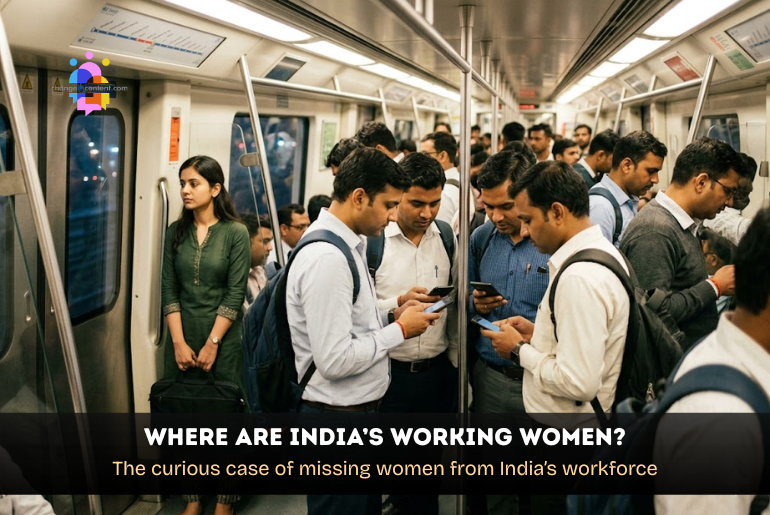
The story of the missing women workforce in India is not new. What is new is how clearly recent data exposes the gap. It is not just the gap in employment, but in how we measure and understand work itself. India’s labour market appears to be improving on paper. Yet, a closer look reveals that millions of women are either stuck in low-quality jobs or missing entirely from official statistics.
Between 2021–22 and 2023–24, India added 83 million jobs. That number signals economic momentum. However, within that growth lies a quiet imbalance. A significant share of women’s participation is concentrated in low-income, informal sectors. And even more concerning, a large number of women are not counted as unemployed at all. They are simply categorised as “out of the labour force.” (Source: Azimji Premji University Report)
The numbers behind the missing women workforce in India
At first glance, the data looks promising. It says we have added 83 million jobs in two years. And also, the women’s labour force participation is rising. But the composition of these numbers tells a different story:
- Around 40 million of the new jobs were in agriculture
- Women accounted for 38 million of these agricultural roles
This concentration matters. Agriculture in India is often characterised by:
- Low wages
- Seasonal instability
- Informal employment
- Limited productivity growth
So while more women are “working,” many are working in sectors that offer little financial security or upward mobility.
When women do not count as ‘Unemployed’
One of the most critical insights into the missing women workforce in India comes from how unemployment is defined. To be counted as unemployed, a person must:
- Not having a job
- Be actively looking for work
That is where the gap emerges.
Men vs Women in Labour Data
- Men without jobs are more likely to be counted as unemployed
- Women are far more likely to be classified as “Out of Labour Force (OLF)”
It means:
- They are not working
- They are not counted as job seekers
- They disappear from unemployment statistics
Let us not look at it as a mere statistical error. In reality, it reflects deeper structural realities.
Why are women missing from the workforce in India?
Now that the gap is visibly clear, let us understand what leads to the gap.
1. The burden of unpaid care work
Women in India spend a disproportionate amount of time on household chores, childcare, and elderly care. That limits their ability to:
- Seek formal employment
- Work full-time
- Participate in the labour market consistently
2. Lack of suitable job opportunities
Even educated women face barriers:
- Jobs are not available near their location
- Roles do not match their qualifications
- Workplace environments are not inclusive
These barriers create a situation where women remain economically inactive despite being qualified.
3. Safety and mobility constraints
Although it is sad to say, in 2026, for many women, especially in semi-urban and rural areas:
- Commuting is unsafe or unreliable
- Workplaces are not designed with safety in mind
That directly impacts workforce participation.
4. Discouragement and repeated rejection
After multiple unsuccessful attempts to find work:
- Many women stop actively searching
- They move into the “OLF” category
It creates a misleading picture of lower unemployment rates but higher hidden inactivity.
Education vs Employment: A growing disconnect
One of the most striking patterns in the missing women workforce in India is the gap between education and employment.
Among young individuals aged 25–29:
- Men remain largely within employment or unemployment categories
- Women show a significant shift into the out-of-labour-force category
It suggests:
- Education alone is not translating into jobs for women
- Structural barriers persist even after skill development
The quality of jobs: A bigger concern than quantity
It is not just about how many jobs exist. Instead, it is about the kind of jobs women are getting. The current trends show:
- A shift of women into agriculture and informal sectors
- Limited access to high-paying, stable jobs
- Minimal representation in formal employment
It creates a cycle:
Low-paying work → Limited savings → Reduced mobility → Continued dependency
The hidden economic cost of the missing women workforce in India
The absence of women from the workforce is not just a social issue. It is an economic one. Studies by global institutions suggest that increasing women’s workforce participation could significantly boost India’s GDP.
When women are excluded:
- Household incomes remain lower
- Consumption slows
- Economic growth loses momentum
What needs to change: Moving from numbers to action
The inclusion of women in the Indian workforce starts with actions. And the first action is recognition. So, here is what needs to change.
1. Recognising invisible labour
- It is only correct to acknowledge that unpaid care work in policy frameworks
- Time-use surveys should inform labour policies
2. Creating quality jobs for women
- Focus on sectors beyond agriculture
- Encourage women in manufacturing, services, and technology
3. Improving workplace infrastructure
- Safe transportation
- Flexible work models
- Childcare support
4. Redefining labour metrics
- Expand definitions of employment and job-seeking
- Capture discouraged workers in official data
5. Supporting women through policy and practice
- Skill development linked to actual job markets
- Incentives for companies hiring women
- Stronger implementation of inclusion policies
A broader context: What workplace data is already telling us
The patterns in the missing women workforce in India align with broader workplace realities highlighted in our previous analysis. From burnout to lack of flexibility, systemic gaps continue to shape women’s professional journeys.
The problem is not that women do not want to work. Instead, the problem is that the system is not designed for them to work. When millions of women are:
- Not counted as unemployed
- Not included in job creation narratives
- Not supported through policy
If you think we are just missing workers, you are not getting it right. In reality, we are missing the full picture.
Conclusion: Counting women is the first step to inclusion
The missing women workforce in India is not just about employment numbers. It is about visibility. Because what is not counted is rarely prioritised.
India’s growth story cannot be complete if half its population remains on the margins. It is incomplete as long as women are working without recognition, or willing to work but excluded from opportunities.
The next phase of economic growth must not just create jobs. It must create space for women within those jobs, and within the systems that measure them.
Disclaimer: The views expressed in this article are based on the writer’s insights, supported by data and resources available both online and offline, as applicable. Changeincontent.com is committed to promoting inclusivity across all forms of content. We broadly define inclusivity in terms of media, policies, law, and history. It encompasses all elements that influence the lives of women and marginalised individuals. Our goal is to promote understanding and advocate for comprehensive inclusivity.
