
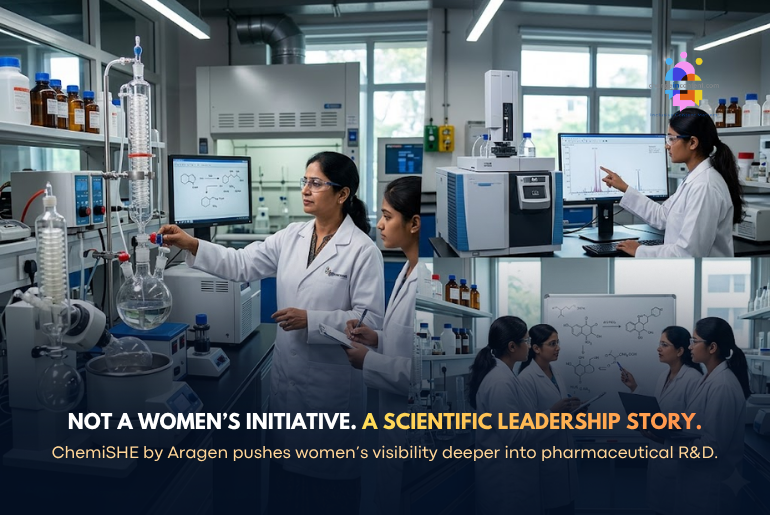
There are company announcements that sound good on paper, and then there are the ones that quietly test a larger possibility. The launch of ChemiSHE by Aragen belongs in the second category.
Aragen, a Hyderabad-based Contract Research, Development, and Manufacturing Organisation (CRDMO), has launched ChemiSHE. It is a first-of-its-kind chemistry synthesis laboratory in India, entirely operated and led by women scientists. Aragen inaugurated the laboratory on April 8, 2026, at the company’s Mallapur campus in Hyderabad. That makes this more than a diversity initiative. It makes it a structural intervention in who gets to lead scientific work, where technical credibility is built.
ChemiSHE focuses on core lab work, including chemical synthesis, testing, and early-stage research, in which women scientists lead and manage every part of the lab, from research planning to daily operations. Pragya Yadav, scientific manager of Discovery Chemistry Solutions, will lead the lab.
Aragen ChemiSHE is designed to build leadership paths for women in Pharmaceutical Research and Development.
ChemiSHE is part of a larger gender diversity initiative by Aragen to bring more women into its scientific teams. The company aims to help women move into leadership roles in pharmaceutical R&D. The lab will start with a small team of about 12 to 14 scientists, using a three-pillar approach to recruitment, training, and retention to advance women’s empowerment.
Along with this, the company has shared plans to hire between 800 and 1,000 women across scientific and leadership roles over the next three years. It shows that the effort extends beyond a single lab and examines long-term changes across the organisation.
Speaking at the inauguration, Manni Kantipudi, MD & CEO of Aragen, commented:
ChemiSHE is designed in line with the International Women’s Day 2026 theme of ‘Give to Gain’ – and it reflects our conviction that investing in women’s leadership multiplies innovation and scientific excellence.
A larger gender gap in the Pharma workforce
Globally, women make up around 25% to 35% of the workforce in pharmaceutical manufacturing. But their share drops in core technical roles. In production, engineering, and maintenance, women’s participation often ranges from 15% to 25%. In shop-floor and shift-based roles, it can go even lower.
Even though India is the world’s third-largest producer of pharmaceuticals by volume and one of the largest suppliers of generic medicines globally, women make up only about 10% to 15% of the formal pharmaceutical manufacturing workforce.
In areas like research, quality control, regulatory work, and documentation, women account for around 25% to 40%. But in production, maintenance, utilities, and engineering roles, their presence usually stays below 10% to 12%.
ChemiSHE will act as a starting point for a larger effort at Aragen to support women’s careers over time. The company plans to expand similar lab roles across its teams, opening up positions for research scientists, project leads, and managers. It also plans to add roles for corporate teams in areas like finance, marketing, and HR. It aims to ensure that women can grow across the organisation.
Also Read: Underrepresentation of women in drug trials compromises treatment safety, says study.
The Changeincontent perspective
What makes ChemiSHE by Aragen interesting is not only that it is a first. It is that it moves the diversity conversation into a place where many companies still hesitate to go: technical authority.
Many organisations are comfortable discussing gender diversity in broad workforce terms. Fewer are willing to ask who gets to lead the science, own research programmes, and build decision-making credibility in labs where innovation is actually shaped. ChemiSHE matters because it puts that question on the table in a very visible way.
But the stronger test will come later. If this lab remains a well-branded exception, its impact will stay limited. If it becomes a pipeline builder that changes hiring logic, mentoring, sponsorship, and leadership patterns across the company, then it becomes much more important.
The real opportunity here is not only to create a women-led lab. It is to prove that women’s leadership in scientific R&D should not be unusual in the first place.
Conclusion: ChemiSHE by Aragen will matter most if it changes how scientific leadership is built
The launch of ChemiSHE adds to a growing effort to bring more women into science and research, especially in roles that require direct lab experience and long-term career growth. In a sector as large as India’s pharmaceutical industry, it is high time we address the gap.
At the same time, the larger goal cannot stop at ring-fenced women-led spaces. The deeper test is whether such models influence the rest of the organisation and make mainstream technical environments more equitable, too.
While such efforts can open doors, the larger goal should be to make existing workplaces more gender-neutral. Shop floors, labs, and technical roles need to be designed so that anyone qualified can work without additional barriers.
Disclaimer: The views expressed in this article are based on the writer’s insights, supported by data and resources available both online and offline, as applicable. Changeincontent.com is committed to promoting inclusivity across all forms of content. We broadly define inclusivity in terms of media, policies, law, and history. It encompasses all elements that influence the lives of women and marginalised individuals. Our goal is to promote understanding and advocate for comprehensive inclusivity.
