
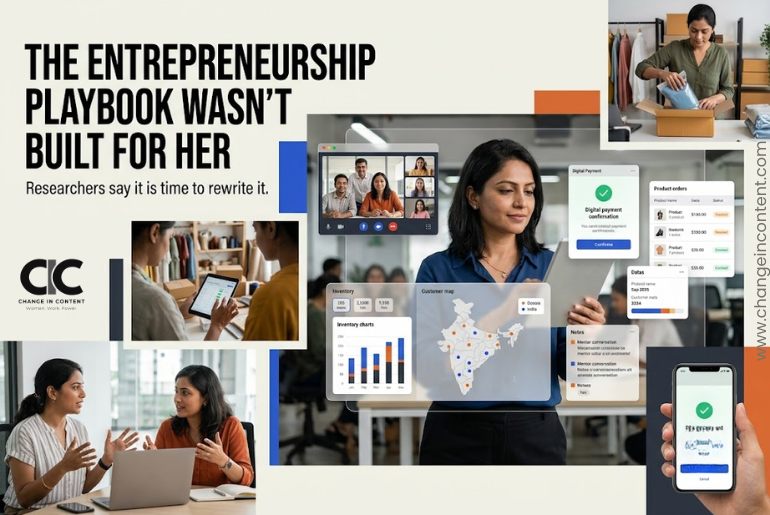
The Quick Read
- Researchers from the University of East London and Quantum University in India have proposed a new women entrepreneurship theory built around digital workplace innovation.
- Their analysis draws on four meta-analysis projects covering 12,281 publications between 1975 and 2025.
- They argue that entrepreneurship programmes still rely too heavily on traditional assumptions about how businesses are started, networks are built, and leadership experience is gained.
- Digital tools, remote collaboration, flexible working and online professional networks can help women build skills and business experience while bypassing some established barriers.
- Technology alone will not fix unequal access to capital, care responsibilities or discrimination. The researchers call for stronger digital skills, institutional support and inclusive business ecosystems.
- For India, the research suggests a practical shift: stop treating finance, mentorship, digital capability, market access and flexibility as separate interventions. Build them into one entrepreneurship pathway.
Women Entrepreneurship Theory
There is a familiar recipe for supporting a woman who wants to start a business.
Give her a workshop. Teach her to make a business plan. Introduce her to a mentor. Tell her where loans are available. Invite her to a networking event. Wish her luck.
Much of that support is useful. Yet researchers studying women entrepreneurship theory are asking whether the recipe itself has fallen behind the way modern businesses are actually built.
Kirk Chang and Ozlem Ozdemir from the University of East London, together with Ritu Kumari from Quantum University in India, reviewed five decades of entrepreneurship research and have proposed a new model centred on what they call digital workplace innovation, or DWI.
Their conceptual paper, published in the Journal of Management Development, draws on four meta-analysis projects covering 12,281 publications between 1975 and 2025. The authors found that digital workplace innovation has generally been absent from theories of women’s entrepreneurship or treated as a secondary factor.
Their argument deserves attention because the business environment has changed dramatically.
- A woman no longer needs a shopfront to find customers.
- She does not need to live in a major city to meet a mentor.
- She can run payroll from a phone, sell internationally from a small town, learn bookkeeping on demand, collaborate with a designer in another country and build a professional network without entering a room where she is the only woman.
None of this makes entrepreneurship easy. It does change what becomes possible.
What are researchers actually proposing?
The new model places digital workplace innovation much closer to the beginning of a woman’s entrepreneurial journey. That includes more than using social media or opening an online store.
Digital workplace innovation can involve:
- Cloud-based business systems
- Remote and hybrid working
- Online collaboration
- Digital payments and banking
- E-commerce
- Virtual mentoring
- Online professional communities
- Digital learning
- AI and productivity tools
- Customer relationship software
- Remote recruitment and team management
The researchers argue that these tools can help prospective women entrepreneurs build confidence, acquire business experience, strengthen professional networks and gain exposure to leadership before or while starting a venture. That changes the conventional sequence.
Traditionally, entrepreneurship support often begins once a woman declares herself an entrepreneur. The researchers suggest that entrepreneurial capability can begin developing much earlier through digital work.
- A woman employed remotely may learn to manage projects across locations.
- A freelancer may begin handling international clients.
- Someone selling through Instagram or an online marketplace may learn pricing, customer acquisition and fulfilment before formally registering an enterprise.
- A manager using digital collaboration tools may develop the operational confidence to build her own company later.
Entrepreneurship starts looking less like one dramatic leap and more like a sequence of capabilities. That feels much closer to how many women actually enter business.
Why does the old entrepreneurship model fit women poorly?
Traditional entrepreneurship theory was largely built around assumptions that were never particularly gender-neutral.
- The archetypal entrepreneur could travel freely.
- He could attend evening networking events.
- He could take financial risks.
- He could spend long periods away from home.
- He could rely on family labour while building the business.
- He was likely to know people who controlled money, customers or influence.
Someone else was often handling the domestic infrastructure around his ambition.
Women enter entrepreneurship with a different distribution of constraints.
They are more likely to face:
- Lower asset ownership and collateral
- Smaller professional networks
- Greater unpaid care responsibilities
- Restrictions on mobility
- Lower access to formal finance
- Greater scrutiny of business risk
- Unequal access to influential business circles
- Interruptions caused by motherhood or caregiving
- Scepticism from customers, bankers or investors
Change in Content has already examined how women-owned MSMEs in India remain concentrated at the smallest end of the market. Women are increasingly visible as business owners, but their representation falls sharply as firms move from micro to small and medium scale. That tells us something important.
Getting women to start is only one part of the entrepreneurship problem. They need a system that helps them continue, professionalise and grow.
Digital access can change the starting line
Consider networking. A traditional business-support programme might advise a woman to attend more industry events. That advice assumes she can travel to the event, stay until late, enter male-dominated groups comfortably, and justify the time away from care responsibilities.
Digital networking changes some of those conditions.
- A founder in Jaipur can speak to a mentor in Bengaluru.
- A woman running a small manufacturing unit in Odisha can attend an export workshop online.
- Someone returning to work after childbirth can join an investor conversation without spending half a day travelling.
- A rural entrepreneur can learn how GST invoicing works without waiting for a local programme to arrive.
It is particularly relevant because physical professional spaces themselves can be exclusionary. Change in Content has previously looked at why women’s participation at professional events remains unequal, including concerns around timing, safety, male-dominated rooms and access to informal networks.
Digital spaces cannot remove bias. They can reduce the cost of entering some networks. That difference can matter enormously at the beginning.
But “give women technology” is not an entrepreneurship strategy
That is where the research deserves a careful reading. The authors are not arguing that smartphones will fix gender inequality. They explicitly note that digital tools need to be supported by digital capability, inclusive workplace design and stronger institutional systems.
- A woman may have internet access and still lack working capital.
- She can attend webinars and still be rejected for a loan.
- She can sell online and still struggle with logistics.
- She can use AI tools and still lack confidence in contracts, taxation or pricing.
- She can join a digital network and still find that the investors inside it predominantly finance men.
Technology changes access. It does not automatically redistribute power. That distinction should guide how governments, banks and entrepreneurship programmes implement the research.
India’s Women Entrepreneurship Platform already points towards a broader ecosystem model. WEP combines access to finance, mentorship, government schemes, incubators, accelerators and business-development support rather than treating entrepreneurship as a single intervention. Its current platform also includes personalised mentor matching and a knowledge hub.
The next opportunity is to connect those pieces more tightly around the life of one entrepreneur.
What could the new women entrepreneurship theory look like in practice?
Research becomes useful when somebody can implement it. For India, I would translate the model into a seven-stage pipeline.
Stage 1: Start with digital business confidence
Before teaching advanced entrepreneurship, programmes should make women comfortable with the basic infrastructure of contemporary business.
That means:
- Digital banking
- UPI and payment systems
- Spreadsheets
- Online invoicing
- Video collaboration
- Cloud storage
- Cybersecurity
- Online marketplaces
- Social selling
- Basic AI tools
The aim is not to create technology specialists. It is to make technology ordinary.
A woman should not need somebody else to send an invoice, download a bank statement or understand what customers are doing online.
Recent Indian evidence suggests female entrepreneurs are already adopting digital finance strongly. Change in Content’s analysis of the DBS Bank India Women and Finance Study found high use of digital payments among surveyed women entrepreneurs, alongside growing use of credit and investment platforms.
The appetite exists. Capability needs to catch up with possibility.
Stage 2: Let women experiment before asking them to leap
Entrepreneurship programmes often create a false binary.
Employee or entrepreneur. Homemaker or entrepreneur. Business owner or non-business owner.
Real careers are messier.
- A woman may begin with a freelance assignment.
- Then five customers.
- Then an Instagram shop.
- Then a partnership.
- Then a registered enterprise.
Digital work allows experimentation at lower cost. That matters for women who cannot immediately afford to abandon a salary or whose families resist a high-risk business decision.
Support programmes could therefore create entrepreneurship test beds: short commercial projects, paid freelance work, digital storefront pilots and customer-validation programmes that allow women to learn through real transactions.
Confidence grows faster from a paying customer than from a motivational speech.
Stage 3: Pair digital access with money
A digital business with no capital remains a small digital business. Women-owned companies continue to face constraints in accessing larger and more complex forms of finance.
Change in Content has examined how complex business loans remain difficult for women entrepreneurs, particularly when they require working capital, collateral, secured lending or larger sums needed for scale.
Financial support therefore needs stages.
A founder may need:
- ₹50,000 to test demand.
- Then ₹5 lakh to purchase equipment.
- Then working capital to manage receivables.
- Then ₹50 lakh to enter another city.
The financial product should grow with the business. Too many programmes help women start and then leave them stranded at the point where growth becomes expensive.
Stage 4: Replace generic mentorship with problem-specific mentorship
“Every woman entrepreneur needs a mentor” sounds sensible until the mentor has no expertise in the problem she is facing.
- A food entrepreneur negotiating modern retail needs different help from a SaaS founder preparing for venture funding.
- A rural producer entering e-commerce needs somebody who understands fulfilment.
- A manufacturer may need advice on certification.
- A second-generation family-business leader may need governance support.
Digital platforms make specialised mentoring far easier because geography no longer determines the available mentor pool.
WEP’s current Smart Match model already moves in this direction by matching entrepreneurs according to industry, stage, location and preferred language.
The new theory gives us another reason to deepen that approach. Mentorship should arrive when a problem arrives.
Stage 5: Women who have built businesses should become infrastructure
One of the research paper’s more interesting contributions is the role it assigns to incumbent women entrepreneurs.
Experienced women founders are not merely success stories. They can become part of the system that produces the next generation.
That could mean:
- Mentoring
- Angel investing
- Supplier introductions
- Customer referrals
- Board advice
- Hiring from women-led firms
- Sharing mistakes
- Opening professional networks
- Sponsoring founders for accelerators
- Helping women negotiate with investors
The difference between mentoring and sponsorship matters. Advice tells a founder what to do. Sponsorship puts her into a room where something can happen.
India needs more of the latter.
Stage 6: Build business networks women can actually use
A woman does not benefit from belonging to a 20,000-member online community if nobody there can answer the question keeping her business awake tonight. Networks need utility.
Useful entrepreneurship communities could be organised around:
- Sector
- Geography
- Business stage
- Export readiness
- Procurement
- Technology
- Capital requirements
- Regulatory issues
Smaller peer circles may also outperform enormous communities. 5 women founders meeting monthly to discuss cash flow may create more business value than thousands of LinkedIn connections.
Change in Content’s examination of the financial health of women-owned SMEs found that women entrepreneurs can have access to mentors and advisers yet remain less likely to use those networks for critical business decisions.
Access and activation are two different problems.
Stage 7: Measure businesses built, not women trained
That is where entrepreneurship support frequently loses credibility.
A programme trains 10,000 women. Wonderful. What happened next?
How many:
- Registered a business?
- Earned their first revenue?
- Survived for two years?
- Hired somebody?
- Accessed formal credit?
- Entered a new market?
- Increased turnover?
- Began exporting?
- Added women employees?
- Raised external capital?
Training counts the activity. Business outcomes measure impact.
Programmes should track women for several years, with appropriate consent and privacy protections. Otherwise, we risk repeatedly training the same entrepreneurial ambition without building more sustainable businesses.
India has a particularly large opportunity
India’s entrepreneurship story already contains an encouraging contradiction. Women are much more visible at the smallest levels of enterprise than they are in large companies.
The 2025 Annual Survey of Unincorporated Sector Enterprises found that female proprietors headed more than 60% of establishments in manufacturing. Across proprietary establishments overall, the female-owned share rose to 26.93%.
Women are entering ownership. The next economic opportunity is to help more of those businesses become employers. That is why the new entrepreneurship theory matters in India.
The country does not need only another campaign telling women to dream bigger. It needs infrastructure that allows a business to become bigger.
- Digital tools can reduce geography.
- Flexible models can reduce some time constraints.
- Online finance can improve access.
- Specialised mentoring can improve decisions.
- Women’s networks can create trust.
- Government platforms can aggregate information.
None of these solves the entire problem. Together, they begin to resemble an ecosystem.
A useful implementation checklist for women entrepreneurs
Researchers are speaking primarily to policymakers, educators and business-support organisations.
There is still something women building businesses can use immediately.
Ask: Which part of my business still depends unnecessarily on my physical presence?
Can sales, invoicing, customer support, bookkeeping, supplier communication or team meetings move online?
Freeing time can create room for growth work.
Audit your digital stack
List the tools you currently use. Then identify what still happens manually.
Do you need:
- Accounting software?
- Customer management?
- Inventory tools?
- Better payments?
- Cloud documents?
- Automated marketing?
- Cybersecurity?
- AI assistance?
Do not buy technology because everybody else has it. Solve a specific friction.
Build a five-person business network
Not 500 contacts. 5 people:
- One entrepreneur ahead of you.
- One financial adviser.
- One sector specialist.
- One potential customer or connector.
- One peer at your own stage.
Make the relationships active.
Seek advice for the decision, not general inspiration
Instead of asking, “Will you mentor me?”, ask:
“I am choosing between two distributors. Can I have 20 minutes to understand what I should examine?”
Specific questions make it easier for experienced people to help.
Learn the financial language of scale
Revenue is not cash flow. Profit is not cash. Working capital is not a loan you think about only when the bank calls.
A founder does not need to become an accountant. She needs enough financial fluency to question one.
Make your business visible digitally
A customer, lender, supplier or mentor is increasingly likely to research a founder before speaking to her.
Your digital credibility should answer:
- Who are you?
- What do you sell?
- Who has bought from you?
- What problem do you solve?
- Can somebody contact you easily?
Visibility lowers the cost of trust.
What should governments, banks and accelerators change?
The research becomes genuinely interesting when it alters programme design. I would start with five shifts.
- From training to trajectories: Follow entrepreneurs beyond a workshop and support the next problem as the business evolves.
- From digital literacy to digital business capability: Teach technology through sales, finance, operations and customers rather than standalone computer classes.
- From mentors to specialised networks: Match women with people who can unlock a specific next stage.
- From microcredit to growth capital: Build financial pathways that allow strong women-led businesses to become small, medium and eventually large enterprises.
- From participation metrics to enterprise outcomes: Measure revenue, survival, employment and scale.
India already has programmes addressing several parts of this equation. The opportunity is coordination.
A woman should not need to discover twelve schemes, three portals, two banks, four accelerator programmes and somebody’s WhatsApp group before she can understand which support fits her business. The ecosystem should do some of that work for her.
The Change in Content Perspective: Stop Preparing Women for Yesterday’s Business World
There is a subtle but important change inside this new women entrepreneurship theory.
The woman is no longer treated primarily as someone who lacks confidence, finance, networks or knowledge and therefore requires fixing. The business environment comes under examination too.
- Perhaps networking does not always require a ballroom.
- Perhaps leadership experience can be built remotely.
- Perhaps mentorship does not depend on living near a major city.
- Perhaps entrepreneurship can begin before somebody resigns from her job.
- Perhaps programmes should adapt around women’s realities rather than asking women to repeatedly adapt to an entrepreneurial model built without them in mind.
Digital workplace innovation will not eliminate sexism, unequal care, biased investment or weak access to assets. It can change the number of doors a woman needs permission to enter. That makes it worth taking seriously.
The next generation of women entrepreneurs does not need another ecosystem that admires their resilience. They need one that requires less of it.
Editorial Note and Disclaimer
This Knowledge Hub article draws primarily on the conceptual study Women entrepreneurship theory through digital workplace innovation: a new concept, published in the Journal of Management Development, together with official information from India’s Women Entrepreneurship Platform and supporting research on women-led enterprises. The paper proposes a theoretical framework based on an integrated review rather than a controlled intervention, proving that digital workplace innovation will produce specific business outcomes. Examples and implementation recommendations in this article are Change in Content’s editorial interpretation of the research. This content is intended for informational purposes and does not constitute financial, investment, legal or business advice.
Sources
- Chang, K., Ozdemir, O. & Kumari, R.: Women entrepreneurship theory through digital workplace innovation: a new concept
- Women Entrepreneurship Platform, India
- Women Entrepreneurship Platform: Knowledge Portal
- World Bank: Digital for Women — Access to Finance
