
The Quick Read
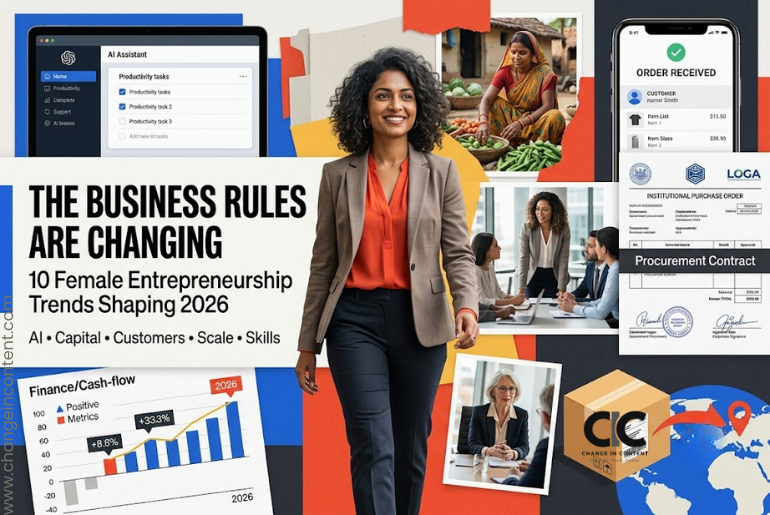
- Female entrepreneurship trends in 2026 are moving towards AI-assisted businesses, leaner operating models, digital-first selling, stronger financial discipline and more specialised founder networks.
- Global Entrepreneurship Monitor research shows women’s startup activity is rising in many markets. Still, women remain less likely than men to operate in ICT and are 11% less likely to see strong business benefits from AI.
- AI is already becoming practical business infrastructure. A 2026 We-Fi evidence review cites research showing AI adoption among digitally connected women entrepreneurs in lower- and middle-income countries rising from 38% to 82% in one year.
- India’s women-founder base is widening. As of January 2026, 1,02,054 of 2,12,283 DPIIT-recognised startups had at least one woman director or partner. That does not mean all are women-led, but it shows women’s growing presence in the startup ecosystem.
- Public procurement is becoming a serious market channel. More than 2.1 lakh women-owned MSEs were registered on GeM and secured 13.7 lakh orders in FY2025–26.
- Starting lean can be sensible. Staying permanently tiny can become a constraint. Founders need to know when technology should replace cost and when people, capital or systems need to be added.
- The most useful skills for the next 12–24 months are AI fluency, financial literacy, sales, digital distribution, customer research, negotiation, cyber awareness and the ability to read business numbers.
- The biggest opportunity is broader than creating more female founders. It is enabling women from different ages, regions and economic backgrounds to build businesses that can become assets, employers and sources of wealth.
Women entrepreneurship trends by mid 2026
By August, a trend should have earned the right to be called one. The novelty has worn off. The predictions made in January have had several months to collide with customers, investors, technology and reality.
And the female entrepreneurship trends shaping 2026 now look considerably more interesting than the familiar story of women simply starting more businesses.
Yes, more women want to become entrepreneurs. In one US QuickBooks survey, 25% said they planned to start a business during 2026, while 58% said they would at least consider doing so over the following 12 months. Globally, the latest Global Entrepreneurship Monitor reports record entrepreneurial activity across many economies.
India has its own momentum. Women are appearing across startups, MSMEs, home enterprises, digital businesses, self-help groups, consulting practices, family businesses and increasingly sophisticated technology ventures. More than one lakh DPIIT-recognised startups now have at least one woman director or partner. Women also own a growing share of establishments in India’s vast unincorporated economy.
But I think the more important question in August 2026 is no longer: Can a woman start a business? Millions already have.
The useful questions are becoming:
- What kind of business should she build now?
- Which technologies deserve her attention?
- When should she stay lean and when should she scale?
- Where will customers come from?
- What should she learn before the market forces her to learn it?
- And how does she ensure that entrepreneurship creates an asset rather than simply another job she performs alone?
Those are the questions this guide attempts to answer.
Trend 1: AI is becoming the first employee many women never hired
For a founder starting with limited capital, 2026 has created an unusual advantage. A surprising amount of the work that once required several people can now be accelerated through AI.
Market research. First drafts of proposals. Customer-email variations. Product descriptions. Basic financial analysis. Meeting notes. Presentation structures. Translation. Customer-service workflows. Coding assistance. Data cleaning. Competitor monitoring. Training material. And so on.
That makes AI particularly interesting for women who begin businesses without large teams or substantial external funding. And many do.
QuickBooks’ US research found that 42% of women business owners surveyed operated as solopreneurs, compared with 19% of men. More than half of women considering entrepreneurship said they were likely to use AI to launch or formalise a business, while nearly four in five expected AI to have some role in their companies’ futures.
Global evidence is beginning to show practical effects too. A We-Fi review published in August 2026 cites a Cherie Blair Foundation study of 3,072 women entrepreneurs across 66 low- and middle-income countries. Among digitally connected respondents, AI adoption reportedly increased from 38% to 82% in a year. Of those using it, 69% reported saving time, while others cited innovation, customer engagement and increased sales.
The opportunity
AI can give a woman with limited resources operating leverage.
- A consultant can research faster.
- A boutique manufacturer can create catalogue copy in multiple languages.
- A trainer can turn expertise into courses.
- A neighbourhood business can analyse customer feedback.
- A first-time founder can build a simple prototype before paying a development team.
For women who have historically faced capital and mobility constraints, lowering the cost of experimentation matters enormously.
The catch
Women cannot afford to enter the AI economy as permanent beginners.
GEM’s latest women’s entrepreneurship research found women less than half as likely as men to be active in ICT and 11% less likely to see the benefits of AI for their businesses. That gap could become expensive.
A founder who ignores AI may increasingly compete against businesses producing more, testing faster and operating with lower costs.
What should women learn?
Do not begin by trying to become an “AI expert”.
Learn 5 practical things:
- How to ask an AI system for useful work.
- How to verify what it produces.
- How to connect AI with a repeatable workflow.
- What company and customer information should never be uploaded casually.
- Which tasks genuinely save time when automated.
Then measure the result. If AI saves you six hours a week, ask what those 6 hours now produce.
More customers? Better products? Higher-quality work? Or merely six additional hours generating content nobody needed?
Technology becomes a competitive advantage only when the saved effort moves somewhere valuable.
Change in Content recently examined digital literacy for women in 2026. For entrepreneurs, that conversation now needs to move rapidly from basic connectivity towards business-grade AI, finance, cybersecurity and digital operations.
Trend 2: The new status symbol is a business that works without burning cash
For much of the startup era, scale carried glamour.
Raise money. Hire quickly. Acquire users. Expand geographically. Raise again. Profit could wait.
2026 is producing a more disciplined founder vocabulary.
Cash flow. Margins. Retention. Recurring revenue. Customer acquisition costs. Founder runway.
The Global Entrepreneurship Monitor’s 2025–26 report identifies what it calls a growing “survival gap”: startup activity is high, but too few ventures successfully make the transition into established businesses. Access to finance and entrepreneurial education remain important constraints.
For women, this correction may contain an opportunity.
Starting with less capital has historically been a disadvantage. In the current environment, knowing how to operate carefully can also become a strength. But there is a difference between capital efficiency and chronic undercapitalisation.
A woman should not proudly bootstrap a company into exhaustion merely because investors or lenders failed to finance her properly.
What should founders watch?
Before chasing scale, know:
- How much you earn on every sale.
- How much acquiring that customer costs.
- Whether customers return.
- How quickly invoices become cash.
- How many months you can operate without new money.
- Which work depends entirely on you.
- Whether hiring one person could release substantially more revenue.
A ₹50 lakh business with healthy margins can be more valuable to its owner than a ₹5 crore business haemorrhaging cash. And a ₹5 crore business may be exactly where you should go if the economics support it.
There is no universally respectable size. There is only a business model that makes sense for what you want to build.
Trend 3: The side hustle is becoming a legitimate first stage of entrepreneurship
Entrepreneurship does not always begin with a resignation letter. That older image of the founder dramatically abandoning corporate life is increasingly incomplete.
QuickBooks found that 42% of women in its US survey had a side hustle. Many intended to keep it that way, partly because employment provided predictable income, benefits and financial stability.
This matters for women of different ages.
- A 24-year-old may freelance while holding her first job.
- A 38-year-old mother may test a consulting practice before leaving salaried work.
- A 50-year-old professional may turn decades of industry expertise into advisory services.
- A retired teacher may build a learning business.
- A rural woman may begin selling a product locally before formalising an enterprise.
There is no requirement that entrepreneurship must begin with maximum risk.
What can a side business fetch you?
Done deliberately, it can create:
- Proof that somebody will pay.
- Customer testimonials.
- Pricing knowledge.
- A portfolio.
- Supplier relationships.
- Savings for future investment.
- A business track record.
- Confidence based on evidence rather than motivation.
The mistake is allowing a side hustle to remain accidental forever.
At some point, ask: Do I want this to become an enterprise?
If yes, separate the finances. Track customers. Formalise where required. Build repeatable processes. Understand tax and compliance. Develop an identifiable offer.
A hobby generates occasional income. A business knows why revenue arrives.
Trend 4: Digital distribution is becoming more valuable than digital presence
Ten years ago, a small business was told to build a website. Then it needed social media. Then an app.
Now the useful question is simpler: Can people actually buy from you?
The International Council for Small Business lists platform-based entrepreneurship and cross-border e-commerce among its leading women-entrepreneurship trends for 2026. It sees digital platforms enabling women to reach customers beyond their immediate geography and build more flexible business models. It is particularly relevant in India.
WhatsApp, Instagram, marketplaces, UPI and increasingly sophisticated commerce infrastructure mean that a small company can combine discovery, conversation, payment and fulfilment without owning expensive physical distribution.
But being “on Instagram” is not a distribution strategy. Neither is accumulating followers.
Build a customer pathway
Ask:
- Discovery: Where does the customer first encounter us?
- Trust: What makes her believe us?
- Conversion: How does she buy?
- Payment: How frictionless is the transaction?
- Delivery: Can we fulfil reliably?
- Retention: What makes her return?
- Referral: What gives her a reason to recommend us?
Remember:
- A woman selling handmade food products may need Instagram for discovery, WhatsApp for conversion, UPI for payment and a logistics partner for fulfilment.
- A B2B consultant may need LinkedIn, referrals, case studies and a strong email process.
- A manufacturer may need IndiaMART, distributors, procurement systems and direct institutional sales.
- A software founder may need outbound sales rather than 100,000 followers.
The channel should follow the customer.
Trend 5: In India, the government itself is becoming a market worth learning to sell to
This is one of the most practical trends Indian women entrepreneurs could overlook.
Public procurement is opening digitally. Under the Government e-Marketplace’s Womaniya initiative, more than 2.1 lakh women-owned MSEs were registered on GeM by FY2025–26 and had secured 13.7 lakh orders. Government reporting says women entrepreneurs have received tens of thousands of crores of rupees in procurement through the platform.
For certain businesses, this changes what “finding customers” can mean. A woman making furnishings, uniforms, food products, office supplies, handicrafts or other eligible goods and services does not need to restrict her ambition to local retail.
Government can become a customer.
Learn procurement, not merely marketing
Women building suitable enterprises should understand:
- GeM registration
- Product categorisation
- Tender documents
- Bid pricing
- Quality specifications
- GST requirements
- Delivery commitments
- Payment terms
- Documentation
- Procurement preferences available to women-owned MSEs
A government purchase order can be less glamorous on Instagram than a venture-capital announcement. It can also be considerably more useful to cash flow.
Change in Content has already reported how women’s ownership is expanding across India’s unincorporated sector. ASUSE 2025 found female proprietors heading more than 60% of establishments in manufacturing. The next opportunity is moving capable enterprises from local survival towards formal markets and larger customers.
Trend 6: Funding is becoming a portfolio, not a single door marked “VC”
Entrepreneurship coverage has conditioned founders to think of capital as venture capital.
Most businesses will never need VC. Many should never take it.
A professional-service company, profitable D2C brand, manufacturing enterprise, local services platform or family business may grow through combinations of:
- Founder savings
- Customer revenue
- Bank credit
- Working-capital finance
- Government schemes
- Credit guarantees
- Grants
- Seed capital
- Angel investment
- Venture capital
- Strategic investors
- Supplier credit
The right money depends on the business. India’s startup financing numbers show both improving access and unevenness.
As of 31 January 2026, Alternative Investment Funds supported under the government’s Fund of Funds for Startups had invested about ₹2,995 crore in women-led startups since 2020. Incubators under the Startup India Seed Fund Scheme had approved roughly ₹294 crore for women-led startups. Yet women-led borrowers represented only around ₹39 crore of the approximately ₹925 crore guaranteed under the Credit Guarantee Scheme for Startups by that date.
Globally, We-Fi continues to identify finance as a structural challenge. Its 2025 annual report says it has now supported more than 600,000 women-led SMEs across 81 countries and mobilised more than $7 billion in public and private financing.
The skill women need now is capital literacy
Before approaching money, know what kind you need.
- If you need ₹10 lakh to purchase machinery that will reliably generate revenue, debt may make sense.
- If you are building a technology platform requiring years of product development before profitability, equity may be necessary.
- If customer advances can finance production, that may be cheaper than either.
- If the company is already profitable, surrendering ownership merely because “startups raise money” may be unnecessary.
Our guide on complex business loans for women entrepreneurs explores why the funding conversation changes once an enterprise moves beyond microcredit and needs meaningful working capital or growth finance.
And the emerging Women Entrepreneurs Finance Code is worth watching because it shifts attention from repeatedly documenting the financing gap towards changing how financial institutions identify and serve women-led enterprises.
Trend 7: Women are finding opportunities in problems the market has historically underestimated
Some of the strongest businesses start where an industry has become accustomed to inconvenience. Women may have particular visibility into needs that have historically received too little product attention.
Healthcare offers an obvious example. FemTech, menopause care, fertility, maternal health, mental wellbeing and eldercare are attracting entrepreneurial interest because enormous markets have spent decades treating women’s experiences as niche.
The wider care economy is also ripe for innovation.
- Care discovery.
- Home healthcare.
- Eldercare coordination.
- Childcare.
- Caregiver scheduling.
- Health navigation.
- Accessible financial products.
- Workplace health.
But this principle extends much further than “businesses for women”. Women can build:
- B2B software
- Climate businesses
- Manufacturing enterprises
- Logistics companies
- Agritech
- Financial technology
- Cybersecurity products
- Education platforms
- Professional-service firms
- Export businesses
- AI applications
ICSB identifies FemTech and the care economy, sustainability, cross-border commerce and platform businesses among prominent entrepreneurship themes this year. Meanwhile, GEM found women-led startups achieving parity with men or higher in innovation among new ventures in 18 of the 51 economies it studied.
The strategic question is therefore not: What businesses are suitable for women?
It is: What problem do I understand unusually well, and is somebody willing to pay for a better solution?
That question has no gendered ceiling.
Trend 8: Founder networks are becoming economic infrastructure
A lot of networking is theatre.
Business cards. Panels. Photographs. LinkedIn posts saying it was wonderful to connect.
The relationships that change a company look different.
- Someone introduces you to a buyer.
- Someone explains why your pricing is wrong.
- Someone warns you away from a bad contract.
- Someone recommends a CFO.
- Someone puts your name before an investor.
- Someone tells you what everybody else in the industry already knows.
ICSB lists community networks, mentorship and ecosystem support among its major women-entrepreneurship trends for 2026. We-Fi’s newest evidence review similarly identifies skills and networks as continuing constraints for women-led SMEs.
For women, the next generation of networks should become more transactional in the best sense of the word.
Not transactional as in exploitative. Transactional as in useful.
Build five kinds of relationships
Every entrepreneur should gradually develop access to:
- A peer who understands her present stage.
- An experienced founder who has already solved the next problem.
- A customer connector who understands her market.
- A money person who understands finance.
- An industry insider who knows how decisions actually get made.
One excellent relationship in each category can be more valuable than 5,000 LinkedIn followers.
India’s expanding Women Entrepreneurship Platform and growing number of formal and informal founder communities can make these connections easier. The founder still has to convert introductions into relationships.
Trend 9: Entrepreneurship is becoming intergenerational
We should stop visualising every entrepreneur as 26 years old and carrying a pitch deck.
The entrepreneurial advantage at 22 may be time and appetite for experimentation.
- At 35, it may be professional skill and a stronger network.
- At 45, it may be deep industry understanding.
- At 55, it may be credibility, capital and decades of pattern recognition.
- At 65, it may be expertise somebody else would gladly pay to access.
ICSB identifies intergenerational entrepreneurship and family-enterprise leadership among its major 2026 trends.
Digital business models make this more important.
- A woman does not necessarily require a factory or a venture-backed technology company to convert expertise into an enterprise.
- A former HR leader can build a specialist advisory business.
- A retired banker can consult SMEs.
- A homemaker with extraordinary regional food knowledge can create a premium product company.
- A family-business daughter can professionalise distribution.
- A craftswoman can sell nationally.
- A teacher can build a learning product.
- A doctor can create health education.
- A 60-year-old entrepreneur does not need to imitate a 25-year-old founder.
She needs to understand the business advantage of being 60.
Trend 10: The entrepreneurship conversation is moving from “start” to “survive and scale”
This may be the most important female entrepreneurship trend of 2026.
The world has become reasonably good at celebrating a woman starting a business. We are less disciplined about asking what happens five years later.
GEM’s latest global report explicitly warns of the gap between entrepreneurial entry and established businesses. Its women-specific research also found that women were 47% more likely than men to close a business for family or personal reasons.
India reveals a similar scale challenge in a different way.
The latest ASUSE data shows women becoming increasingly visible as proprietors, particularly in manufacturing. Yet many remain inside very small businesses. Change in Content’s analysis of women-owned unincorporated enterprises argued that the next test is whether women-owned businesses can formalise, digitise, hire and create more employment.
That is where the conversation should go now.
A woman launching a business is good news. But a woman building something that survives her exhaustion, employs others, produces wealth and can eventually operate without her presence every hour is a much bigger economic story.
What should women entrepreneurs train themselves in for the next two years?
I would not recommend collecting certificates indiscriminately. Learn according to the bottleneck in your business. But if I were building a personal curriculum for a woman entrepreneur in August 2026, these would be the priorities.
1. AI fluency
Learn how to research, analyse, draft, automate and build workflows with AI. More importantly, learn when not to trust it.
2. Sales
Every entrepreneur should be able to sell. Understand discovery calls, objections, proposals, negotiation, follow-up and closing.
Marketing can create attention. Sales turns attention into revenue.
3. Financial literacy
Know your:
- Revenue
- Gross margin
- Net margin
- Cash flow
- Receivables
- Debt
- Runway
- Customer acquisition cost
- Customer lifetime value
You do not have to become a chartered accountant. You must be able to understand what the accountant tells you.
4. Digital distribution
Learn whichever channel connects you with your buyer.
That might be Meta advertising. LinkedIn. Amazon. GeM. ONDC. WhatsApp. SEO. Email. Marketplaces. Export platforms.
The tool matters less than the customer journey.
5. Negotiation
Price. Payment terms. Rent. Vendor agreements. Salaries. Investor terms. Equity. Distribution.
Negotiation affects almost every line of a business. Treat it as a commercial skill rather than a personality trait.
6. Cybersecurity
If your money, customers and records are digital, cybersecurity is business hygiene.
Use strong authentication. Control access. Back up critical data. Understand phishing. Protect customer information. Know what employees and vendors can access.
7. Customer research
Talk to customers before spending months building what you think they need.
The ability to ask a good question and listen carefully will remain useful long after today’s AI tools have been replaced.
8. Leadership
At some point, growth requires other people.
Learn delegation. Hiring. Feedback. Goal setting. Conflict. Performance management.
A founder who cannot stop doing everything herself eventually becomes the company’s capacity limit.
We-Fi’s 2026 evidence review makes a useful point here: entrepreneurship training works better when it is matched to the founder’s stage and actual needs. Generic programmes can produce disappointing outcomes, while targeted managerial, innovation and practical skills interventions can perform significantly better.
Training should solve the problem in front of you.
Which opportunity fits where you are right now?
Women entrepreneurs are not one segment. That is why advice written for “female founders” can become almost useless.
If you are a student or in your early career
Your greatest advantage is inexpensive experimentation.
Freelance. Test products. Join startup teams. Learn AI. Sell something. Do internships inside small companies where you can see how the whole machine works.
Do not feel pressured to “become a founder” immediately. Accumulating capability is also entrepreneurship preparation.
If you are employed and considering a business
Use your job as intelligence.
- What inefficient process frustrates everybody?
- What does your industry buy badly?
- Which customer problem keeps appearing?
- What expertise would clients pay for independently?
Test before resigning where your employment terms permit it. A salary can fund learning.
If you are returning after a career break
Do not assume your first business has to be small because your career paused. Your earlier expertise remains an asset.
Consulting, specialist services, training, B2B businesses, franchise models, digital commerce and professional practices can all provide routes back into economic activity.
If you are building from a rural or small-town market
Digital distribution matters enormously, but do not ignore physical networks.
SHGs, local producer groups, banks, district industry centres, GeM, government livelihood missions and women-entrepreneurship programmes can become infrastructure.
Change in Content’s coverage of the national push for rural women entrepreneurship shows the policy system increasingly recognising the need to connect training with finance, mentorship and markets.
If you already run a small business
Your question should increasingly become: What prevents this company from functioning without me?
Document processes. Automate. Delegate. Develop a second line. Separate household and business money. Professionalise bookkeeping. Identify your most profitable customers. And consider institutional sales.
If you lead a growth business
Prepare for capital before needing capital.
Build governance. Clean the books. Track metrics. Develop management. Build an advisory network. Understand equity. Protect intellectual property. Improve cybersecurity.
And learn to tell investors why the business becomes substantially more valuable with their money.
A 90-day founder reset for the rest of 2026
Trends become useful only when they change behaviour. So here is what I would do between now and November.
Days 1–30: Audit
Write down:
- What makes money
- What consumes time
- Which customers are most profitable
- Where customers come from
- Which tasks AI could accelerate
- What only you can currently do
- How much cash is available
- Which skill is blocking growth
Do not add anything yet. Understand the machine.
Days 31–60: Experiment
Choose one meaningful improvement. Not twelve.
Automate one process. Launch one new sales channel. Test one price. Apply to GeM. Conduct 10 customer interviews. Hire 1 freelancer. Create 1 AI workflow. Speak to 3 lenders. Build 1 institutional-sales proposal. Measure what changed.
Days 61–90: Systemise
If the experiment worked, turn it into routine. Document it. Assign ownership. Create a metric. Then choose the next constraint.
Business growth becomes less mysterious when you stop trying to transform everything at once.
What is on the line for women entrepreneurs?
Quite a lot.
Entrepreneurship creates income, but ownership can create something employment cannot always offer: equity. An asset. A customer base. Intellectual property. A distribution network. A company somebody may eventually buy. An enterprise children may inherit. And an employer other women can work for.
That distinction matters particularly for women because wealth gaps cannot be closed by wages alone.
India’s startup ecosystem already shows wider female participation. More than one lakh recognised startups have at least one woman director or partner. Government-supported AIFs are investing increasing sums in women-led startups. Public procurement is reaching women-owned MSEs at scale. Digital finance is becoming more familiar among female entrepreneurs.
These are encouraging signals. Yet the journey from participation to ownership, and from ownership to significant economic value, remains unfinished. That is why I would resist defining the success of the next decade by how many women become entrepreneurs.
- Count businesses that survive.
- Businesses that export.
- Businesses that employ people.
- Businesses that enter supply chains.
- Businesses that win government contracts.
- Businesses that raise growth capital.
- Businesses that develop technology.
- Businesses that create intellectual property.
- Businesses women still own after they succeed.
Those numbers would tell us considerably more.
The Change Ahead: Build for the Opportunity, Not the Trend
Trends can be useful. They can also make founders ridiculous. For example:
- Every business suddenly needs AI.
- Every entrepreneur becomes a personal brand.
- Every small company wants to call itself a platform.
- Every ordinary product discovers a purpose statement.
That is not what I take from the female entrepreneurship trends of 2026. I see something more encouraging.
The distance between having an idea and testing it has become shorter. The cost of professional tools has fallen. Today, a woman can reach customers outside her geography.
She can acquire skills without entering a classroom. She can find mentors outside her city. At the same time, she can sell to the Government. She can automate work she once needed employees to perform. Furthermore, she can begin alongside a salary. And she can start at 22 or 62.
None of that guarantees success. Customers still have to buy. Cash still has to arrive. Products still need to work. People need to be managed. Taxes need paying. Competitors will copy. Technology will change again. That is precisely why the opportunity feels real.
Female entrepreneurship does not need a separate fantasy economy where every woman who follows her passion becomes successful. Women deserve access to the real one.
Learn the tools. Understand the money. Know the customer. Build relationships. Protect your time. Ask for capital when capital can create value. Hire when remaining solo becomes expensive.
And remember that the objective is not to look like an entrepreneur in 2026. It is to build something worth owning in 2036.
Editorial Note and Disclaimer
This guide draws on entrepreneurship research and data available as of August 2026 from the Global Entrepreneurship Monitor, Government of India, Women Entrepreneurs Finance Initiative, International Council for Small Business and other identified primary or institutional sources. Some global and US survey findings have been used to identify emerging patterns and should not automatically be assumed to represent all women entrepreneurs in India. Women entrepreneurs differ substantially by geography, income, age, industry, business size and personal circumstances. The recommendations in this article are editorial guidance and do not constitute financial, investment, tax, legal or professional business advice.
Sources
- Global Entrepreneurship Monitor: 2024/2025 Women’s Entrepreneurship Report
- Global Entrepreneurship Monitor: 2025/2026 Global Report — From Uncertainty to Opportunity
- Government of India, Ministry of Commerce & Industry: Women in DPIIT-recognised startups, March 2026
- Government of India: Womaniya — Building Inclusive Market Access for Women
- We-Fi: 2026 Evidence Snapshot on Access to Skills for Women-Led Businesses
- We-Fi: 2025 Annual Report — Scaling Finance for Women Entrepreneurs
- International Council for Small Business: Top Ten Trends 2026 for Women Entrepreneurship
- QuickBooks: Women Entrepreneurs 2026 Research
