The Quick Read
- The first South Zone Justice for Women Conference was held on 8–9 August 2026 at the Karnataka Judicial Academy in Bengaluru.
- It was organised in collaboration with the National Commission for Women, the Supreme Court of India, the High Court of Karnataka, and the Karnataka Judicial Academy.
- Supreme Court Justice B.V. Nagarathna inaugurated the conference.
- Karnataka High Court Chief Justice Vibhu Bakhru drew attention to the gap between strong legislation and effective enforcement, arguing that certainty, speed and fairness of punishment matter greatly in preventing crimes against women.
- NCW Chairperson Vijaya Rahatkar described justice with dignity for women as a shared constitutional responsibility.
- Discussions placed women’s safety within several everyday settings, including the home, marriage, workplace and public spaces.
- For Change in Content, the most important question after such a conference is what moves from judicial discussion into the everyday experience of a woman approaching the justice system.
‘Justice for Women’ Conference
India does not suffer from an absence of laws intended to protect women.
There are laws against domestic violence and sexual harassment. Criminal law addresses sexual offences, cruelty and assault. Constitutional guarantees promise equality and dignity. And yet a woman can still spend years waiting for the protection those laws promised her.
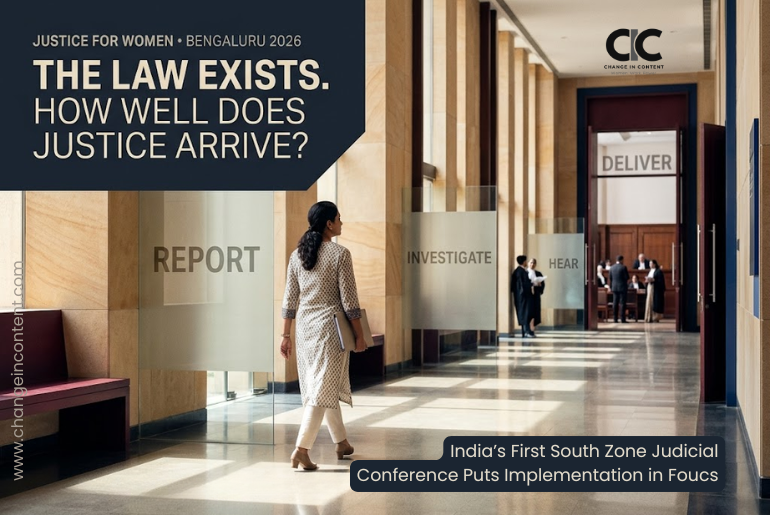
That gap sat at the heart of conversations in Bengaluru over the weekend, where the first South Zone Justice for Women Conference brought together members of the judiciary and other legal stakeholders to examine how India’s justice system responds to women.
Held on August 8 and 9 at the Karnataka Judicial Academy, the regional conference was organised through the National Commission for Women, the Supreme Court of India, the High Court of Karnataka and the Karnataka Judicial Academy. Supreme Court Justice B.V. Nagarathna inaugurated the event.
It was a judges’ conference, rather than a public awareness event. That gives its central question particular weight:
What happens between a woman having a right and actually receiving justice?
Justice B.V. Nagarathna opened the first South Zone conference
Justice B.V. Nagarathna of the Supreme Court inaugurated the conference in Bengaluru.
The event brought members of the higher and district judiciary from southern India into discussions centred specifically on women’s experience of the justice system. The NCW positioned the initiative as an opportunity for judicial dialogue around strengthening the delivery of justice for women.
The significance lies partly in the audience.
Judges encounter the consequences of violence, family disputes, sexual offences, workplace harassment and discrimination after many other institutions have already interacted with the woman involved.
A police complaint may have been filed. Evidence may have been collected. An employer may have conducted an inquiry. A protection officer may have become involved. A family may have attempted reconciliation. By the time a matter reaches court, the quality of everything that happened earlier can determine what the judicial system is able to do.
Conferences of this kind therefore have value when they move beyond discussing statutes and examine how women actually travel through the system.
Chief Justice Bakhru: Stronger punishment alone will not solve the problem
One of the sharper interventions came from Karnataka High Court Chief Justice Vibhu Bakhru.
He argued that India already possesses an extensive legislative framework for protecting women, but a significant gap remains between the intent of those laws and their enforcement.
His broader argument was straightforward: making punishment progressively harsher does not automatically prevent crime. What matters is whether consequences are certain, swift and fair.
He identified delays in investigation and trials, weaknesses in forensic support, problems with evidence collection and hostile witnesses among the factors capable of undermining cases involving women.
That distinction deserves attention.
- A severe punishment written into a statute offers limited reassurance to a woman who cannot get her complaint investigated properly.
- A strong workplace law offers limited protection when an internal committee is dysfunctional.
- A fast-track court offers little comfort if the case reaching it has already been weakened by poor evidence gathering.
Justice is experienced as a process long before it arrives as a judgment.
The home, workplace, marriage and street all entered the conversation
Chief Justice Bakhru also spoke about the different environments in which women encounter violence and insecurity, identifying the home, workplace, marriage and public spaces as important areas where women’s safety is tested. That framing is particularly relevant because it refuses to locate gender justice only inside criminal courts.
Women experience rights across everyday institutions.
- At home, domestic violence can remain hidden by family pressure.
- At work, harassment can intersect with power, promotion and fear of retaliation.
- Within marriage, financial dependency or social expectations can affect a woman’s ability to pursue remedies.
- In public spaces, safety can influence whether women study, work late, travel or participate fully in economic life.
Law interacts with each of these environments differently. What unites them is the need for a woman to believe that reporting harm will improve her position rather than create another ordeal.
‘Justice with dignity’ was the NCW’s message
NCW Chairperson Vijaya Rahatkar framed the conference around the institutional responsibility of delivering justice to women.
Her message, shared officially by the Commission, was that justice with dignity for women is a shared constitutional responsibility.
The word dignity is important.
We cannot judge access to justice solely by whether a woman eventually wins a case.
- How was she spoken to?
- How many times did she have to repeat an account of violence?
- Was confidentiality protected?
- Could she understand the process?
- Could she afford representation?
- Was she made to feel responsible for what happened?
- How long did she wait?
- Did the process jeopardise her livelihood?
Legal systems can technically process a case while making the human being inside it feel very small. A women-responsive justice system has to care about both the outcome and the route to it.
The workplace deserves particular attention
One strand of the conference has direct implications for employers.
Women’s participation in paid work has increased, making workplaces an increasingly important arena for questions of dignity, harassment, safety and economic independence.
India already has the Sexual Harassment of Women at Workplace Act. Recent judicial developments have also continued to clarify the reach and operation of workplace remedies.
Change in Content recently examined the judicial expansion of PoSH compliance, including the principle that a woman should not be left without an accessible complaints route merely because the alleged harasser works for another organisation.
That is precisely where judicial thinking and organisational behaviour meet.
- An employer cannot outsource justice to the courts after workplace systems fail.
- Internal committees need independence.
- Employees need to know where to complain.
- Investigations must be fair to everyone involved.
- Confidentiality matters.
- Retaliation must carry consequences.
- And managers should understand that workplace safety is an operational responsibility, rather than a once-a-year PoSH presentation.
India’s challenge increasingly looks like implementation
There is a recurring temptation in gender policy to respond to every shocking case with a demand for another law or a harsher sentence.
Sometimes legislation genuinely does need reform. But the Bengaluru discussions point towards another problem India cannot legislate away quite so easily.
Implementation. Investigation. Forensics. Judicial capacity. Timelines. Victim support. Legal aid. Workplace processes. Social attitudes. Institutional sensitivity.
Each can determine whether a statutory right becomes useful in a woman’s life.
Our International Women’s Day 2026 examination of rights, justice and action made a similar distinction: rights have limited meaning when enforcing them becomes unaffordable, inaccessible or humiliating.
The law creates the promise. Institutions determine how much of that promise survives contact with reality.
The Change in Content Perspective: Justice Should Not Require Exceptional Endurance
The Justice for Women Conference in Bengaluru matters because senior members of the judiciary were discussing something women have understood for years: Having the law on your side and obtaining justice are not always the same experience.
India has progressively strengthened legal protections for women. That progress deserves recognition.
The next gains may come from less dramatic places.
- A complaint recorded properly.
- Evidence collected professionally.
- A workplace committee doing its job.
- A survivor treated respectfully.
- A case heard without needless delay.
- A woman understanding what happens next.
- A judgment arriving while it can still change her life.
These improvements do not produce spectacular legislative headlines. They produce something considerably more useful. Trust.
And a justice system ultimately earns its legitimacy when a woman seeking help believes entering it will reduce the injustice she has already experienced rather than add another layer to it.
Editorial Note and Disclaimer
This report is based on information released by the National Commission for Women and public material concerning the South Zone Regional Judges’ Conference on “Justice for Women”, held in Bengaluru on 8–9 August 2026. Statements have been summarised for clarity unless presented as short attributed quotations. Change in Content has focused on aspects of the conference directly relevant to women’s access to justice, workplace safety, dignity and institutional implementation. This article is intended for editorial and informational purposes and does not constitute legal advice.
Sources
- National Commission for Women: South Zone Regional Judges’ Conference on “Justice for Women”
- National Commission for Women: Official conference updates and statements
- National Commission for Women: Conference announcement, 8–9 August 2026