The Brief
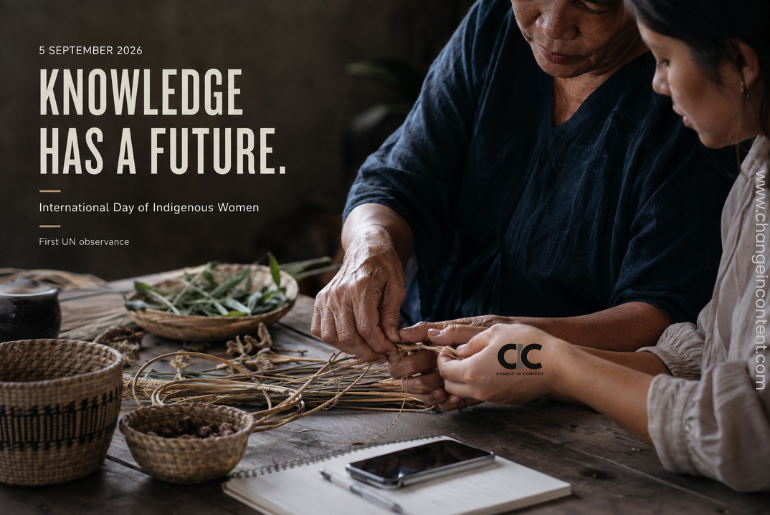
- September 5, 2026 marks the first official UN observance of the International Day of the World’s Indigenous Women and Girls. The UN General Assembly proclaimed the annual day in November 2025.
- The United Nations estimates there are around 185 million Indigenous women worldwide. They play important roles in preserving languages, traditional knowledge, governance systems, biodiversity and community life.
- Indigenous women often experience overlapping disadvantages linked to gender, Indigenous identity, poverty, land insecurity, violence and weaker access to health care, justice and decision-making.
- Their economic contribution is equally important. Indigenous women work as farmers, artisans, entrepreneurs, caregivers, workers and knowledge holders, although much of this work can remain informal, poorly paid or unrecognised.
- Recognising Indigenous women, therefore, means protecting culture and rights while also expanding access to decent work, education, markets, finance, and leadership on their own terms.
International Day of Indigenous Women, 2026
In India, September 5 arrives with a familiar association.
Teachers. School assemblies. Flowers. Tributes to Dr Sarvepalli Radhakrishnan.
But from 2026, the date carries another international significance.
September 5 is now officially the International Day of the World’s Indigenous Women and Girls, following a United Nations General Assembly resolution adopted in November 2025. This year will be the first observance under the UN calendar.
The International Day of Indigenous Women is intended to bring greater visibility to women and girls whose roles in their communities can be immense, even as their representation in formal systems of power remains limited.
They preserve languages. Transmit knowledge. Manage land and natural resources. Carry cultural practices across generations. Lead communities. Work. Care. Farm. Trade. Create. Organise. And often do several of these things at once.
The new international day asks the rest of the world to notice all of that more clearly.
Why is September 5 observed as the International Day of Indigenous Women?
The date predates the new UN designation.
September 5 has been observed in parts of Latin America since 1983 in memory of Bartolina Sisa, an Aymara Indigenous leader who resisted Spanish colonial rule in the eighteenth century and was executed on September 5, 1782. The date subsequently became associated with Indigenous women’s resistance, dignity and rights.
The UN General Assembly gave the observance formal global recognition in 2025.
Its resolution specifically acknowledges Indigenous women’s contributions to sustainable development, biodiversity, environmental protection, climate resilience, Indigenous languages, traditional medicine, maternal health and the transfer of knowledge between generations.
The official name deliberately includes women and girls. That matters.
Preserving Indigenous cultures is not only about recognising existing traditions. It also depends on whether younger generations have the right, freedom and opportunity to inherit those traditions without being excluded from education, economic opportunity or decision-making.
There are around 185 million Indigenous women in the world
The UN estimates that approximately 185 million Indigenous women live worldwide.
There is enormous diversity inside that number.
Indigenous communities live across different countries, economies, political systems and landscapes. Their languages, cultures, occupations and relationships with land can be entirely different.
So describing “Indigenous women” as one uniform population would be misleading. Their experiences are not interchangeable. What appears repeatedly across international evidence, however, is the combination of contribution and disadvantage.
Indigenous women are often custodians of community knowledge while having weaker access to formal decision-making.
They may contribute substantially to agriculture or household economies while having less control over land, finance or income. They can carry responsibilities for care and cultural preservation while also encountering discrimination outside their communities.
The UN notes structural barriers including poverty, insecure access to lands and resources, weaker health care, limited access to justice, violence and unequal participation in decisions that affect their lives.
Recognition therefore cannot stop at celebrating culture. Rights matter too.
Work is part of this story
This is where the observance also intersects naturally with the work we do at Change in Content.
When people speak about Indigenous women, economic contribution can easily disappear behind discussions of heritage. But cultural preservation and work are often deeply connected.
- Traditional agriculture is work.
- Weaving is work.
- Forest-based livelihoods are work.
- Community tourism is work.
- Traditional medicine can involve highly developed knowledge and professional practice.
- Producing food, handicrafts or natural products is work.
- Caring for families and communities is work, even when nobody attaches a salary to it.
The International Labour Organisation has long pointed out that Indigenous and tribal peoples face barriers to decent work because of discrimination, limited access to skills and training, and pressure on traditional livelihoods. Indigenous women can experience the combined effects of gender and Indigenous identity, while much of their employment remains informal or economically insecure.
Being economically active is not necessarily the same as having decent work.
Someone can work extensively and still lack:
- regular income;
- legal protection;
- social security;
- ownership;
- access to markets;
- control over earnings;
- or recognition of the skills involved.
India already encounters a similar question when discussing women’s rural employment more broadly. Our analysis of women in agricultural employment has shown why simply counting a woman as working tells us little about whether that work provides income, security or economic independence.
The same caution becomes particularly important when work is embedded in family, land or community life.
Traditional knowledge has economic value too
One of the quieter forms of exclusion occurs when modern economies recognise a qualification but fail to recognise knowledge.
An Indigenous woman may understand forests, seeds, crops, medicine, water systems, biodiversity, weaving techniques, or local ecology through knowledge developed and passed down over generations.
That knowledge can be economically valuable. It can also be culturally irreplaceable. Yet traditional knowledge does not always fit neatly inside formal education systems, CVs or professional credentials.
The ILO has specifically identified non-recognition of traditional skills as one of the obstacles Indigenous people can face when trying to enter formal economic activity.
That raises an important question for organisations working in sustainability, tourism, agriculture, conservation, fashion, food, wellness and natural-resource industries.
- When Indigenous knowledge creates value, who owns that value?
- Who is paid?
- Who receives recognition?
- Who has decision-making power?
- And who gets reduced to a source of “local knowledge” while somebody else builds the commercial product?
Those questions belong inside the discussion of inclusive work.
What does this mean in India?
This needs careful language.
The global UN framework uses the term Indigenous Peoples. India’s constitutional and policy systems primarily use categories such as Scheduled Tribes, while many communities and movements also use terms including Adivasi.
These concepts overlap in important ways but should not automatically be treated as identical.
So we should resist turning a global Indigenous observance into a simplistic claim about one Indian administrative category.
What is relevant to India is the broader question.
Women from tribal and marginalised rural communities often participate heavily in agriculture, forest-linked work, self-employment, crafts, and informal livelihoods, while facing barriers related to education, skills, markets, and formal employment.
UN Women’s work in India, for example, has included programmes supporting education, vocational training and employment pathways for women in districts with significant tribal and marginalised populations, including parts of Odisha and Madhya Pradesh.
India’s recent employment data also show that female labour-force participation is being driven primarily by rural women, even as questions remain about income and employment quality. Our July 2026 PLFS analysis found rural women accounting for much of the latest improvement in female participation and employment.
That gives September 5 contemporary economic relevance alongside its cultural meaning.
Preservation should not become confinement
There is a delicate balance here.
Celebrating Indigenous women as guardians of culture can itself become limiting if that becomes the only role society permits them to occupy.
- A woman can preserve a language and become an engineer.
- She can carry traditional ecological knowledge and run a business.
- She can practise a traditional craft and negotiate with international buyers.
- She can lead a community and participate in national politics.
- She can choose to remain within a traditional occupation.
- She can choose to leave it.
Respect for Indigenous culture should include respect for Indigenous women’s choices. Otherwise, admiration becomes another form of expectation.
The goal should be to protect the right to preserve cultural knowledge without making women personally responsible for carrying the entire burden of preservation.
Economic opportunity can strengthen culture rather than erase it
Modernisation is sometimes framed as a choice between cultural continuity and economic opportunity. That is unnecessarily narrow.
Indigenous women can build enterprises around traditional textiles, food, agriculture, eco-tourism, art, knowledge and other forms of cultural production while retaining ownership and control.
- Cooperatives can give workers bargaining power.
- Digital platforms can expand markets.
- Training can help women navigate finance, regulation and commerce.
- Formal recognition can protect traditional skills rather than replace them.
But the model works best when women themselves participate in deciding how their knowledge is used.
The UN resolution underlying the new international day emphasises Indigenous women’s full, equal and meaningful participation in decision-making, including principles of free, prior and informed consent where applicable.
That principle is important whether the conversation concerns land, environmental projects, cultural heritage or economic development.
Nothing about Indigenous women should be designed entirely without Indigenous women.
September 5 is about visibility. What follows matters more.
International days can become ceremonial very quickly.
A poster. A hashtag. A speech. Then tomorrow.
The United Nations itself acknowledges that symbolic action and practical action need to work together. The purpose of the new observance is to generate visibility that contributes to longer-term attention, advocacy and resources.
The useful questions therefore begin after the celebration.
- Are Indigenous women represented in decisions affecting their land and communities?
- Can traditional occupations provide decent incomes?
- Do women have access to education without losing connection with language and culture?
- Can entrepreneurs access finance and markets?
- Are traditional skills recognised?
- Do women control the economic value generated from their own knowledge?
- Can younger Indigenous women imagine futures that include both identity and choice?
Those are much harder questions than creating an awareness post. They are also much closer to what the day is asking the world to consider.
Change in Perspective: Let Her Carry What She Chooses
There is something powerful about the idea of a woman carrying culture across generations.
But she should not have to carry it alone. Nor should preserving tradition require sacrificing economic independence, education, safety or the freedom to choose a different career.
On this first UN International Day of the World’s Indigenous Women and Girls, Change in Content celebrates Indigenous women not only as custodians of the past but also as workers, entrepreneurs, leaders, creators, and decision-makers shaping what comes next.
Their knowledge deserves protection, their work deserves recognition, their voices deserve room, and their futures should belong to them.
Editorial Note & Sources
This Knowledge Hub article marks the first UN observance of the International Day of the World’s Indigenous Women and Girls on September 5, 2026. The term “Indigenous” follows United Nations and International Labour Organisation usage. In the Indian context, terms such as Scheduled Tribes, tribal communities, Adivasi and Indigenous Peoples have distinct legal, political and cultural histories and should not be treated as automatically interchangeable. The article therefore avoids assigning a single identity label to all Indian tribal communities. Employment discussion is intended to connect the observance with economic participation without reducing Indigenous women’s identities to labour-market outcomes.
Sources
- United Nations — International Day of the World’s Indigenous Women and Girls: Official background, purpose and global context for the September 5 observance.
- United Nations General Assembly — Resolution A/RES/80/10: Primary resolution proclaiming September 5 as the International Day of the World’s Indigenous Women and Girls.
- United Nations DESA — General Assembly Adoption of the International Day: Background on the creation of the observance and its intended role in increasing visibility, advocacy and long-term attention.
- International Labour Organisation — Decent Work for Indigenous and Tribal Peoples in the Rural Economy: Evidence on Indigenous livelihoods, discrimination, informality, traditional occupations and access to decent work.
- International Labour Organisation — Empowering Women in the Rural Economy: Context on Indigenous and rural women as custodians of traditional knowledge and the barriers affecting their economic participation.
- UN Women India — Second Chance Education and Vocational Learning Programme: Examples of education, skills and livelihood pathways for marginalised women, including work in regions with Indigenous and tribal communities.