
The Brief
- Avtar Group says the rollback of DEI in the United States has had a significant knock-on effect on gender inclusion efforts at multinational companies operating in India.
- President Trump’s January 2025 Executive Order 14173 (Revoked Executive Order 11246) directed federal contractors and agencies to call out illegal DEI discrimination and preferences.
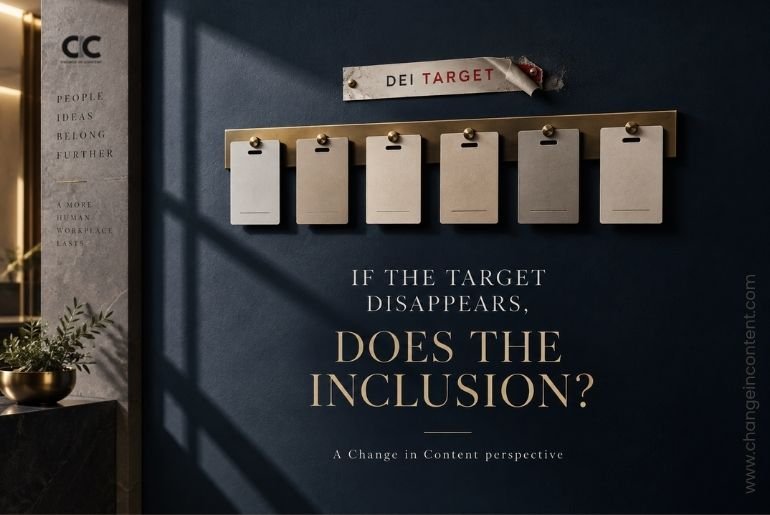
- Change in Content does not dismiss the risk created by the anti-DEI climate. But if corporate commitment to women disappears when political pressure changes, that commitment was never strong enough.
- Regulation and targets can open doors. Real inclusion begins after the door opens: in who gets meaningful work, pay, progression, authority and the freedom to stay.
- A woman hired primarily so that an organisation can satisfy a number is not evidence of equality. Neither is removing her opportunity when nobody is forcing the organisation to count anymore.
There is something deeply unsettling about the latest argument around DEI. Not because it is entirely surprising. Because if it is true, it tells us something rather embarrassing about all the progress we thought we had made.
At a recent virtual press conference, Avtar Group Managing Director Saundarya Rajesh said the Trump administration’s January 2025 action against DEI in the United States had affected women working in India too.
According to her, companies that previously worked actively to increase women’s representation have started pulling back. Her conclusion was emphatic: “We definitely have to say that this has had a very strong impact on women in India.”
I believe her concern deserves attention.
When American multinationals change their global DEI strategies, India does not live on another corporate planet. Policies, language, budgets, reporting structures and leadership priorities travel across borders.
But there is another question I cannot shake. If an executive order in Washington can make an Indian company lose interest in hiring and retaining women, how committed was that company to inclusion yesterday?
First, the Trump order did change the environment
Let us be precise about what happened.
On 21 January 2025, President Donald Trump signed Executive Order 14173, titled Ending Illegal Discrimination and Restoring Merit-Based Opportunity.
The order revoked Executive Order 11246, the federal-contractor framework dating back to 1965. It directed the Office of Federal Contract Compliance Programs to stop promoting diversity, enforcing affirmative-action obligations and encouraging workforce balancing based on protected characteristics.
The administration’s stated position is straightforward. It argues that employment should be based on individual merit, ability and performance, and not amount to unlawful discrimination or preference based on race or sex.
One does not need to agree with that interpretation to describe it accurately. And the policy environment did not stop with federal government programmes.
The order explicitly instructed agencies to encourage the private sector to end DEI practices deemed discriminatory compliance investigations of major corporations and other institutions. For multinational employers, that understandably changes the risk calculation.
What began as American public policy can therefore influence global corporate behaviour. Including in India.
But this is where I start getting uncomfortable
Suppose a company spent 5 years telling us: women belong here; diverse teams are better; women deserve equal opportunity; representation matters; leadership should reflect society.
Then an American administration changes direction.
Suddenly the budgets shrink. Programmes disappear. Targets become embarrassing. The vocabulary gets rewritten. Women who were apparently important to business strategy become politically inconvenient.
What exactly were we celebrating during those five years?
Because if the answer is: compliance, reputation and whatever headquarters required at the time, then we should stop calling it inclusion.
That is corporate obedience wearing progressive clothes.
Regulation can open a door. It cannot create belief.
I want to be careful here. I am not arguing that governments should withdraw gender-equality regulation. Quite the opposite.
Rules often become necessary precisely because institutions do not correct entrenched inequality voluntarily. India understands this.
The policy in the country prescribed classes of companies to have at least one woman director. SEBI’s listing regulations require listed entities to have at least one woman director. At the same time, the top 1,000 listed entities by market capitalisation must have at least one independent woman director.
Those interventions matter. Without external pressure, change can move painfully slowly. But regulation should be the floor. It cannot become the philosophy.
Because there is a difference between:
“We need a woman on this board because the regulation requires one.”
and:
“We have spent years excluding half the available talent from networks, opportunities and succession pipelines. Let’s change the way we identify leaders.”
The first produces a seat. The second begins producing inclusion.
One woman in the room is not necessarily progress
We have a word for representation without influence. Tokenism.
Change in Content has described it before as the practice of creating the appearance of diversity without changing access to authority, opportunity or meaningful participation.
- One woman on the board.
- One woman on the panel.
- One woman in every recruitment photograph.
- One senior woman repeatedly invited to Women’s Day.
And somewhere inside the organisation, everything important continues much as before.
Our earlier piece on tokenism in the workplace put the distinction plainly: visibility can exist without power. That is precisely why I am uneasy about measuring gender progress predominantly through headcount.
A company can hire women because the dashboard wants them. It can promote a woman because a global target is due. It can announce 40% representation.
None of those numbers tells me whether she is being paid fairly; getting the important assignment; being considered for P&L responsibility; receiving sponsorship; allowed to disagree; returning after maternity; moving towards leadership; or staying.
Representation is useful. It is not the finish line.
And please don’t make women the enemy of merit
Whenever DEI enters trouble, “merit” arrives. I find this framing exhausting.
As though organisations spent centuries selecting every man through some flawless scientific measurement of talent, only for diversity teams to suddenly introduce identity into an otherwise perfectly objective system.
Hiring has never operated in a vacuum.
- Networks matter.
- Pedigree matters.
- Who knows whom matters.
- Confidence is interpreted differently.
- Career breaks matter.
- Mobility matters.
- Care responsibilities matter.
- Leadership prototypes matter.
- Bias matters.
It does not mean every unequal outcome is discrimination. It means the word merit does not make subjectivity disappear.
Our earlier analysis of meritocracy and diversity in Indian workplaces made it clear that relevant barriers can strengthen meritocracy rather than weaken it.
I do not want a woman to receive a job she cannot do because someone needed another woman on a spreadsheet. That helps nobody. Not the company. Not her colleagues. And certainly not the woman whose competence will forever be questioned because everyone assumes she was the “diversity hire”.
I want her to have a genuine opportunity to compete for work she can do without assumptions excluding her before merit is even evaluated.
That is a very different proposition.
Targets can still be useful
This is where the argument needs nuance.
Targets and measurement are not inherently tokenistic. Sometimes organisations need numbers because without measurement, exclusion remains remarkably easy to ignore.
- If women comprise 45% of eligible employees but 8% of promotions, I want to know.
- If a recruitment process consistently produces an almost entirely male shortlist, somebody should ask why.
- If women disappear between middle management and executive leadership, the pipeline needs investigation.
- If return after maternity is high but retention one year later collapses, the initial statistic is incomplete.
Data exposes problems. Targets can force attention. Regulation can break inertia.
But the objective should always be to reach the point where an organisation understands why inclusion improves its access to talent, rather than continuing indefinitely because somebody outside the building demands a particular number.
We recently wrote a practical guide to gender equality concepts because these distinctions matter.
- Equity is not the same as a guaranteed outcome.
- Representation is not the same as inclusion.
- Inclusion is not the same as power.
- And a target is not the same as equality.
The Avtar warning should worry us for two reasons
The first is the obvious one. If companies reduce initiatives that were genuinely helping women enter, remain and progress at work, women may lose opportunities. That deserves scrutiny.
Avtar’s own Best Companies for Women in India benchmark is built around recruitment, culture and gender-inclusion practices rather than headcount alone. So a broad corporate retreat can matter far beyond terminology.
But the second reason worries me more. If global companies are retreating rapidly because the political environment has changed, perhaps some DEI programmes never became sufficiently connected to:
- talent strategy;
- business performance;
- leadership behaviour;
- retention;
- organisational culture;
- or simple human fairness.
They remained programmes. Programmes are very easy to cancel. Beliefs embedded in how a business operates are much harder to reverse.
Imagine the DEI team disappeared tomorrow
This is probably the test I would give any organisation.
Take away the acronym.
- No DEI department.
- No diversity score.
- No Women’s Day.
- No external target.
- No ESG presentation.
- No regulatory requirement beyond anti-discrimination law.
Now watch what happens.
- Would your hiring process still widen the candidate pool?
- Would managers still question biased assumptions?
- Would a woman returning after maternity leave receive important work?
- Would men still take parental leave?
- Would promotion data still be examined?
- Would a woman be considered for operations rather than automatically channelled towards HR or communications?
- Would harassment still be taken seriously?
- Would senior leaders still sponsor people outside their familiar networks?
- Would the company still care whether talented women were leaving?
If the answer is yes, you have begun building inclusion. And if the answer is no, you had a programme. That is the distinction I want us to talk about.
Women should never have been a compliance category
There is something demeaning about the entire cycle.
- First, women are excluded.
- Then regulations and DEI programmes are introduced to increase representation.
- Then critics say women are getting unfair preference.
- Then those programmes are rolled back.
- Then women’s representation falls.
At every stage, the woman herself somehow becomes secondary to the argument about her.
Her competence. Work. Ambition. Experience. Ideas.
All disappear behind the label.
DEI hire. Woman director. Quota candidate. Diversity statistic.
I would rather build a workplace where the category becomes increasingly boring.
A woman is there because she is good enough to be there. The organisation has made sure outdated barriers do not prevent her from demonstrating that. And nobody is surprised by her presence. That, to me, is inclusion.
Change in Perspective: If the Rule Goes Away, Does the Woman Go Too?
Avtar is right to raise the alarm. A political attack on DEI in the world’s largest economy can influence businesses far beyond American borders. We should pay attention to what happens next. But perhaps we should use this moment for an audit of something larger.
For years we celebrated representation rising. We praised targets. Programmes. Rankings Commitments. Perhaps not often enough did we ask: Would this company still do it if nobody were watching?
Because equality that survives only while government policy rewards it is fragile. Inclusion that survives only while headquarters reports it is shallow. And representation that vanishes as soon as the target does may have been tokenism all along.
Governments still have a responsibility to create fair rules. Regulators still have a role in breaking entrenched barriers. Organisations should still measure outcomes.
None of that needs to disappear. But the ambition has to be bigger than compliance.
I do not want women hired because Donald Trump approves of DEI. And I do not want women not hired because Donald Trump opposes it.
Frankly, neither should determine a woman’s worth in an Indian workplace.
I want companies to reach a far less dramatic conclusion: There is talent here. There is capability here. And there is leadership here.
So, why would we deliberately leave it out?
That is not DEI theatre. That is simply a better workplace.
Editorial Note & Sources
Avtar Group has attributed some weakening in women’s workforce representation among companies operating in India to corporate responses following the Trump administration’s rollback of DEI policies in the United States. Change in Content treats this as Avtar’s assessment rather than proof of direct causation. This commentary also distinguishes between unlawful identity-based discrimination, which the US executive order says it targets, and broader lawful practices intended to reduce barriers and improve inclusion. The views expressed beyond the reported Avtar remarks are those of the author and Change in Content.
Sources
- The White House: Executive Order 14173, Ending Illegal Discrimination and Restoring Merit-Based Opportunity, 21 January 2025. Primary source for the Trump administration’s policy, including Order 11246 and directions regarding private-sector DEI practices.
- *Federal Register: Official published legal text of the January 2025 executive order.
- The White House: Fact Sheet on Ending Illegal DEI, 22 January 2025. Primary source setting out the stated rationale around merit, civil rights and private-sector DEI.
- Avtar & Seramount: Best Companies for Women in India 2026. Primary Avtar source describing its gender-inclusion benchmark and its focus on recruitment, retention, advancement and workplace practices.
- Ministry of Corporate Affairs, Government of India: Companies Act, 2013, Section 149. Primary legal source for prescribed classes of companies includes at least one woman director.
- Securities and Exchange Board of India: Listing Obligations and Disclosure Requirements. Primary regulatory source requiring a woman director owoman director for the top 1,000 listed entities.
