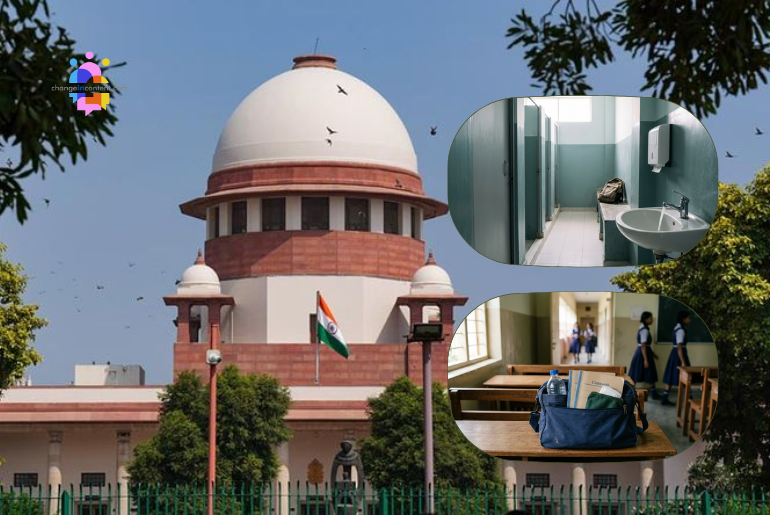
The Short Read
- The Supreme Court has asked the Union and States to make menstrual hygiene rights meaningful and workable.
- The Court said its earlier recognition of menstrual hygiene as part of Article 21 cannot remain only on paper.
- The case concerns menstrual hygiene facilities for school-going girls in Classes 6 to 12.
- The Court has asked the Union to monitor States and Union Territories, collect compliance data and file progress reports every three months.
- The larger issue is simple: girls should not have to miss school, sit through discomfort, or drop out because basic menstrual support is unavailable.
Menstrual hygiene rights now move from judgment to implementation
The Supreme Court has made an important point that every policy conversation in India should remember.
A right is not meaningful because it exists in a judgment. It becomes meaningful when a girl can actually use it.
That is the heart of the Court’s latest intervention on menstrual hygiene rights. While reviewing compliance with its earlier directions, the Supreme Court told the Union and States that menstrual hygiene, recognised as a facet of Article 21, must be made meaningful and workable through action on the ground.
That is where the story becomes bigger than the law. For a schoolgirl, menstrual dignity does not begin in a courtroom.
- It begins in a toilet that has water.
- It begins with access to a pad when she needs one.
- It begins when she can ask to leave class without being questioned in front of everyone.
- It begins when teachers, boys, parents and school staff understand that menstruation is normal, not shameful.
The Supreme Court has given the constitutional language. Now governments and schools have to build the everyday system.
What the Supreme Court said on Menstrual Hygiene Rights
The Court was hearing the matter related to its 30 January 2026 judgment on menstrual hygiene management in schools. In that judgment, the Court had issued pan-India directions for the implementation of the Union’s Menstrual Hygiene Policy for School-going Girls.
The directions covered adolescent girls from Classes 6 to 12 and required schools to provide free sanitary napkins and functional, gender-segregated toilets with usable water connectivity.
In the latest hearing, the Court said that a mere declaration of menstrual hygiene as a fundamental right would not serve the purpose. It directed the Union to study the shortcomings raised before it and address them at the earliest.
The Court also asked the Union to keep monitoring and guiding States and Union Territories, collect necessary data on compliance, and file fresh progress reports every three months.
That monitoring is important because India does not suffer from a shortage of well-intentioned policies. It suffers when those policies stop at circulars, schemes and announcements. The Court makes it clear that menstrual hygiene rights must extend to schools, not just government files.
Also read: Supreme Court rejects plea seeking menstrual leave policy for women.
Why this matters for girls’ education
The conversation about menstrual hygiene is often made smaller than it is. Administrators still treat it as a pad distribution issue. Or a sanitation issue. Or a health awareness issue. It is all of those, but it is also an education issue.
- When a girl does not have access to a clean toilet, she may avoid school during her period.
- When there is no pad available, she may sit in fear of staining her uniform.
- When there is no water, no disposal bin, or no privacy, the school day becomes a test of endurance.
- When teachers are not sensitised, asking for help can feel embarrassing.
- When boys do not receive the right education, teasing becomes another barrier.
That is not a small inconvenience. It affects attendance, confidence, concentration, dignity and learning. Over time, poor menstrual hygiene facilities can quietly push girls away from classrooms.
That is why the Supreme Court’s framing matters. It places menstrual hygiene rights within the larger promise of equality, education and life with dignity.
The message is clear: A girl’s body should not become the reason she receives less education.
The gap is not awareness alone. It is infrastructure.
India has spoken about menstrual awareness for years. But awareness without infrastructure has limited value.
A girl may know what menstruation is. She may know how to use a pad. She may understand hygiene. But what happens if her school toilet is locked, dirty, unsafe, without water, or missing a disposal system?
The latest compliance discussion before the Court brought attention back to this gap. The concern is not simply whether governments have policies. The concern is whether schools across states are implementing those policies.
This distinction matters.
- A policy can say that girls must have access to menstrual hygiene products. A school can still fail to provide them.
- A policy can require toilets. A toilet can still be unusable.
- A policy can mention awareness. A teacher can still shame a girl.
That is why the way forward must be practical. Menstrual hygiene rights need clear budgets, school-level audits, regular maintenance, trained staff, student feedback, supply chains for pads, safe disposal systems and transparent reporting.
Rights become real when someone is responsible for delivery.
Also read: Right to menstrual health: Supreme Court ruling in India.
What should happen next?
The Court’s continuing monitoring allows India to move from symbolic recognition to measurable action.
The Union and States should now focus on a few clear outcomes.
- Every school must have functional, gender-segregated toilets with water.
- Sanitary products should be available without embarrassment.
- Disposal systems must be safe and regular.
- Teachers need basic menstrual health training.
- Boys should receive age-appropriate education, too.
- District officials must inspect facilities and listen to students.
- Compliance data should not be vague. It should show what exists, what works and what still needs repair.
That is not only a government task. School managements, local bodies, education departments, health departments, parents and civil society all have a role to play.
Most importantly, girls must be heard.
No menstrual hygiene policy can be called successful if it does not ask girls whether the toilets are usable, whether pads are available, whether they feel safe, and whether asking for help still feels shameful.
That is the difference between provision and dignity.
Changeincontent perspective on the Menstrual Hygiene Rights ruling by the Supreme Court
The Supreme Court’s reminder is timely because India has already crossed the stage where menstrual hygiene can be treated as a private problem.
The issue is now squarely in the public policy space. That is progress.
But progress will not be measured by how many times the words dignity, health and equality appear in government documents. It will be measured in school corridors, toilet blocks, classrooms and attendance registers.
- A girl should not have to lose learning because her school did not plan for menstruation.
- She should not have to treat pain, staining, discomfort or shame as personal failure.
- She should not have to choose between education and dignity.
The positive way forward is not complicated.
Build the facilities. Fund the systems. Train the adults. Educate the boys. Listen to the girls. Track the gaps. Fix what is not working.
Menstrual hygiene rights will become meaningful only when girls do not have to fight for the basics.
Editorial Note and Disclaimer
This article is based on the Supreme Court’s continuing monitoring of compliance with its 30 January 2026 judgment in Dr Jaya Thakur v. Government of India and Others. It is written as a short DEI Insights news-analysis piece for Changeincontent. The article does not offer legal advice. It explains the ruling, its backdrop, and its wider relevance to education, dignity, and gender-responsive public infrastructure.
Sources
LiveLaw reported that the Supreme Court told the Union and States that menstrual hygiene rights must be made meaningful and workable, and warned that any laxity in compliance would be viewed strictly. The report also notes that the Union must file progress reports every three months.
The Supreme Court’s 30 January 2026 judgment recognised menstrual health as part of Article 21, linked menstrual hygiene to equality and education, and directed compliance within three months.
The Times of India reported that the Court asked the Centre to ensure implementation in letter and spirit, and that States must submit status reports to the Centre by 15 August, with further compliance reporting listed for 1 September.
Supreme Court Order on the case of DR. JAYA THAKUR v. GOVERNMENT OF INDIA AND ORS|W.P.(C) No. 1000/2022.