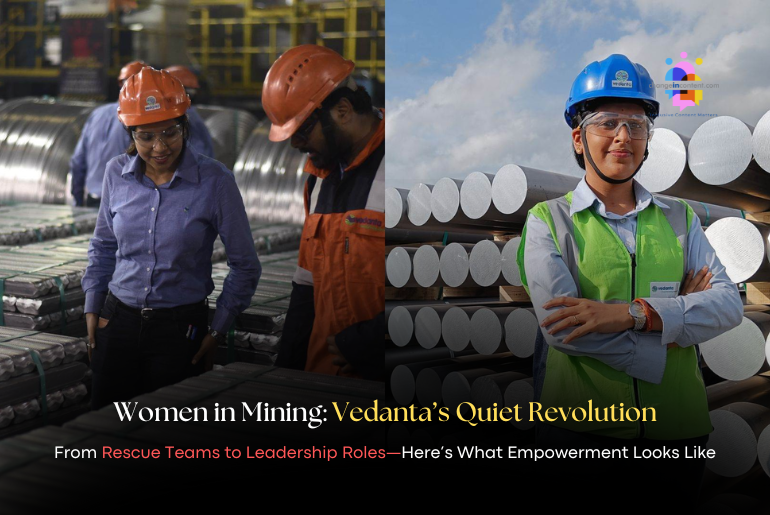
Women empowerment at Vedanta is not an add-on; it is a core business priority. While most industries talk of inclusion, Vedanta has turned the conversation into implementation.
The metals and mining sector has long remained male-dominated. Globally, women represent only 8–17% of the mining workforce, an average of just 12.5%. This significant gap shows how underrepresented women are in an industry that plays a vital role in the economy. Vedanta Limited, a diversified natural resources company with operations in oil & gas, zinc, lead, silver, aluminium, iron ore, steel, copper, ferroalloys, power, nickel, semiconductors, and glass, is actively working to change that.
Women empowerment at Vedanta: From ambition to action
Priya Agarwal Hebbar, Chairperson of Hindustan Zinc and Vedanta Director, said, “Vedanta is committed to an inclusive workplace where women lead growth. Closing the gender gap could add $770 billion to India’s economy with just a 10% rise in women working. This is about more than equality, it’s a smart economic move. Through flexible policies and leadership development, we focus on ability, not gender. At Vedanta, we’re reshaping roles and building a future where diversity and inclusion drive progress and lasting impact.“
30% women in the workforce by 2030, says Vedanta
Vedanta targets to have 30% of its workforce made up of women by 2030. As of March 2025, women already make up 21% of its total workforce. What stands out even more is that 28% of these women hold decision-making roles, making Vedanta a leader in gender diversity among Indian metal and mining companies.
In the early 20th century, women were more involved in the mining sector. That changed with the Indian Mining Act of 1923, which barred them from working underground. A complete ban followed in 1937 during British rule. Although the restriction was lifted briefly between 1943 and 1946, allowing about 70,000 women to work underground, the belief that mining was unsuitable for women stayed strong for decades.
This perception finally shifted in 2019 when seven mining engineering students petitioned for change. After the ban was lifted, Vedanta’s Hindustan Zinc became the first company in India to deploy women engineers in underground mines.
Leading the way with inclusive initiatives
Vedanta has taken multiple steps to create a more inclusive environment and support women across roles and regions.
India’s First All-Women Mine Rescue Teams
Hindustan Zinc formed two all-women underground rescue teams. These teams later earned second place at the International Mines Rescue Competition 2024 in Colombia, proving their capability on the global stage.
All-Women Aluminium Production Line
Vedanta Aluminium, the country’s largest aluminium producer, has a production line at its Jharsuguda plant in Odisha that is operated entirely by women. This plant, the largest aluminium smelter in the world, has over 100 positions filled by women across various skill levels as part of a three-phase rollout.
Durga Vahini – Women in Security
Cairn Oil & Gas, another Vedanta business, has formed an all-women security team called Durga Vahini. These women, many from rural backgrounds, now safeguard 38 oil field sites in Rajasthan. They also form part of a Quick Response Team, boosting emergency preparedness and setting a new example for gender roles in security.
Women’s Day Initiatives and Beyond
Vedanta’s efforts go beyond symbolic celebrations. Throughout March 2025, the company provided leadership shadowing programs for women professionals at Hindustan Zinc and Vedanta Sesa Goa. Self-defence workshops trained 15,000 women in personal safety and emergency response.
Sakhi Utsav
Hindustan Zinc’s Sakhi Utsav brought together 10,000 women entrepreneurs from Rajasthan and Uttarakhand. The event focused on stories of women’s leadership in business, social change, and talent development.
A workplace that works for women
Vedanta is building a work environment where women can grow in their careers without having to give up their personal lives. The company gives women the chance to take on important roles, even in areas like night shifts at the Rampura Agucha mine. This shift in roles came after open conversations with authorities to make sure women had equal chances to work across all shifts, just like men.
To make work more manageable, especially for women with families, Vedanta offers flexible work options. Employees can choose a mix of working from the office and at home, depending on their roles. Women who become mothers can take a 12-month break and return to their jobs without pressure. The company also has crèche (childcare) facilities at the workplace so that mothers can be close to their children during working hours.
A life in balance: Vedanta’s ecosystem for working women
Madhu Srivastava, Chief Human Resources Officer, Vedanta, says, “We don’t just include women, we elevate them as central architects of transformation. Our policies are designed to dismantle invisible barriers and create an environment where ambition and family life are not in conflict but in harmony.“
Vedanta goes one step further by supporting not just employees but their families too. The company offers jobs for spouses through a spouse-hiring policy, which helps families stay together. In some of their township areas, Vedanta has built schools, hospitals, parks, and other facilities. These setups make life easier for employees, especially women, because they don’t have to worry about running around for basic needs or childcare.
With these steps, Vedanta is creating a workplace where women don’t have to choose between building a career and taking care of their families, as they can do both with support and confidence.
Women empowerment at Vedanta: A blueprint for industry-wide change
The metals and mining sector may still be male-dominated, but companies like Vedanta are changing the bias through clear goals, inclusive policies, and visible leadership opportunities for women. Vedanta is not only increasing the number of women in the workforce but also changing perceptions about what women can do in heavy industries. From deploying India’s first all-women mine rescue teams and control room operators to offering flexible work policies and township-level support systems, the company is making it clear that women belong in every part of the industry.
The mining and metals sector is central to economic growth. However, if half the population remains on the sidelines, the industry limits its own potential. Companies must step up, not just for the sake of diversity, but because real progress depends on everyone having an equal chance to contribute, lead, and succeed.
At Changeincontent, we believe that real empowerment happens when women lead from the frontlines, not just from boardrooms. Vedanta’s model proves that gender equity is scalable, even in the toughest sectors.
Also read: Bharti Airtel Foundation’s bold bet: 50% Women in workforce—Can India Inc. keep up?
Disclaimer: The views expressed in this article are based on the writer’s insights, supported by data and resources available both online and offline, as applicable. Changeincontent.com is committed to promoting inclusivity across all forms of content. We broadly define inclusivity as media, policies, law, and history, encompassing all elements that influence the lives of women and marginalised individuals. Our goal is to promote understanding and advocate for comprehensive inclusivity.