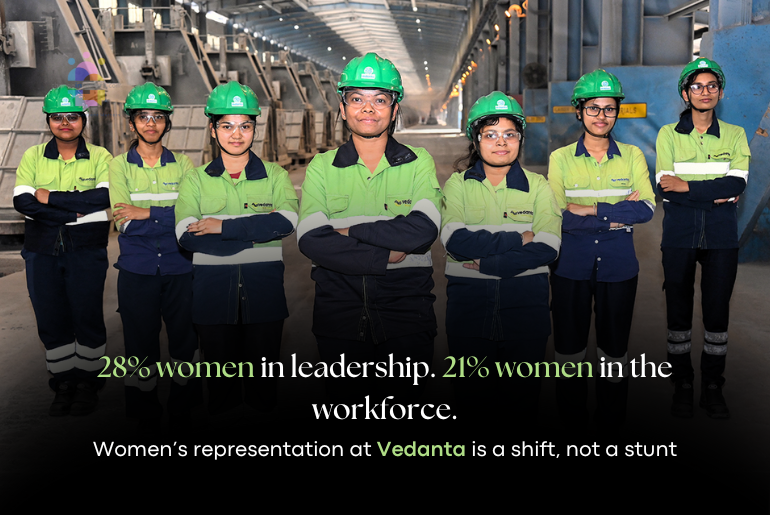
In a sector long known for its masculine dominance, one company is rewriting the script. The story of women’s representation at Vedanta is no longer about catching up; it is about leading from the front.
From managing entire aluminium potlines to forming India’s first all-women mining rescue and firefighting teams, Vedanta is no longer just building mines. It is building futures for women, with women.
As of March 2025, Vedanta has 21% women in its workforce, with 28% occupying decision-making roles. It is the highest leadership representation among metal and mining companies in India. It is not tokenism but a policy-backed progress. With a clear target of 30% women in the workforce by 2030, the conglomerate is working steadily to create space and power for women in every layer of its operations.
Progressive policies powering real inclusion
The success in increasing women’s representation at Vedanta is not accidental. Behind the numbers lies a deliberate ecosystem of support: a ‘no questions asked‘ work-from-home policy, flexible work hours, spouse hiring programs, and sabbaticals for childcare. All these policies are geared to meet women where they are in life.
But what makes Vedanta’s policy suite unique is that it moves beyond women. The company also provides financial aid for education and gender affirmation procedures. It shows an expanded vision of inclusivity that includes transgender employees.
Mentorship programs, accelerated leadership tracks, and career paths in high-growth businesses are integrated into the company’s structure. These initiatives ensure that inclusion is a business strategy for them.
From campaigns to courage: The ‘Women of Zinc’ initiative
On International Women’s Day 2025, Vedanta’s group firm, Hindustan Zinc, launched the “Women of Zinc” campaign. But this was not another feel-good campaign of the day. Instead, it was a bold move to attract real talent. It challenged stereotypes about women in manufacturing, mining, and metallurgy.
The campaign highlights career possibilities in core sectors and positions women not just as contributors but as changemakers. This builds on Vedanta’s existing leadership-first approach, where women already manage complex industrial operations like aluminium potlines and participate in mining rescues.
Vedanta’s women-first outlook is leading the industry
At 21% representation overall and 28% in leadership, women’s representation at Vedanta is setting new benchmarks for the Indian industry. In a space where even single-digit diversity figures are considered normal, these numbers signal intent.
While many companies still struggle to address their skewed gender ratios, Vedanta is placing women at the centre of its operational strategy. It is not only hiring them but also empowering them to lead from day one.
Women’s representation at Vedanta: A shift, not a stunt
What makes Vedanta’s approach different is that it does not wait for March 8 to make noise. Its policies are visible in March, applicable in May, and impactful in December.
Women’s representation at Vedanta is not a one-day performance; it is a long-term plan. And while we at Changeincontent strongly advocate for #NoWomensDay, we believe initiatives like these are worth spotlighting, regardless of the calendar. #NoWomensDay is a movement against tokenism and pinkwashing.
It is a reminder that real change happens when equity becomes part of everyday business, not a yearly campaign.
Disclaimer: The views expressed in this article are based on the writer’s insights, supported by data and resources available both online and offline, as applicable. Changeincontent.com is committed to promoting inclusivity across all forms of content. We broadly define inclusivity as media, policies, law, and history—encompassing all elements that influence the lives of women and marginalised individuals. Our goal is to promote understanding and advocate for comprehensive inclusivity.