The Short Read
- A working paper by the Economic Advisory Council to the Prime Minister studies labour formalisation using PLFS and ASUSE 2025 unit-level data.
- The paper finds that women are 4.8 percentage points more likely than men to be engaged in informal employment.
- The finding matters because women’s workforce participation has improved, but job quality remains uneven.
- Education emerges as the strongest determinant of formal employment.
- Graduates and above are 43.8 percentage points less likely to be in informal work than illiterate workers.
- Training also helps, reducing the probability of informal employment by 4.8 percentage points.
- The paper suggests that education, skilling, digital adoption and enterprise registration can play a stronger role in moving workers and businesses towards formality.
More women are working. The job-quality question remains.
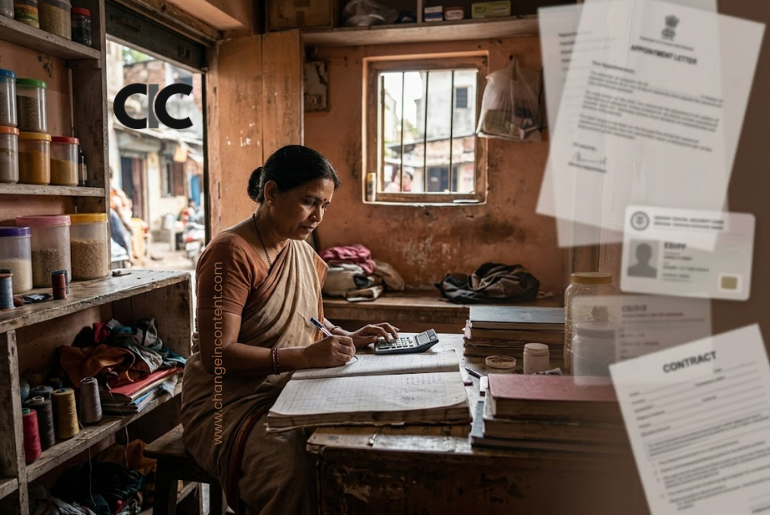
Women workers and informal employment sit at the centre of a new labour-market warning from the Economic Advisory Council to the Prime Minister. A working paper titled Formalization of Labour Market in India: Evidence from PLFS and ASUSE 2025 Unit-Level Data finds that women are 4.8 percentage points more likely than men to be engaged in informal employment.
That number may look small at first glance. In labour-market terms, it says something important.
Women’s workforce participation has improved in recent years. More women are entering paid work, self-employment, family enterprises, casual labour and other forms of economic activity. But the paper points to a gap between participation and protection.
A woman may be counted as working. That does not automatically mean she has a contract, paid leave, predictable wages, Social Security, protection from sudden income loss, or a clear route to financial growth. That is the distinction this paper brings into focus.
India is making progress on women’s participation. The next question is the quality of that participation.
What the EAC-PM paper studied about women workers and informal employment
The EAC-PM working paper uses unit-level microdata from two national surveys: the Periodic Labour Force Survey, or PLFS 2025, and the Annual Survey of Unincorporated Sector Enterprises, or ASUSE 2025.
PLFS examines workers and labour market outcomes. ASUSE looks at the unincorporated enterprise sector, which includes household-owned and individually operated firms outside the Companies Act.
By examining both worker-side and enterprise-side data, the paper seeks to understand India’s labour market and the large informal enterprise sector together. That approach is useful because informality is not only about workers. It is also about the businesses that employ, contract with, engage, or indirectly depend on them.
A worker may remain informal because the enterprise itself is unregistered, low-productivity, digitally disconnected, outside formal credit systems, or weakly linked to regulation.
For women, this connection is especially important. Many work in unpaid family labour, domestic work, home-based production, small businesses, casual jobs and uncontracted arrangements where the line between household work and market work is blurred.
That is why the latest findings connect directly with Change in Content’s earlier coverage of women workers in the informal sector in India. The issue is not women’s absence from work alone. It is the terms on which they enter and remain in work.
What informal employment means in simple terms
Informal employment usually refers to work that lacks formal protection. It can mean no written contract, no employer-linked social security, no paid leave, no provident fund, no health cover, no maternity benefit, no stable wage arrangement, or no clear legal protection in practice.
That can include casual wage work, unregistered enterprise work, home-based work, domestic work, own-account work, unpaid family work, and other arrangements in which income is earned without the security usually associated with formal employment.
For a woman, informality often has a double cost.
The first cost is economic. Income may be low, irregular or dependent on piece rates and daily demand.
The second cost is protective. When there is no contract or formal structure, it becomes harder to claim rights, prove work history, access credit, build savings, negotiate wages or move into better jobs.
That is why the EAC-PM finding matters. More women entering the workforce is encouraging. More women entering weak work is a warning.
Why women are more exposed to informal work
The paper links women’s higher likelihood of informal employment to their concentration in unpaid family labour, domestic work and home-based production, where formal contracts are often absent. That is a familiar pattern in India.
Women may work on family farms, in small shops, in tailoring, food preparation, packaging, sorting, craft work, domestic service, caregiving, home-based piece-rate work, local retail support, or informal services. Many of these roles are flexible enough to fit around household responsibilities, but that flexibility often comes with low bargaining power.
Care responsibilities are a major factor. Women are more likely to adjust their work around children, elders, cooking, household management and family expectations. Formal jobs may demand fixed hours, mobility, documentation, education, digital access or employer negotiation. Informal work often becomes the available option.
The result is visible in labour data and in everyday life.
- Women work, but their work may be described as “help”.
- Women earn, but their income may be seen as supplementary.
- Women contribute, but the structure around their work may offer little protection.
That is also where the discussion on home-based workers in India becomes relevant. A woman doing paid production from home may support a supply chain, but remain almost invisible as a worker.
Education is the strongest shield
One of the paper’s sharpest findings is about education.
Graduates and above are 43.8 percentage points less likely to be engaged in informal work than illiterate workers. That is a large gap.
The finding suggests that education remains the strongest individual-level determinant of formal employment. In simple terms, the more education a worker has, the better the chances of moving into formal work.
For women, this matters deeply. Education does more than improve employability. It can increase access to regular wage jobs, expand occupational choices, improve confidence in navigating institutions, strengthen digital use, and reduce dependence on casual work.
The paper also points out that among women, higher education substantially increases the likelihood of regular wage employment and reduces dependence on casual labour. That should matter to policymakers and employers.
If India wants women’s workforce participation to translate into stronger livelihoods, education cannot be treated only as a social goal. It is labour-market infrastructure.
Training also reduces informality
The paper finds that participation in vocational training and skill-development programmes reduces the probability of informal employment by 4.8 percentage points. That figure matters because millions of women cannot go back and redesign their schooling. But they can benefit from practical, local, job-linked training. The important word is job-linked.
Training must connect to actual labour-market pathways: regular wage jobs, formal enterprise roles, digital work, registered micro-enterprises, higher-productivity self-employment, and better access to credit or formal supply chains.
A certificate alone will not change women’s work if the local economy has no pathway to absorb the skills.
Women need training that fits their realities: timing, mobility, childcare, language, digital access, safety, transport and placement support.
The EAC-PM paper points to the same broader message that formalisation depends on capabilities, not only on regulation.
Enterprise formalisation matters too
The paper also looks at the enterprise side of India’s informal economy. It highlights the role of digital adoption and enterprise registration in improving productivity, formalisation and credit access.
That is important because many women work in or around small unincorporated enterprises. If these enterprises remain unregistered, digitally disconnected and outside formal credit systems, workers attached to them are also more likely to remain informal.
The paper reports that digital adoption is strongly associated with improved enterprise performance. It also indicates that government-backed registration systems, such as Udyam and Udyam Assist, are associated with improved access to formal credit.
For women-owned enterprises, this is a crucial point. The paper notes that female proprietors remain less likely than male proprietors to access formal credit, but registration improves the probability of formal credit access among women-owned enterprises.
That connects women’s employment with women’s enterprise. A woman may not be a wage employee. She may be a micro-entrepreneur, self-employed worker, home producer, shop owner, service provider or family business contributor. Formalisation can help only when it recognises these different ways women work.
That is also why women’s labour-market security cannot be separated from financial capability. The wealth-generation gap and financial literacy among women are relevant here because women need the knowledge and access to move from income survival to income growth.
The simple reading of the paper on women workers and informal employment
The paper’s findings can be understood through four clear messages.
- First, India is seeing more women participate in work, but participation alone does not guarantee protection.
- Second, women remain more exposed to informal employment because of the kinds of work available to them and the unpaid or home-linked roles they often occupy.
- Third, education is the strongest pathway out of informality. Skill training helps too, especially when it connects to real jobs or formal enterprise opportunities.
- Fourth, business formalisation matters. Registered, digitally connected and credit-linked enterprises are better placed to create more formal work.
For readers, the takeaway is: Do not judge women’s labour progress only by how many women are working. Ask what kind of work they are doing.
What this means for policymakers
The paper points towards practical areas for policy attention.
Education for girls and women remains central. Vocational training should be expanded with women-specific access barriers in mind. Digital adoption among micro and small enterprises should be treated as an employment-quality issue. Enterprise registration should become easier, local and multilingual. Formal credit should reach more women-owned enterprises.
At the same time, India needs better recognition of work that happens in households, family enterprises and home-based production.
Women should not have to become invisible simply because their work does not fit the image of a formal office or factory job.
The final thoughts and the Change in Content view
The EAC-PM paper gives India a useful reminder: rising women’s workforce participation is good news, but it is not the full story.
- A woman working without a contract is still vulnerable.
- A woman earning through casual work may still have little security.
- A woman contributing to a family enterprise may still lack a worker identity.
- A woman running a small, unregistered activity may still struggle to access formal credit.
The next phase of women’s labour progress must focus on job quality.
Education, training, digital access, enterprise registration, formal credit and social protection can make a real difference. They can move women from fragile work towards more secure work. They can help women convert labour into income stability and income stability into financial growth.
India needs more women working. It also needs more women working with protection, dignity and a path forward.
FAQs
Q: What does the EAC-PM paper say about women workers?
A: The paper finds that women are 4.8 percentage points more likely than men to be engaged in informal employment, reflecting their concentration in unpaid family labour, domestic work and home-based production.
Q: Why is informal employment a concern for women?
A: Informal employment often means no written contract, limited social security, irregular income, weak bargaining power and reduced access to benefits or legal protection.
Q: What is the role of education in formal employment?
A: The paper finds that graduates and above are 43.8 percentage points less likely to be engaged in informal work than illiterate workers, making education the strongest determinant of formal employment.
Q: Does skill training help reduce informal employment?
A: Yes. The paper finds that participation in vocational training and skill-development programmes reduces the probability of informal employment by 4.8 percentage points.
Editorial Note and Sources
This article is based on the EAC-PM working paper titled Formalization of Labour Market in India: Evidence from PLFS and ASUSE 2025 Unit-Level Data, along with official MoSPI and government labour-data releases. It is written as a DEI Insights news explainer for Change in Content and focuses on what the findings mean for women workers and informal employment in India.
Sources:
- Economic Advisory Council to the Prime Minister: Formalization of Labour Market in India: Evidence from PLFS and ASUSE 2025 Unit-Level Data
- MoSPI: Periodic Labour Force Survey, Calendar Year 2025
- MoSPI: Annual Survey of Unincorporated Sector Enterprises 2025
- PIB: 7.92 crore unincorporated non-agricultural establishments reported in ASUSE 2025