
The Short Read
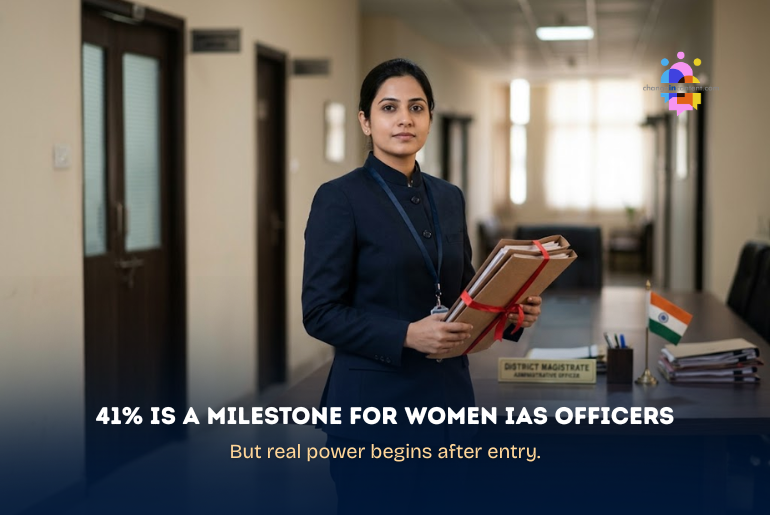
- Women’s representation in IAS has reached nearly 41% in the 2024 batch, marking one of the highest-ever levels of gender participation in the service.
- Union Minister Dr Jitendra Singh called this a reflection of the democratisation of opportunity in contemporary India.
- The 2024 IAS batch is part of the Assistant Secretary Programme, under which young officers work with the central Ministries and Departments for first-hand policy exposure.
- The number shows that more women are entering India’s most powerful administrative pipeline.
- But representation at the point of entry is not the same as equality in power.
- The real test will be postings, promotions, cadre culture, field authority, safety, family support, leadership roles and whether women officers are allowed to shape governance without being boxed into gendered expectations.
Women’s representation in IAS: A record number, and a familiar question
India has a new number to celebrate.
Women’s Representation in the IAS has reached nearly 41% in the 2024 batch. That makes it one of the strongest signs yet that more women are entering the country’s top administrative service. Union Minister Dr Jitendra Singh described the moment as a reflection of the democratisation of opportunity. He argues that the changing profile of the civil services mirrors wider social change in India.
It is a powerful number. It deserves attention. But it also deserves a sharper reading.
Because when women enter powerful institutions in larger numbers, the story does not end with applause. It begins there.
The Indian Administrative Service is not just another career track. IAS officers help run districts, implement welfare schemes, coordinate disaster response, influence policy, manage public institutions and act as the bridge between the state and citizens. Their decisions can affect education, health, land, policing coordination, welfare delivery, urban planning, rural development and everyday governance.
So, when more women enter this space, it is not only a gender milestone. It is a governance milestone.
The question is not whether women can clear one of India’s toughest examinations. They have already shown they can. The question is whether India’s administrative system is ready to give them equal room to lead.
What the 41% figure tells us
The latest government communication places women’s participation in the 2024 IAS batch at nearly 41%. The same batch is being exposed to central policy-making through the Assistant Secretary Programme, where officer trainees are attached to Ministries and Departments before moving deeper into their administrative careers.
It is an important consideration because early exposure shapes confidence, networks and administrative imagination.
For a young officer, the first few years in service are not only about training. They are about learning how power speaks, how files move, how policy becomes action, and how authority works in public institutions.
If women are present in this stage in stronger numbers, the pipeline changes.
The image of the young district officer, the future secretary, the policy drafter, the crisis manager and the public administrator becomes less male by default. That has symbolic value. But it also has practical value.
Women in administration may bring lived experience into areas where governance has historically been designed without listening enough to women. Public transport, sanitation, maternal health, workplace safety, welfare access, school infrastructure, gender violence response, nutrition and care work all benefit when decision-making tables are not overwhelmingly male.
It does not mean every woman officer will automatically govern with a gender lens. Women are not a single political or administrative category. But when institutions become more diverse, blind spots are harder to defend.
That is where representation begins to matter.
Also read: India Justice Report 2025: Why diversity in justice systems still matters.
Why is this bigger than an exam success story?
It is tempting to treat this as a UPSC success story. More women studied, more women competed, more women cleared, and the system became more gender-balanced.
That reading is true, but incomplete.
A woman entering the IAS is not just an individual achievement story. It is often the result of a wider ecosystem.
- Families investing in daughters
- Women moving to cities for coaching
- Digital access improving preparation
- Smaller towns producing serious aspirants
- More women seeing role models before them
- Social permission expanding, slowly and unevenly
That is why Dr Jitendra Singh’s phrase, democratisation of opportunity, is politically significant.
The society once imagined civil services through a narrow social lens. We often saw the ideal candidate as male, urban, upper- or middle-class, English-comfortable, and socially mobile. That image has been changing. Not completely. Not evenly. But visibly.
More women in the IAS batch tells us that India’s ambition map is shifting.
But an opportunity is truly democratic only when entry, experience and growth are all fair. If women enter the system in higher numbers but face gendered assumptions once inside, the celebration remains unfinished.
The pipeline is improving. The power structure still needs work.
A 41% share in a batch is an important pipeline signal. It tells us that future leadership could look different. But India must not confuse batch-level progress with system-wide equality.
Across many professions, women are entering education and competitive pipelines in stronger numbers. Yet their presence drops sharply at senior levels. This pattern is visible in law, medicine, academia, corporate leadership, politics, policing and public administration.
The same caution applies here.
Women entering the IAS in larger numbers does not automatically mean women will hold equal power in district postings, state secretariats, central ministries, crisis roles, revenue administration, urban governance or top bureaucratic positions.
Institutions have their own culture. They reward certain behaviours; they create informal networks; they decide who is considered “tough”, “available”, “field-ready”, “politically savvy” or “leadership material”.
These labels are rarely neutral.
- A male officer who is firm may be called decisive. A woman officer who is firm may be called difficult.
- A male officer with family support is seen as stable. A woman officer with family responsibilities may be seen as constrained.
- A man who is mobile is considered committed. A woman negotiating caregiving may be judged before she is heard.
That is the invisible layer beneath representation. Numbers can open the gate. Culture decides who gets to move freely inside.
Gender bias can begin before the service even starts
Social expectations also shape the journey into the civil services.
A 2024 research paper that analysed thousands of UPSC mock interview questions found gendered patterns in the questions asked of male and female candidates. The study used questions from mock interviews and showed how gender bias can appear even in preparatory ecosystems that are meant to help aspirants succeed.
That is important because civil service preparation is not only academic. It is psychological. It teaches candidates how to sit, speak, defend, perform with confidence, manage pressure and present authority.
If women candidates are questioned differently, judged differently or coached to sound acceptable within gendered limits, the system begins shaping them even before they enter public service.
That is why the 41% figure should not make us complacent. It tells us women are breaking through. It does not tell us the walls have disappeared.
Also read: CSW70: Why the justice gap cannot be separated from gender stereotypes.
Women’s representation in IAS: What women officers can change in governance?
When more women enter the IAS, governance can gain from a broader understanding of public life.
Women citizens experience the state differently.
A ration shop, a police station, a public toilet, a hospital queue, a school, a bus stop, a workplace inspection, a welfare office, a shelter home, a district grievance camp or a public hearing can all look different through women’s lived realities.
That does not mean only women can understand women’s issues. It means institutions that exclude women from authority often fail to notice what women have been saying for decades.
Women officers in greater numbers can strengthen administrative attention to safety, access, dignity, welfare delivery, educational continuity, nutrition, maternal health, childcare, sanitation, and gender-responsive planning.
They can also challenge the old imagination of authority.
For too long, public authority has been associated with masculine performance. Loudness. Distance. Control. Toughness. Command.
Modern governance needs something else, too.
It needs listening. Responsiveness. Community trust. Ethical use of technology. Sensitivity to marginalised groups. Clarity during crisis. Courage without arrogance.
The best officers, regardless of gender, need these qualities. But when women enter leadership in larger numbers, the definition of leadership itself can expand.
But women should not be reduced to “women’s issues”
There is one trap that the administration must avoid.
As more women enter the IAS, the administration should now quietly push them only towards departments or assignments considered naturally suitable for women. Health. Women and child development. Education. Social welfare. Nutrition.
These areas are important. But the system must not box women officers into them.
A woman officer must be as visible in finance, home, infrastructure, revenue, industry, technology, transport, defence-related administration, disaster management, urban development and economic policy.
Representation becomes real only when women get the trust with the full range of power. Otherwise, the system simply updates its optics while keeping old assumptions alive.
A woman administrator is not valuable only because she can understand women’s pain. She is valuable as an administrator.
Also read: Women in the Central Government: What the CBDT report tells us.
What the government and training institutions must do next
The next step is not another congratulatory statement. It is institutional follow-through.
Training academies and government departments must study how women officers experience the service across postings, cadres and career stages.
- Do they get equal access to challenging assignments?
- Are safety and housing concerns handled seriously?
- Are maternity and childcare systems strong enough?
- Do cadre transfers account for family realities without penalising women?
- Are complaints of harassment addressed with trust and urgency
- Are women officers informally pushed towards certain departments?
The answers matter.
India should also track not only how many women enter the IAS, but how many reach senior positions, how long they remain in key roles, what kinds of portfolios they receive, and whether career interruptions affect their rise.
That is where transparency can help.
The civil services have always been data-rich when it comes to exams, ranks and batches. They now need to become more data-conscious about inclusion, career progression and institutional culture.
A 41% batch is a start. The real reform is to make sure that the number does not thin out as power increases.
The Changeincontent perspective
Women’s representation in the IAS, at 41%, is not a small development. It is a sign that Indian women are claiming space inside one of the country’s most powerful institutions.
But we should resist the easy headline. That is not only a story of women clearing an exam. It is a story of who gets to govern India.
If women are nearly 41% of a new IAS batch, then India must ask whether its administrative culture is ready for that change.
- Are women officers trusted with difficult districts?
- Are they seen as authority figures without being forced to overperform toughness?
- Are they protected from harassment, stereotyping and informal exclusion?
- Are they given the same freedom to fail, learn, lead and rise?
Representation is the doorway. Power is the room.
India should celebrate the widening of the doorway. But it must now look honestly at the room women are entering.
Editorial Note and Disclaimer
This article is based on the official PIB release dated 27 May 2026 and DD News coverage on women’s representation in the 2024 IAS batch. It has been written as a DEI Insights news-analysis piece for Changeincontent. The article does not treat the 41% figure as complete gender equality. It examines the figure as a pipeline milestone and situates it within the broader questions of power, career progression, institutional culture, and women’s roles in public administration.
Sources
- DD News, Women’s representation in IAS hits record 41%; Jitendra Singh calls it democratisation of opportunity.
- Press Information Bureau, Women Representation in IAS Reaches record 41%; Dr Jitendra Singh Calls It a Reflection of Democratisation of Opportunity in Contemporary India, 27 May 2026.
- Banerjee, Dutta, Datta and KhudaBukhsh, Gender Representation and Bias in Indian Civil Service Mock Interviews, arXiv, 2024.
