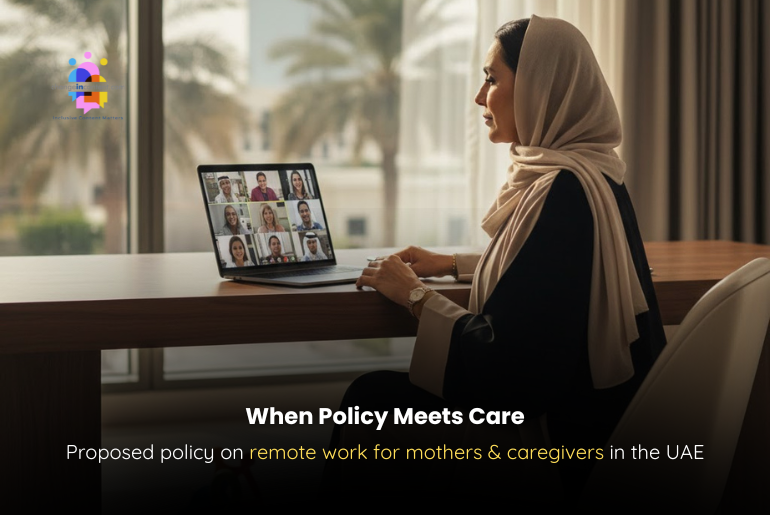
The conversation around remote work for mothers in the UAE has taken a decisive turn. In January 2026, lawmakers in the United Arab Emirates openly discussed prioritising remote and flexible work arrangements for mothers with children under the age of 10.
The proposal signals more than administrative reform. It reflects a growing recognition that caregiving is not a private inconvenience but a public reality shaping workforce participation, gender equity, and national productivity.
What the UAE is proposing, and why it matters
During a recent session of the Federal National Council (FNC), members urged the government to formally prioritise remote and flexible work options for groups with heightened caregiving responsibilities. These include mothers of young children, caregivers of elderly parents, persons with disabilities, and humanitarian cases.
The proposal was tabled during deliberations on family protection and social stability. It is a critical framing. The government did not present it as a “women’s issue” alone, but as a structural intervention. The idea is to strengthen families without pushing women out of the workforce.
While the scope (public, private, or both sectors) remains under discussion, the intent is clear. Flexibility should no longer be discretionary or informal, but policy-backed.
Remote work for mothers in the UAE: A shift in how care is valued
At the centre of the proposal is a radical but straightforward acknowledgement. The fact is that a mother’s presence during a child’s early years matters. Enabling that presence should not come at the cost of economic participation.
Mariam Majid Bin Thania, Second Deputy Speaker of the FNC, clearly articulated this when she stressed the importance of maternal presence, particularly for children under 10 and those with special needs. Her remarks reframed caregiving as a contribution to national development, not a withdrawal from it.
This framing matters. It moves the conversation away from productivity loss and towards the sustainability of families, careers, and societies.
Why this proposal is timely and necessary
Across the Gulf and globally, women continue to exit the workforce at disproportionate rates after motherhood. Research from the International Labour Organisation and the World Bank consistently shows that the lack of flexible work arrangements is a primary driver of maternal attrition.
Remote work does not eliminate the gendered burden of care. Instead, it reduces the penalty attached to it.
For the UAE, where women’s labour force participation has steadily increased over the past decade, policies like this act as retention mechanisms. They ensure that education, skill-building, and workforce investments made in women are not lost during caregiving years.
Maternity leave and the global context
Alongside flexible work, the FNC also recommended extending maternity leave in the government sector to 98 fully paid days. That aligns the UAE more closely with global best practices.
This matters because flexibility without adequate leave often leads women to return to work too early. They are physically present but unsupported. When leave and flexibility work together, women are more likely to return, stay, and progress.
Countries that have adopted similar policy combinations (such as extended paid leave alongside flexible return-to-work options) show higher maternal workforce retention and lower burnout rates.
What this could mean for employers
If implemented well, the policy on remote work for mothers in the UAE could reshape workplace norms beyond motherhood alone. Flexible work policies tend to benefit broader employee groups, including fathers, caregivers, and employees managing health needs.
For employers, the upside is tangible. It is lower attrition, higher engagement, and a more resilient workforce. The risk lies not in flexibility itself, but in uneven or informal implementation. That leaves women negotiating accommodations individually rather than having access to them as a right.
The changeincontent perspective
At Changeincontent, we see this proposal as part of a larger, overdue shift. It is a shift where we finally recognise care as infrastructure.
Policies like these work best when they are accompanied by cultural change. The change concerns performance metrics that value outcomes over hours, as well as leadership buy-in. At the same time, it helps safeguard against flexibility becoming a career ceiling for women.
Remote work should not be a concession. It should be a design choice.
Remote work for mothers in the UAE: Final thoughts
The discussion on remote work for mothers in the UAE is about more than just location. In reality, it is about legitimacy. Who is seen as a “serious” worker. What kinds of lives are workplaces built for? And whether economies are willing to evolve alongside the people who sustain them.
If this proposal moves from recommendation to regulation, it could set a powerful precedent; not just in the Gulf, but globally.
Disclaimer: The views expressed in this article are based on the writer’s insights, supported by data and resources available both online and offline, as applicable. Changeincontent.com is committed to promoting inclusivity across all forms of content. We broadly define inclusivity as media, policies, law, and history. It encompasses all elements that influence the lives of women and marginalised individuals. Our goal is to promote understanding and advocate for comprehensive inclusivity.