
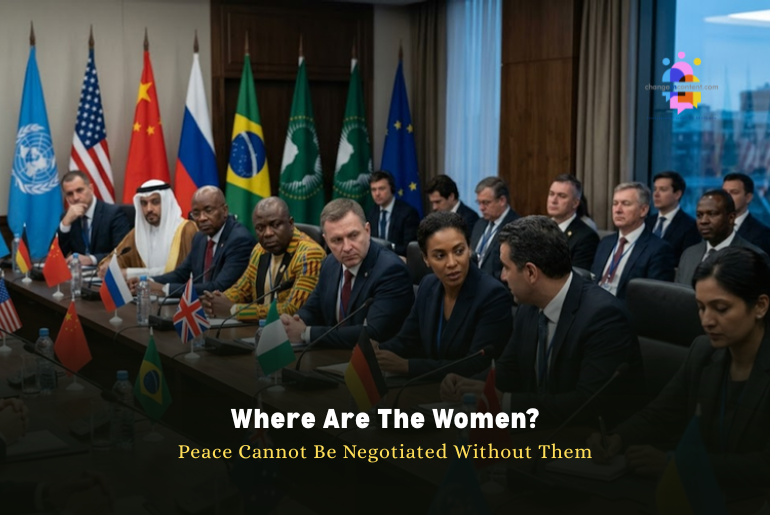
The discussion about the role of women in peacekeeping always focuses on representation. That framing is outdated. In 2026, as conflicts stretch across Ukraine, the Middle East, parts of Africa, and geopolitical tensions rise globally, the question is no longer whether women deserve inclusion. The real question is why systems continue to exclude a group that has consistently demonstrated better outcomes in conflict resolution.
Across global peace tables, the imbalance is visible and striking. The rooms where wars are negotiated, ceasefires are drafted, and futures are decided remain overwhelmingly male. Yet, outside those rooms, women are already doing the work. They are mediating conflicts at community levels, sustaining fragile ecosystems of peace, and rebuilding societies long after headlines move on.
A world at war, still negotiating without half its strength
The modern geopolitical landscape is unstable. Conflicts today are not isolated incidents. They are prolonged, layered, and increasingly complex. From the ongoing Russia-Ukraine war to rising tensions in the Middle East, global diplomacy is under pressure to deliver faster and more durable solutions.
Yet, despite decades of evidence, the composition of negotiation tables remains narrow.
According to United Nations Peacekeeping data, women made up only about 7% of negotiators globally. Nearly 90% of peace processes had no women negotiators at all. It is not a marginal gap, but a systemic exclusion.
Even when global frameworks attempt to correct this imbalance, progress remains slow. The UN Security Council Resolution 1325, adopted in 2000, set a global agenda for women’s full participation in peace processes. More than two decades later, the target remains far from reality.
The contradiction is hard to ignore. The world is facing increasingly complex conflicts, yet it continues to rely on incomplete perspectives to resolve them.
Women in peacekeeping: What the data clearly proves
The argument for women in peacekeeping is not ideological, but empirical.
- A 2015 study by the International Peace Institute found that when women participate in peace processes, the probability of an agreement lasting at least two years increases by 20%.
- Further research highlighted that when civil society groups, including women’s organisations, are involved, peace agreements are 64% less likely to fail.
- A separate study supported by Swiss research institutions in 2018 reinforced this finding. It shows that agreements involving women are not only more durable but also better implemented.
The implications are significant. It is not about inclusion for fairness, but about inclusion for effectiveness.
Countries with higher levels of gender equality are also statistically less likely to resort to violent conflict. The presence of women shifts not just the negotiation process but also the nature of the decisions.
If women deliver better outcomes, why are they still excluded?
The gap is not due to a lack of interest or capability.
Globally, women are deeply involved in informal peacebuilding. A 2020 study found that in over 75% of grassroots peace efforts, women’s groups were active participants in mediation and conflict resolution.
The issue lies elsewhere.
- Exclusion has become an integral part of the systems.
- Power structures often shape negotiation spaces. These power structures favour long-standing networks, many of which remain male-dominated.
- Informal diplomacy happens in rooms and environments where access itself is restricted.
- Historical biases influence decision-making hierarchies. That continues to define who we see as “strategic” or “authoritative.”
There is also a deeper cultural bias at play. Leadership in conflict is still unconsciously associated with aggression, control, and dominance. We often code these traits as masculine.
What gets overlooked is that modern conflict resolution requires something different. It demands negotiation, empathy, long-term thinking, and community rebuilding. These are areas where women have consistently demonstrated strength.
Women in peacekeeping on the ground: Beyond the negotiation table
While global forums debate inclusion, women in peacekeeping roles are already transforming outcomes on the ground.
In UN missions, female peacekeepers have been shown to improve community trust, increase reporting of violence, and enhance engagement with vulnerable populations. Their presence changes how local communities respond to peacekeeping forces.
India, notably, has played a significant role in this space. From deploying all-women police units in UN missions to contributing female officers in conflict zones, the country has consistently demonstrated how gender-inclusive peacekeeping can reshape ground realities.
We explored this in detail in our earlier story. These examples are not symbolic. They are operational proof that inclusion strengthens outcomes.
From war rooms to boardrooms: What organisations must learn
This is where the conversation moves beyond geopolitics. The story of women in peacekeeping is also a workplace story.
Replace a peace negotiation table with a corporate boardroom. Replace geopolitical conflict with organisational crisis. The patterns remain familiar.
Women are often present in execution, coordination, and support roles. They manage complexity, sustain teams, and drive outcomes quietly. Yet, when it comes to strategic decision-making, they remain underrepresented.
The same biases apply.
- Who is seen as decisive
- Who is invited into high-stakes discussions
- Whose voice is considered “authoritative”
The cost of exclusion is also similar.
Organisations that fail to include diverse perspectives often make short-term decisions, overlook systemic risks, and struggle with long-term sustainability. Just like fragile peace agreements, fragile organisational decisions collapse under pressure.
Inclusive leadership is not a moral choice. It is a strategic advantage.
The economic and social multiplier of inclusion
The impact of women’s leadership extends beyond conflict resolution.
A United Nations report highlighted that women’s participation in decision-making improves community outcomes across sectors. In India, for instance, regions led by women have shown significantly higher success in water management projects. In countries like Norway, women in governance have been linked to stronger childcare systems.
These outcomes are not isolated. They reflect a pattern.
When women lead, systems tend to become more inclusive, sustainable, and community-oriented.
Now apply that to peacekeeping. The argument becomes clear. Excluding women is not just unfair. It is inefficient.
The Changeincontent perspective
At Changeincontent, we see the role of women in peacekeeping as one of the clearest reflections of how the world continues to underutilise its most effective resources.
The issue is not awareness. The data exists, and outcomes are proven. So, the issue is intent.
If systems continue to prioritise familiarity over effectiveness, representation will remain performative.
If leadership continues to be defined through outdated lenses, inclusion will remain a checkbox.
The real shift will happen when inclusion is treated as a strategy. Not diversity optics, not policy compliance, and not temporary campaigns, but strategy.
Because the world is no longer dealing with simple problems. And simple perspectives will not solve complex conflicts.
Conclusion: Women in peacekeeping are the missing present, not the future
Women in peacekeeping are not waiting to be included. They are already doing the work.
- They are negotiating at the community level.
- They are rebuilding societies.
- They are sustaining peace where systems fail.
What is missing is not participation. It is recognition at the highest levels.
In a world where over 600 lives are lost daily to conflict, the question is no longer whether we can afford inclusion. The question is whether we can afford exclusion.
Because every negotiation table without women is not just incomplete. It is less effective.
Disclaimer: The views expressed in this article are based on the writer’s insights, supported by data and resources available both online and offline, as applicable. Changeincontent.com is committed to promoting inclusivity across all forms of content. We broadly define inclusivity in terms of media, policies, law, and history. It encompasses all elements that influence the lives of women and marginalised individuals. Our goal is to promote understanding and advocate for comprehensive inclusivity.
