
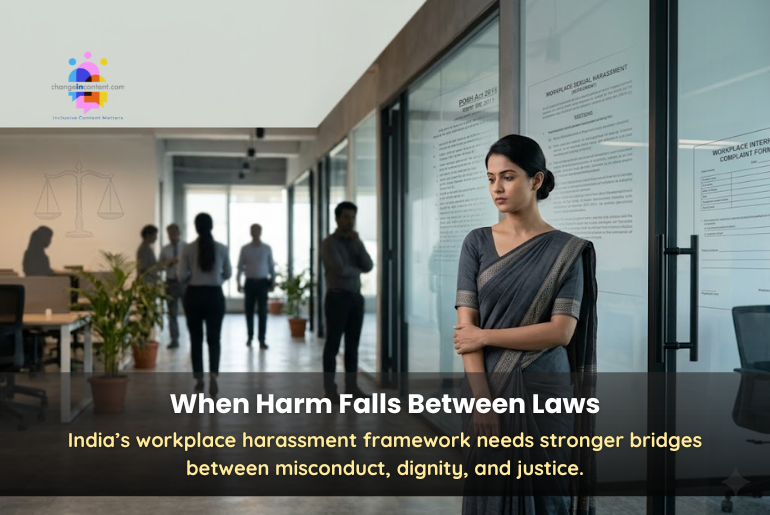
Workplace harassment rarely arrives with a clear legal label. It may begin with a stare that lingers too long. A comment that sounds casual to others but feels invasive to the woman receiving it. A pattern of being watched, followed, interrupted, cornered, joked about, or made uncomfortable in ways that are difficult to prove but impossible to ignore. That is where the legal blind spots in workplace sexual harassment become visible.
India has the PoSH Act. Criminal law also recognises sexual harassment, voyeurism, stalking, words, gestures, and acts that insult the modesty of a woman. Yet, between what women experience and what the law can clearly punish, there is still a space where harm survives.
That space matters, as it determines whether a woman is heard or dismissed. At the same time, it decides whether the law treats a complaint as harassment, misconduct, misunderstanding, or exaggeration. More importantly, it tells women whether the system sees the everyday realities of unsafe workplaces or only the most obvious violations.
Why are legal blind spots in workplace sexual harassment still a problem in India?
The problem is not that India has no law. The problem is that different laws respond to different kinds of harm.
- Criminal law asks whether an act fits a clearly defined offence.
- Workplace law asks whether conduct creates an unsafe, hostile, or intimidating environment.
In theory, both systems should support each other. In practice, women often fall between them.
The PoSH Act
The PoSH Act aims to protect women from sexual harassment at work. The Act recognises that sexual harassment violates equality, dignity, and the right to work in a safe environment. Its text covers women in formal and informal workplaces, including employees, contract workers, trainees, apprentices, volunteers, and domestic workers.
Criminal Law
The criminal law, now under the Bharatiya Nyaya Sanhita, 2023, deals with specific offences.
- Section 75 covers sexual harassment, including unwelcome explicit sexual overtures, demands for sexual favours, showing pornography against a woman’s will, and sexually coloured remarks.
- Section 77 covers voyeurism, but only where a woman is watched, recorded, or her image is circulated while she is engaged in a “private act”.
That distinction is crucial. A workplace act can be humiliating, intimidating, and sexually invasive without fitting neatly into a criminal provision. The law may see the conduct as wrong, but not necessarily as a crime. That is where the blind spot begins.
Understanding the legal framework: What the law covers
India’s workplace sexual harassment framework broadly rests on two routes.
- The first is the PoSH Act, which aims to prevent, prohibit, and redress sexual harassment at the workplace.
- The second is criminal law, which can punish certain acts when they meet the threshold of a defined offence.
What does PoSH cover?
The PoSH Act takes a wider view of harm. It does not look only at physical acts. It recognises that harassment can also be verbal, non-verbal, behavioural, environmental, and power-driven.
The Act says that circumstances connected with sexual harassment may include interference with work, an intimidating or hostile work environment, humiliating treatment, threats linked to employment, or promises of preferential treatment.
That matters because many workplace incidents do not appear to be textbook crimes.
- A senior colleague may repeatedly stare at a woman, causing her to avoid meetings.
- A manager may make suggestive remarks in private but remain polished in public.
- A team may circulate “jokes” that sexualise one woman until she stops speaking in group chats.
These incidents may not always produce dramatic evidence, but they can make a workplace unsafe.
What does the Criminal Law cover?
Criminal law works differently. It cannot punish every uncomfortable or inappropriate act unless the act satisfies the legal ingredients of an offence.
Under the current Bharatiya Nyaya Sanhita, sexual harassment requires specific acts such as physical contact with explicit sexual overtures, demands for sexual favours, showing pornography, or sexually coloured remarks. Voyeurism requires watching, capturing, or sharing images of a woman engaged in a private act.
So the legal framework is not empty. It is layered. But the layers do not always connect.
The legal blind spot in workplace sexual harassment: Where the gap became visible
The recent discussion on this issue stemmed from the Bombay High Court’s ruling in Abhijit Baswant Nigudkar v. State of Maharashtra.
The Court held that staring at a colleague’s chest, however inappropriate, did not amount to voyeurism under Section 354C of the Indian Penal Code. Why? Because voyeurism required watching or recording a woman engaged in a “private act”.
Does that make the conduct acceptable? No. But the conduct did not satisfy the legal ingredients of voyeurism. The difference may sound technical, but it is at the heart of the problem.
The core problem
A woman may experience such staring as invasive.
- She may change how she dresses.
- She may avoid the person.
- She may stop entering certain rooms alone.
- She may feel watched in a workplace where she must feel professional.
Yet, if the case is placed before a criminal court under the wrong provision, the court may have no choice but to reject it.
That is why the ruling is uncomfortable. It shows that a behaviour can be clearly harmful but still legally misclassified. It also shows why women often feel that the law recognises only extreme harm. At the same time, everyday violations of dignity are treated as too small, too subtle, or too difficult to punish.
The Court’s interpretation may be legally sound because criminal law must be precise. But the social message is far more troubling. If workplace systems are weak and criminal law is too narrow for certain forms of harm, where does the woman go?
That is the legal blind spot in workplace sexual harassment cases in India.
Between misconduct and crime: The false binary hurting women at work
The deepest problem is the false binary between misconduct and crime. In many workplace harassment cases, the system behaves as if there are only two options. Either the conduct is serious enough to be criminally prosecuted, or it is treated as an internal workplace issue.
Real life does not work that way.
Imagine a young employee who notices that a senior colleague always sits opposite her in meetings and stares at her body. He does not touch her; he does not send a vulgar message; he does not explicitly ask for sexual favours. But his behaviour is repeated, targeted, and visible enough for her to feel unsafe.
She starts choosing seats carefully; she asks a friend to accompany her to meetings. Her work suffers not because she lacks skill, but because she is forced to manage a threat that no one else wants to name.
The never-ending cycle
Now imagine she complains internally and is told,
“He did not say anything”
“Maybe you misunderstood.”
“Do not make this bigger than it is.”
At that point, the workplace has failed her. If she then turns to criminal law, the court may ask whether the conduct fits a specific offence. If it does not, the case may collapse. That collapse is then used to suggest that the complaint was weak. But the complaint may not have been weak. The legal route may simply have been unsuitable.
That is the cycle women are forced into.
- Workplace mechanisms fail.
- Women seek stronger remedies.
- Criminal law asks for strict ingredients.
- The case does not fit. The harm remains.
The answer is not to criminalise every instance of inappropriate conduct. That would create its own dangers. The better answer is to make workplace redressal credible enough that women do not feel forced to convert every complaint into a criminal case just to be taken seriously.
How courts have understood dignity in earlier sexual harassment cases
Indian courts have not always taken a narrow view of dignity.
Supreme Court in the Vishaka v. State of Rajasthan case
In Vishaka v. State of Rajasthan, the Supreme Court recognised workplace sexual harassment as a violation of the fundamental rights of working women under Articles 14, 19, and 21. The case arose in the absence of a specific workplace sexual harassment law, and the Court created guidelines to fill that legislative vacuum.
The ruling matters because it treated sexual harassment not merely as individual misconduct, but as a constitutional issue. The Court linked workplace safety with equality, dignity, and the right to work. That foundation eventually shaped the PoSH Act.
Other cases also show how courts have sometimes expanded legal understanding to recognise women’s dignity.
State of Punjab v. Major Singh (1964)
In State of Punjab v. Major Singh, the Supreme Court interpreted “modesty” broadly. The Supreme Court held that:
- “Modesty” is not rigid
- Any act affecting a woman’s dignity can fall under Section 354
Rupan Deol Bajaj v. KPS Gill (1995)
In Rupan Deol Bajaj v. KPS Gill, the Court recognised that even a single inappropriate act, when intentional and violating dignity, could fall within the law’s protection. It can amount to outraging modesty.
What the expansions mean and what bothers
These cases are examples of purposive interpretation where courts looked beyond a narrow reading of physical harm.
But this is exactly why the current blind spot feels significant. Courts can expand legal concepts in some contexts, but criminal law still has limits. A judge cannot simply stretch every offence to cover every harmful workplace behaviour. That is why institutional design matters.
The question is not whether every uncomfortable act should become a criminal offence. The question is whether India’s workplace systems are strong enough to recognise and remedy non-criminal but deeply harmful conduct.
Everyday examples of workplace harassment that the law may struggle to capture
The legal blind spots in workplace sexual harassment become easier to understand when we stop thinking only in legal categories and start looking at ordinary workplace scenes.
The new colleague
A woman joins a new company. During team calls, one colleague keeps commenting on how she looks “different today”. At first, she laughs it off. Then the comments move to private messages.
- “You looked nice in that colour.”
- “You should smile more in meetings.”
- “You are becoming everyone’s favourite.”
None of these statements, by themselves, may look like a legal emergency. Together, they create unease.
The friendly colleague
Another woman works late during a deadline week. A senior colleague begins waiting near the lift at the same time. He says he is only being polite. He walks with her to the parking area. She never asked him to. She starts leaving ten minutes earlier just to avoid him. When she tells a peer, the response is familiar: “Maybe he is just friendly.”
The social media stalking
In another office, a woman notices that two men stop speaking whenever she enters. Later, she learns that her social media photos were a part of the team chat. Nobody touched her. Nobody made a direct demand. But the workplace has already turned hostile. She now knows her body and private life have become office entertainment.
The compliments with hidden messages
Then there is the woman who receives repeated compliments from her reporting manager. They sound harmless to others, but they arrive before appraisals, after late-night work calls, and during one-on-one meetings. She cannot easily object because he controls her growth. She cannot easily prove intent because every comment can be framed as casual.
These examples matter because harassment is not always one explosive incident. Sometimes, it is a pattern, a culture, and the slow removal of ease from a woman’s working day.
The law is often better at recognising incidents than atmospheres. Women, however, experience both.
Why the PoSH Act should be the bridge, but often is not
The PoSH Act was designed for exactly these grey areas. It recognises:
- Hostile work environments
- Humiliating treatment
- Interference with work
- Conduct linked to employment power
It also requires every employer to constitute an Internal Committee, with:
- A senior woman as the Presiding Officer
- At least two employee members
- One external member from a women’s organisation or a person familiar with sexual harassment issues
- At least half the committee members are women.
On paper, this is a strong structure. The Internal Committee also has powers similar to those of a civil court for inquiry purposes, including the power to summon individuals and require the production of documents. The law demands the completion of the inquiry within 90 days. If allegations are proved, the committee can recommend action for sexual harassment as misconduct under service rules and compensation where appropriate.
Yet many women do not trust workplace redressal. The reason is simple. A law is only as strong as the institution that implements it.
Common implementation failures
In many workplaces, Internal Committees exist only for compliance.
- Members are appointed but not trained.
- External members are chosen for convenience rather than independence.
- Employees do not know how to complain.
- Survivors fear retaliation, character assassination, career damage, or being labelled “difficult”.
- Delayed or non-existent action
In smaller companies and informal work settings, the situation can be even weaker.
It creates a credibility crisis. Women begin to see POSH mechanisms as ineffective, biased, and procedural rather than protective. That is why many cases escalate to criminal courts, even when they are not meant to.
For a deeper look at how POSH is evolving and where it still falls short, refer to our previous analysis on the judicial expansion of PoSH.
Why this matters for women’s participation at work
Workplace harassment is not only about individual discomfort. It affects women’s ability to enter, stay, grow, and lead in the workforce.
NIUA has pointed out that only 25.4% of females aged 15 and above participate in the urban labour force, compared with 74.5% of males. The government’s own labour force data also show that urban female labour force participation remains far lower than male participation, even with small monthly improvements.
Unsafe workplaces make this gap worse.
When women know that harassment will be trivialised, they begin making invisible adjustments.
- They avoid networking events.
- They refuse to attend late meetings.
- They stop travelling with certain colleagues.
- They choose silence over escalation.
- They leave teams, industries, or formal employment itself.
The cost of these legal gaps
The cost is not only emotional. It is economic. It affects promotions, leadership pipelines, financial independence, and organisational diversity. A workplace that fails to address harassment does not merely fail one woman. It weakens its own talent system.
That is why legal blind spots are not niche legal debates. They shape how safe women feel inside India’s professional spaces.
What policymakers must fix without over-criminalising every workplace wrong?
The solution is not to turn every uncomfortable act into a criminal offence. Criminal law must remain careful because it carries serious consequences. But India does need a more intelligent bridge between workplace misconduct and criminal prosecution.
First, policymakers should strengthen PoSH implementation through regular public audits. Organisations should not be allowed to treat Internal Committees as paperwork. The organisation must review its composition, training, inquiry timelines, and annual reporting more closely.
Second, there should be clearer guidance on pattern-based harassment. A single stare may be difficult to classify. Repeated staring, targeted comments, strategic isolation, or nonverbal conduct that creates a hostile environment should be easier for Internal Committees to identify and address.
Third, Local Committees need far more attention. Women in small establishments, informal employment, contract work, domestic work, gig work, and non-traditional workplaces cannot rely only on corporate compliance systems. If Local Committees are invisible, inaccessible, or poorly resourced, PoSH protection remains incomplete.
Fourth, the law should encourage graded remedies. Not every case requires imprisonment. Some may require an apology, training, transfer, written warning, compensation, managerial consequences, or strict workplace monitoring. A credible system must recognise different degrees of harm without dismissing the harm itself.
Fifth, treat retaliation as a serious violation. Many women do not report harassment because the aftermath is often worse than the incident. The organisation must treat transfers, exclusions, poor appraisals, rumours, and forced resignations as part of the harassment ecosystem.
What organisations must do before the law reaches the courtroom?
The first point of justice in a workplace is not the court. It is the employer.
Organisations must stop treating PoSH as an annual training module and a poster near the reception. The law asks for structures, but culture decides whether those structures work.
A serious organisation should train managers to recognise early signals of harassment.
- It should make complaint pathways visible.
- It should ensure that Internal Committee members understand law, trauma, evidence, confidentiality, and power dynamics.
- It should appoint external members who are genuinely independent.
- It should protect complainants from retaliation.
- It should also make outcomes credible without violating confidentiality.
Most importantly, organisations must stop asking women to prove discomfort in the language of criminal law. A woman should not have to wait until her behaviour becomes extreme before she is taken seriously.
Safe workplaces are built by acting early, not only after an FIR, or after a social media post, or only after a scandal.
Methodology and editorial note
This article is based on a review of the analysis of the Bombay High Court ruling in Abhijit Baswant Nigudkar v. State of Maharashtra, the text of the PoSH Act, the Bharatiya Nyaya Sanhita provisions on sexual harassment and voyeurism, and the Supreme Court’s Vishaka judgment. The article also uses publicly available labour force data to explain why workplace safety matters for women’s economic participation.
It is not a legal opinion or legal advice. It is an editorial analysis of how India’s legal and workplace systems respond to sexual harassment, particularly when conduct is harmful but may not neatly meet the elements of a criminal offence.
Changeincontent Perspective: The law must learn to see the grey areas
The legal blind spots in workplace sexual harassment do not exist because India has no law. They exist because harm often appears in forms that law, policy, and workplace culture still struggle to name. A woman’s discomfort is not always dramatic, recorded or visible to others. But it can still change how she works, speaks, moves, performs, and grows.
At Changeincontent, we believe the future of workplace safety cannot depend only on criminal prosecution. It must depend on stronger institutions, better workplace culture, trained Internal Committees, and a deeper understanding of dignity.
The law must punish crimes. Workplaces must prevent harm. Between the two, India must build a system that does not tell women to wait until the damage becomes legally obvious.
Sources
- Bombay High Court: Abhijit Baswant Nigudkar v. State of Maharashtra
- Supreme Court: State of Punjab v. Major Singh (1966)
- Supreme Court: Rupan Deol Bajaj v. KPS Gill (1995)
- Supreme Court: Vishaka v. State of Rajasthan (1997)
- National Commission for Women Reports
- Ministry of Women and Child Development (POSH Guidelines)
- The Sexual Harassment of Women at Workplace (Prevention, Prohibition and Redressal) Act, 2013.
- The Bharatiya Nyaya Sanhita, 2023.
