
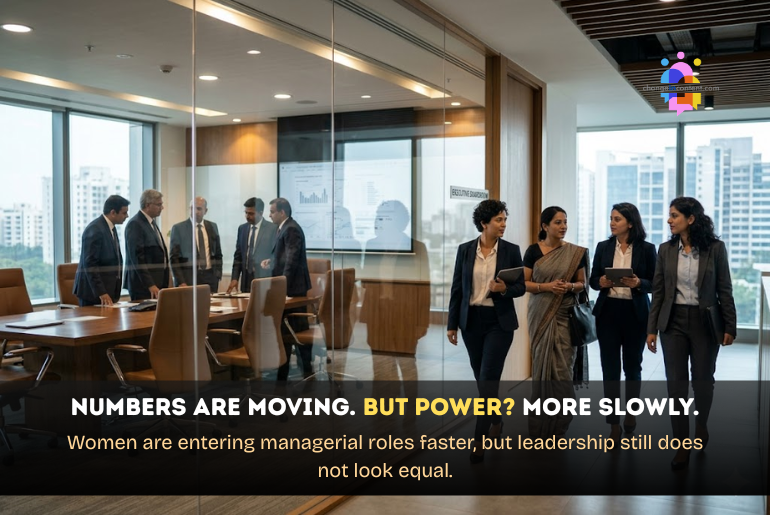
At first glance, the latest Women and Men in India 2025 report by the Ministry of Statistics and Programme Implementation (MoSPI) seems to offer a hopeful picture. One of the most striking shifts is in decision-making. The report says women’s participation in household decision-making has crossed 90% in 16 states and 6 Union Territories. It also says that more women in managerial roles are entering leadership spaces faster than men have in recent years. However, the harder question is whether these numbers reflect equal power or mainly reflect movement from a very low base.
That is where the story becomes more interesting than the headline. A 102.54% increase sounds dramatic, and it is meaningful. But percentage growth alone does not tell us how much of leadership women actually occupy, how much authority they hold once they enter, or whether the structure of decision-making has changed enough to call this equal progress.
To read this number honestly, we have to place it beside the rooms where power remains visibly male.
More women in managerial roles, but how much leadership has actually shifted?
The MoSPI report says that between 2017 and 2025, the number of men in managerial positions increased by 73.80%, while the number of women increased by 102.54%. That looks like huge progress for women. However, percentage growth does not always show the full reality.
What does growth mean when the starting base was tiny?
A high growth rate can happen when the starting number is very low. For example, if a company had 10 women in managerial roles and that number increased to 20. That would show a 100% increase. If the same company had 200 men in similar roles, women would still make up only a small part of leadership. The percentage looks high, but the actual representation stays low.
In 2006, for every 100 men in administrative and managerial positions, only 2 women held similar roles. That shows how small women’s presence in leadership was to begin with. So when the base is that low, even a 102.54% increase does not automatically mean women now hold equal space in leadership.
Women still hold fewer than one-third of management positions in many sectors. More women are entering leadership roles, but leadership is still not equally shared. Women may be moving into management faster than before, but men still hold most of the seats where key decisions get made.
Despite having more women in managerial roles, the leadership gap remains
The Marching Sheep Inclusion Index 2025 studied 840 listed companies across 30 sectors, including steel, pharma, BFSI, FMCG, and IT. It found that 63.45% of companies had zero women in Key Managerial Positions. It means that in more than 6 out of 10 companies, women were completely absent from some of the most important leadership roles.
Other corporate data shows the same trend.
PrimeInfobase’s latest study clearly shows the same pattern. Women are 23% of employees in listed firms, but only 14% of key managerial personnel, 10% of executive directors, and 5% of MDs or CEOs. So women are part of the workforce. But that presence does not continue in leadership.
In 2024, 319 of the Nifty 500 companies, or 63.8%, had no women in Key Managerial Personnel roles. That means in most of India’s top companies, women are still missing from the rooms where major business decisions are made.
Why participation does not always mean power, at work or at home
The MoSPI report also says that women’s participation in household decision-making has crossed 90% in 16 states and 6 Union Territories. When over 90% of women say they take part in household decisions, it is important to ask what these decisions actually include.
- Does this mean women have an equal say in major financial choices, property ownership, children’s education, relocation, and long-term investments?
- Or does it mostly refer to decisions around groceries, caregiving, and daily household needs?
These questions matter because participation and power are not always the same thing.
Being in the room is not always the same as deciding
A woman may be part of a discussion, but that does not always mean she makes the final call. She may manage the home, organise expenses, and handle care work, while major financial or long-term decisions still stay with male family members.
While the numbers show that more women are involved in household decisions, they do not tell us how much control women actually have. Data can show that women are present in decision-making, but it cannot always show how much influence they have. Being part of a discussion does not always mean having equal power to decide the outcome.
The Changeincontent perspective
The most useful way to read more women in managerial roles is not as a neat success story, but as a signal that the pipeline is moving while the power structure still resists changing at the same pace. That distinction matters. A leadership system can absorb more women and remain unequal if women remain clustered in lower-level management, remain scarce in executive authority, or remain absent from the roles where the final strategic calls are made.
That is also why the comparison with household decision-making is so revealing. In both homes and offices, participation can rise faster than actual power does. Women can be present, consulted, relied upon, and even praised, while still not controlling the outcome in proportionate ways.
The challenge now is not only to increase women’s entry into decision-making spaces, but to ask much harder questions about authority, ownership, and who still gets treated as the default decision-maker.
Conclusion: More women in managerial roles is progress, but it is not the same as equal authority
A 102.54% increase does not automatically mean women now hold equal space in leadership. When the starting number is very low, even a large percentage increase can still leave women underrepresented. The same applies to the 90% figure for household decision-making. It shows that women are part of family discussions, but it does not indicate whether they have equal control over major financial choices, property, investments, or long-term decisions.
So the percentages do show progress. More women are entering decision-making spaces than before. But the gap between participation and power remains. The numbers are moving, but equal control, equal authority, and equal leadership still have a long way to go.
