
The Short Read
- The ILO Convention on Home Work, also known as Convention 177, was adopted on 20 June 1996.
- It recognised that people working from home for employers or contractors should receive fair treatment comparable to other wage earners.
- In India, many home-based workers are women who remain in the informal economy, often paid on a piece-rate basis and excluded from basic labour protections.
- Their work supports supply chains, local markets, export industries and app-based services, but their worker identity remains weak.
- The way forward needs legal recognition, fair wages, social security, clearer employer responsibility, collective bargaining and better data on women’s home-based work.
The woman who works before the city wakes
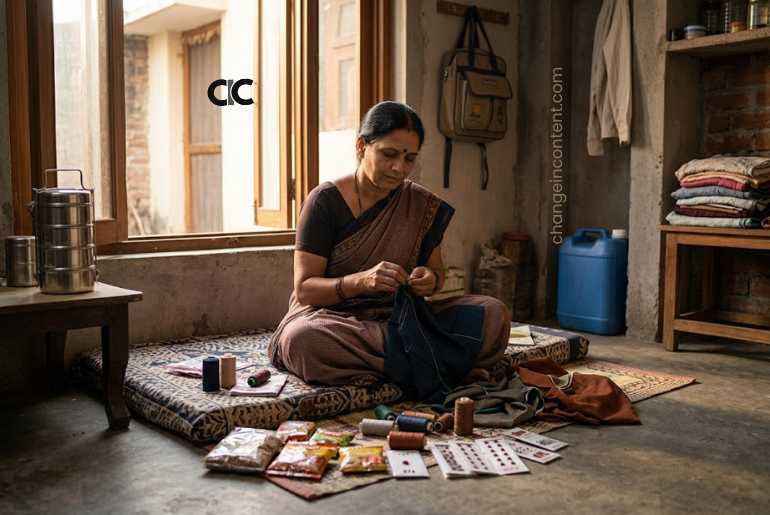
At 5:20 in the morning, Suman lights the stove in a rented house in Kota. There is school tiffin to pack, tea to make, uniforms to find, water to store before the supply stops, and a mother-in-law who needs help sitting up. By 8:30, the family has left in different directions. That is when her second workday begins.
A plastic sack sits near the window. Inside are small decorative pieces for a local supplier. Suman has to trim loose threads, attach beads and pack them in sets of 12. She earns by the piece. If the order is urgent, her daughters help after school. If one bead falls, one piece is rejected. And if the supplier delays payment, she waits.
- No payslip.
- No paid leave.
- No written contract.
- No social security.
- No recognised workplace.
Yet the work is real enough to tire her eyes and bend her back.
In another city, Bhavna in Rajkot rolls incense sticks between lunch and dinner. Somewhere in Jaipur, Kavita does mirror work for blouses that will later sit in a boutique with a very different price tag. And in Indore, Neelam packs small items for a neighbourhood distributor who now supplies quick-commerce sellers.
These women may never call themselves part of a labour force. They may say they “help”, “do some work from home” or “earn a little”. The language and the content make the work sound casual. And the income often keeps households afloat.
That gap between what the work is called and what the work carries is exactly why the ILO Convention matters even after 30 years.
What Convention 177 tried to correct
The ILO Convention on Home Work, 1996, known as Convention 177, was adopted in Geneva on 20 June 1996. Its importance lies in one clear idea: home-based work is work.
The Convention covers work carried out by a person in their home or on other premises of their choice for remuneration. It is work that results in a product or service specified by an employer, regardless of who provides the equipment, materials or other inputs.
That recognition was a major step because home-based workers had long been treated as extensions of households rather than participants in production.
The Convention asks ratifying countries to adopt a national policy on home-based work. It also calls for equality of treatment between homeworkers and other wage earners, as far as possible, particularly on matters such as freedom of association, protection against discrimination, occupational safety and health, remuneration, social security, maternity protection, training and minimum age.
On paper, it is a practical framework. In lived reality, its promise has travelled slowly.
India has not ratified Convention 177. The absence matters because it leaves women home-based workers without a strong national anchor that clearly recognises their rights as workers in a distinct category.
India’s invisible production floor
India’s home-based workers are not a small exception sitting outside the economy. They are part of the economy’s hidden production floor.
- They roll bidis and incense sticks.
- They stitch garments.
- They embroider, embellish and finish textiles. They sort agricultural produce.
- They make papads, pickles, bangles, artificial jewellery, packaging material, craft items and small components.
Some now do platform-linked or supply-chain work from home, where the contractor is harder to identify, and the pressure for speed is higher. Much of this work is done by women because the home becomes the only workable site of employment.
- A factory job may be too far.
- A full-time job may conflict with caregiving.
- A family may not allow paid work outside the home. Public transport may feel unsafe.
- A young child may make fixed shifts impossible.
Home-based work slips into that space: permissible, flexible and underpaid. The flexibility is real. So is the exploitation.
A woman can pause to cook, help a child with homework, take an elder to the clinic and return to her unfinished bundle. The same flexibility allows contractors to avoid responsibility for working hours, safety, wage floors and employment records.
That is why conversations about legal protection for domestic workers in India feel connected to the question of home-based workers. Both groups work in spaces that look private from the outside. Also, both are overwhelmingly shaped by gender. And both struggle because the law and the market often fail to see the home as a place where labour is being performed.
The piece-rate trap
The most punishing part of home-based work is often the wage structure. Piece-rate payment sounds simple. Make more, earn more. In practice, it shifts risk onto the worker.
- If the raw material is poor, the worker loses time.
- If a child falls sick, output falls.
- If a contractor rejects a batch, payment drops.
- If electricity goes, if water collection takes longer, if care work increases, the day’s income shrinks.
The rate itself is usually set elsewhere.
Suman may know she gets a few rupees for a finished set. She may never know what the supplier earns, what the retailer charges, or how much value her labour adds by the time the product reaches a customer.
That lack of visibility weakens bargaining power.
A woman working alone at home rarely knows what others are paid. She may not meet the women doing the same work two lanes away. And she may not know whether a contractor is cutting rates only for her. Isolation keeps wages low.
That is where collective bargaining becomes central. Home-based workers need to be counted, organised and represented. Without that, every woman negotiates from the weakest possible place: alone, replaceable and under-informed.
Why do women stay in this work?
It is easy to ask why women continue to work in low-paid, home-based work. The better question is about the choices these women have actually been given.
For many women in Tier-II and Tier-III cities, home-based work is the only form of earning that fits within social rules. It allows them to remain physically present at home while contributing financially. They can do it between cooking, caregiving, school runs and family obligations. It does not require commuting. It does not demand a formal résumé. The cost is invisibility.
A man leaving for work each morning is easily recognised as a worker. But a woman doing paid work beside the kitchen may still be seen as someone “using free time”. Her income is treated as support, not wages. Her tiredness is treated as household fatigue rather than occupational strain.
That is where women disappear from labour debates. They are working, but not always recorded. Producing, but rarely protected. Earning, but not bargaining. Present in supply chains, but absent in boardroom conversations about labour standards.
The ongoing struggle of domestic workers to access rights shows how difficult it is for women in informal and home-linked work to convert recognition into enforceable protection. Home-based workers face a similar battle. They have the added challenge of their employer being hidden behind layers of intermediaries.
The new economy has not solved the old problem
There is a tempting belief that new forms of work will automatically create new dignity. They do not.
Quick-commerce and platform-linked supply chains have made Indian consumers comfortable with speed. Behind that speed lies a broader ecosystem of sorting, packing, delivery, support, and micro-work. Women can enter parts of this economy from home or near home, but speed often strengthens the pressure without strengthening the protection.
A woman packing small items for a local aggregator may not know whether her work is linked to a larger platform. She only knows the deadline. She knows the rate and the penalty for delay.
That is why the growth of quick service apps and women workers must be examined carefully. New business models should not become old informality with better technology.
If the economy can track a ten-minute delivery, it can also track who packed, sorted, stitched or prepared the work that made that delivery possible. The question is whether it wants to.
What still goes missing
30 years after the adoption of ILO Convention 177, several gaps remain in India.
- The first is legal recognition. Home-based workers need a clearer place in labour law and social protection systems. Their work should not vanish because it happens inside the home.
- The second is data. India needs better measurement of women’s home-based work across sectors, regions, caste groups, income levels, subcontracting chains and platform-linked work. Workers who are not counted are easier to ignore.
- The third is wage protection. Piece rates need transparency and minimum standards. If the finished product has value in the market, the worker’s time must have value too.
- The fourth is social security. Health cover, maternity protection, old-age support, accident support and income protection cannot remain tied only to formal employment.
- The fifth is occupational safety. Home-based workers deal with poor lighting, repetitive strain, dust, chemicals, sharp tools, fumes, long hours of sitting, and cramped spaces. The home may be familiar, but that does not make the work safe.
- The sixth is responsibility across supply chains. Brands, exporters, platforms, aggregators and contractors cannot benefit from invisible labour while denying knowledge of how it is organised.
- The seventh is voice. Women home-based workers need unions, cooperatives, self-help groups, producer collectives and worker organisations that can negotiate beyond the individual household.
What change could look like
The solution does not need to begin with grand speeches. It can begin with a simple acknowledgement that women working from home for pay are workers. From there, the road becomes clearer.
India can create a national policy for home-based workers aligned with the spirit of Convention 177.
- States can register workers through simple, local and multilingual systems.
- Urban local bodies can help identify clusters of home-based workers.
- Labour departments can work with women’s collectives, self-help groups and worker organisations to map sectors and contractors.
- Minimum piece-rate guidelines can be created for common sectors such as garment finishing, embroidery, bidi work, agarbatti rolling, packaging and food processing.
- Social security can be linked to worker registration without forcing women through complex paperwork.
- Brands and suppliers can be required to disclose whether home-based labour exists in their supply chains.
- Public procurement can reward ethical sourcing from registered collectives.
- Skill programmes can include financial literacy, digital payments, product pricing and collective bargaining.
Most importantly, women need local points of support. A worker in Kota or Rajkot should not have to understand international labour law to ask for fair payment. She should have access to a worker group, a helpline, a local registration system and a grievance route. Rights become real when they are reachable.
The impact of recognition
Recognition would change more than wages.
- It would change how families see women’s work. A registered worker card, a fair wage record, a social security link or a cooperative membership can shift the perception of home-based work from “extra income” to legitimate labour.
- It would change how girls see their mothers. A daughter watching her mother stitch late into the night may learn that women work constantly. Recognition would help her learn that women’s work deserves value too.
- It would change how markets operate. Contractors would find it harder to push rates down without scrutiny. Brands would face more pressure to know who sits at the bottom of their supply chain.
- It would change women’s bargaining power. A worker who knows the rate, the group, and the law can negotiate differently.
- It would also change policy. Once home-based workers become visible in data, they become visible in budgets, schemes, labour reforms and electoral promises.
Visibility is the first wage.
Change in Content View
ILO Convention 177, turning 30, should make India pause.
The world recognised home-based work as work three decades ago. In many Indian homes, that recognition still has not arrived at the doorstep.
Women continue to produce for markets while being treated as dependents. They help supply chains run while carrying the full weight of care. Furthermore, they add value to products without knowing the value assigned to them. They also work inside homes that double as production units, yet their rights remain outside the frame.
It is not a sentimental issue. It is a labour, gender and economic issue.
India cannot speak seriously about women’s employment while ignoring women who are already working. It cannot build inclusive growth on labour that remains unnamed. It cannot celebrate entrepreneurship, exports, platforms, and consumption while leaving the lowest-paid women in the chain unprotected.
The next phase needs resolve
Ratification of Convention 177 should return to the policy conversation. A national framework for home-based workers should be built with urgency. State governments should map workers and sectors. Companies should examine supply chains. Worker organisations should be strengthened. Social security should follow the worker, not the office address.
Suman’s work should not become visible only when a product leaves her home. It should be visible while she is making it. That would be a fairer anniversary to mark.
FAQs
Q: What is ILO Convention 177?
A: ILO Convention 177 is the Home Work Convention adopted on 20 June 1996. It recognises home-based work as work and calls for fair treatment of homeworkers in relation to other wage earners.
Q: Who are home-based workers?
A: Home-based workers are people who carry out paid work from their own homes or premises of their choice. Many women in India do such work through contractors, suppliers, local markets or informal arrangements.
Q: Has India ratified ILO Convention 177?
A: India has not ratified ILO Convention 177. Labour groups and worker organisations have continued to call for stronger recognition and protection for home-based workers.
Q: Why does this matter for women?
A: Many home-based workers in India are women working in the informal economy. Without recognition, they often lack fair wages, contracts, social security, maternity protection, occupational safety and bargaining power.
Editorial Note and Sources
This is an opinion-led Mosaic article based on publicly available information on ILO Convention 177, India’s informal workforce and the rights of home-based workers. The names and scenes used in the article are fictional composite portraits created to reflect common realities faced by women home-based workers in Indian Tier-II cities. They do not refer to specific individuals. The article is not legal advice.
Sources:
- International Labour Organisation: C177 Home Work Convention, 1996.
- International Labour Organisation: Up-to-date Conventions not ratified by India.
- WIEGO: C177, The Homework Convention – It’s Time for Action
- HomeNet International: Home-based Workers United Towards Ratification of ILO Convention 177.
- International Labour Organisation: Promoting rights and social inclusion through organisation and formalisation
