
The Quick Read
- Women’s empowerment in Indian companies in 2026 begins with a stronger legal baseline. India’s four Labour Codes, effective since November 2025, prohibit gender discrimination in wages, reinforce equal pay principles and expand women’s access to sectors and shifts subject to consent and safety requirements.
- Workplace safety remains fundamental. The PoSH Act requires formal mechanisms to prevent and address sexual harassment, while the government’s SHe-Box provides a centralised platform linked to Internal and Local Committees.
- Good employers are increasingly moving beyond maternity leave towards return-to-work integration, childcare, flexible transitions, and structured career comeback programmes. Infosys, for example, reported a 99% post-maternity return rate in FY2025 and hired more than 900 women on career breaks through Restart with Infosys in FY2026.
- Career empowerment also means access to sponsorship, leadership development, commercial roles and transparent promotion systems. AIMA-KPMG’s 2026 research warns that women’s leadership ambition remains high while progression and perceptions of fairness remain uneven.
- Women evaluating employers should therefore investigate outcomes as carefully as policies: who gets promoted, who returns after maternity, who receives stretch assignments, who occupies revenue roles, whether pay gaps are audited, and whether flexibility comes with an invisible career penalty.
Women empowerment in Indian companies: The 2026 edition
A company posts a photograph on 8 March.
There are flowers. There is probably purple somewhere. A senior leader writes something admirable about women’s strength. Everyone receives cupcakes.
By 10 March, a woman is negotiating her salary. In June, another returns from maternity leave. In August, somebody wants a promotion. Another employee reports harassment. Someone asks to work flexibly because her father is ill. A 48-year-old manager begins struggling with menopause symptoms. A woman who left work four years ago sends in her CV. And a young engineer asks whether she can take the night shift, which would lead to better operational experience.
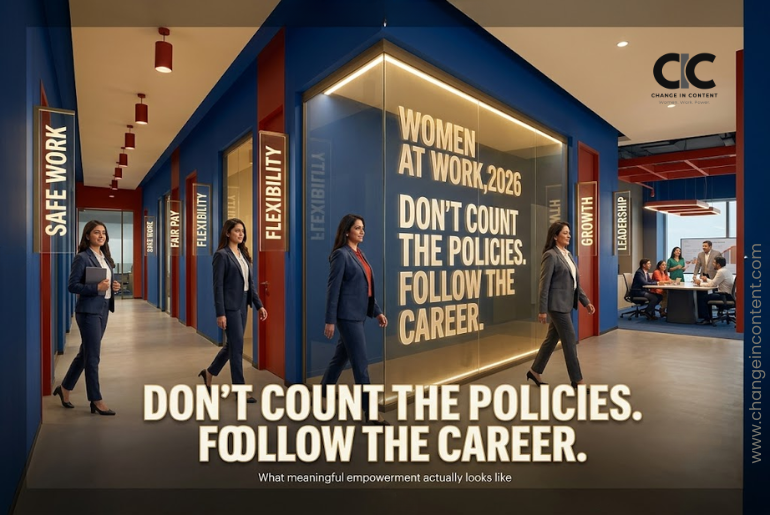
Those are the days when women’s empowerment is tested. That is what this guide to ‘Women Empowerment in Indian Companies 2026’ is about.
There has been genuine progress inside Indian workplaces. Companies are hiring women into industries once considered predominantly male, creating returnships, investing in leadership programmes, improving childcare infrastructure, strengthening safety systems, and discussing women’s health more openly.
Some organisations are doing very interesting work. But a policy and a career outcome are two different things.
For a woman deciding where to work, stay, return or grow, the useful question is no longer: “Does this company support women?” Almost every organisation will say yes.
Ask instead: “How does this company support women when support becomes inconvenient?”
That is a much better test.
First, know what the law already gives you
Before discussing progressive employers, we need to distinguish between legal entitlement and corporate generosity.
A company does not become a women’s empowerment champion simply by complying with the law. Compliance is the floor.
1. Equal pay and non-discrimination are baseline expectations
India’s Code on Wages, 2019, which came into force as part of the Labour Codes on 21 November 2025, prohibits gender discrimination in wages for the same work or work of a similar nature.
It also prohibits discrimination on the ground of sex in recruitment for the same or similar work and in conditions of employment, except where employment is legally restricted.
That sounds straightforward. Real pay fairness requires organisations to go further.
2 people may technically receive the same salary for the same title. At the same time, inequality enters through starting salaries, bonuses, performance ratings, stock grants, promotion speed, larger territories, revenue ownership, high-value projects, and who gets hired into the better-paying parts of the company.
That is why employers serious about equality increasingly need pay audits, transparent salary bands and consistent promotion criteria.
Women should ask about these.
A recruiter becoming uncomfortable when you ask how compensation bands are determined is itself information.
Our recent examination of why women lose out on senior roles makes the individual side equally important: women need to know their market value, compensation expectations and career goals clearly enough to participate confidently in these systems.
2. Safety needs a functioning system, not a policy PDF
The Sexual Harassment of Women at Workplace (Prevention, Prohibition and Redressal) Act, 2013 remains a critical workplace protection. Its purpose covers prevention, protection and formal redressal of sexual harassment at work.
The government’s SHe-Box now creates a centralised mechanism through which complaints can be filed and routed to the relevant Internal Committee or Local Committee, while also creating a repository of these mechanisms across government and private-sector workplaces.
But a good employer’s test begins before anybody files a complaint.
- Does the company explain its process?
- Do employees know who sits on the Internal Committee?
- Are managers trained?
- Are complainants protected against retaliation?
- Are confidentiality rules understood?
- Does the organisation treat inappropriate behaviour seriously before it becomes spectacular enough for senior management to notice?
Safety is infrastructure. Women make career decisions around it. They decide whether to travel. Stay late. Visit plants. Attend client events. Take field assignments. Accept promotions involving mobility.
An organisation can therefore have an excellent leadership programme for women and still indirectly restrict women’s careers if women do not feel safe enough to take the assignments that leadership requires.
The legal floor improved in 2025. Good companies should now build above it.
India’s four Labour Codes widened women’s ability to participate across employment categories. Government guidance says women can work across sectors and at all times, including night shifts and roles involving mining or heavy machinery, subject to their consent and appropriate safety protections.
That is important. For decades, “protecting women” sometimes resulted in protecting women away from opportunity.
If the job that leads to plant leadership requires shift experience, barring women from shifts limits the eventual leadership pool. If mine operations require field experience, women kept away from mines cannot accumulate the credentials required to run them.
Tata Steel offers a useful example of what changing the opportunity architecture can look like. Its Women@Mines initiative placed women in mining shifts after regulations changed. In December 2024, the company launched an all-women shift at its Noamundi iron ore mine, with women operating heavy earth-moving machinery, drills, loaders and other equipment while also supervising the shift. Its Tejaswini programme has trained women from surrounding communities for operational roles in mining.
The point is larger than one company. Access to difficult work creates access to bigger careers. That is policy number one that women should investigate: Does this company put women where the business actually happens?
3. Maternity policy matters. What happens after maternity matters even more.
26 weeks of maternity support is now part of India’s statutory framework, alongside measures such as nursing breaks, crèche requirements in applicable establishments, and the scope for work-from-home arrangements where feasible.
The more revealing employer question starts on the first Monday after a woman returns.
- What work does she receive?
- Her old portfolio?
- A reduced portfolio?
- A meaningful role?
- A convenient holding assignment from which nobody gets promoted?
- Does her manager assume she no longer wants travel?
- Does somebody ask her?
- Does flexibility quietly affect her performance rating?
- Does she remain in succession discussions?
Those questions determine whether maternity leave becomes a temporary career transition or the start of a permanent slowdown.
Infosys provides an interesting current example. Its FY2025-26 ESG reporting states that 99% of women who took maternity leave returned to work in fiscal 2025, and 80% remained in their roles after 12 months. The company describes a four-week transition period for returning mothers alongside Mom’s Net spaces, lactation facilities, childcare arrangements and related support.
That 12-month number is important. Companies commonly celebrate return rates. Women should also look for retention rates.
Returning is one milestone. Still having a worthwhile career a year later is the more meaningful one.
4. A career break should be a comma, not an obituary
This is one area where Indian corporate practice has evolved noticeably.
Women take breaks for childbirth, childcare, eldercare, health, relocation, family circumstances, education, and occasionally because life behaved like life.
The old corporate response treated an employment gap as evidence of professional decay. That assumption wastes talent.
Our guide to women returning after career breaks explains why re-entry needs more than a recruitment campaign. Women often need skills refreshers, fair role mapping, confidence around changed technology and employers willing to value experience acquired before the break.
Some Indian employers are now formalising that transition.
Restart with Infosys accepts experienced women returning after career breaks, offering reskilling, mentorship and full-time or fixed-term employment depending on the role. In FY2026, Infosys says it onboarded more than 900 women through the programme following a large hiring initiative across five campuses.
Mahindra’s SOAR programme similarly offers women returning from career breaks access to mainstream full-time opportunities, alongside part-time or job-sharing possibilities where roles permit, structured induction, mentorship and leadership engagement.
Notice what makes these programmes interesting. They are connected to real jobs. That should be your test. A returnship is valuable when it leads somewhere.
If an organisation advertises a women’s comeback programme, ask:
- How many women entered?
- How many received jobs?
- At what level?
- Were their previous years of experience recognised?
- How many remained after 12 months?
- How many were promoted?
The glossy launch photograph will not answer any of those questions.
5. Flexibility should give you flexibility, not a quieter career
Flexible work became one of the most important workplace developments of this decade. For many women, it can determine whether a career remains possible. But flexibility contains a trap.
A company may officially permit hybrid work, remote work, flexible start times, part-time arrangements, or job sharing, while informally rewarding the people who remain physically visible for longer.
Then flexibility exists administratively. Career flexibility does not. This is particularly dangerous at mid-career.
The AIMA-KPMG Women Leadership in Corporate India 2026 study identifies mid-career as a major pressure point, where caregiving, burnout, and rigid organisational expectations can slow progression or lead women to leave despite their continued ambition. The report argues for flexible role design while maintaining clear performance expectations.
Our own analysis of workplace issues and women’s career progression reaches the same practical question from another direction: benefits become less empowering when employees fear that using them will cost visibility or advancement.
So ask: Do senior people use flexibility here? That will often tell you more than the policy.
If junior mothers mostly use flexible working while senior leadership appears permanently available, the company’s implicit leadership model has not changed.
6. Childcare policy is career infrastructure
Childcare is often put under “employee benefits”. That undersells it.
For many women, childcare availability determines whether paid employment remains economically and logistically viable.
A crèche close to work. Backup childcare. Childcare partnerships. Predictable schedules. Support during school holidays. Dependent-care leave.
These can influence attendance, mobility, promotion decisions, shift choices, travel, and whether a woman remains employed at all.
Infosys describes on-site, proximity and network childcare options across its Indian operations, coupled with lactation rooms and integration programmes for returning mothers.
There is also a cultural question. Does the company treat childcare as a parent issue or a woman issue? The second approach can inadvertently reinforce the same burden it is trying to solve.
Tata Steel’s enhanced parental-benefit approach explicitly frames caregiving as shared rather than automatically maternal. That is worth watching.
The strongest women’s policy sometimes ends up encouraging men to carry more of what women have traditionally carried alone.
7. Leadership programmes matter less than leadership opportunities
Here is where corporate empowerment frequently becomes decorative.
A company announces: Women Leadership Programme 2026.
There are workshops. Executive coaches. Excellent speakers. Certificates. Photographs. Then the P&L role goes to somebody else.
Training is useful. Power comes from opportunity.
The AIMA-KPMG 2026 study found that 79% of women professionals aspire to leadership, while only 1% of respondents held board-level positions. It also highlights uneven access to leadership development, sponsorship, stretch assignments, visibility and decision-making authority.
That is precisely why our earlier analysis of women’s leadership in Corporate India focused on the conversion problem.
Women are ambitious. Organisations need to convert ambition into commercial responsibility,
large teams, business ownership, difficult assignments, international exposure, succession nominations, board visibility, and measurable authority.
A woman considering a company should look beyond the number of leadership programmes it offers.
Ask: How many women actually run important businesses here? That is harder to decorate.
8. Mentorship is useful. Sponsorship changes careers.
Almost everybody now offers mentoring. Good.
But there is another question: Who puts your name forward when you are absent? That is sponsorship.
Our guide to the sponsorship gap for women explains why the distinction matters. Mentors provide guidance. Sponsors use organisational credibility to advocate for somebody’s advancement.
AIMA-KPMG’s 2026 recommendations similarly emphasise senior-leader advocacy, stretch assignments and access to decision-making authority rather than relying on training alone.
A serious corporate programme should therefore connect promising women with leaders who have enough influence to create opportunity.
And then measure:
- who received stretch roles,
- who entered succession pools,
- who gained cross-functional exposure,
- who moved into P&L leadership,
- who was promoted.
If nothing changes after the mentoring coffee, the coffee may have been lovely. It was not a leadership strategy.
9. Transparent promotions are an empowerment policy too
Companies often think about women’s empowerment in terms of benefits. Sometimes the biggest intervention is simply making ordinary career systems fairer.
- Clear promotion criteria.
- Written definitions of leadership readiness.
- Structured performance assessments.
- Comparable evidence requirements.
- Published career paths.
- Calibration processes.
- Audits of promotion outcomes by gender.
The 2026 AIMA-KPMG research raises concerns about perceptions of fairness and consistency in leadership evaluation. It argues for transparent, bias-resistant assessment mechanisms and greater accountability around advancement.
Women should therefore ask a deceptively simple question during career conversations: “What exactly gets somebody promoted here?” A strong employer should be able to answer without consulting astrology.
If the explanation consists entirely of “leadership presence”, “readiness”, “visibility”, “fit”, and “you’ll know when the time is right”, keep asking.
Subjective criteria create more room for inconsistent judgement.
10. Women’s health belongs in workplace design
A company may support women beautifully during maternity and then behave as though the female body retires from the conversation at 35.
Women’s working lives are longer than that. Menstrual health. Fertility treatment. Pregnancy loss. Endometriosis. Mental health. Perimenopause. Menopause. Cancer screening. Bone health.
These issues can affect attendance, concentration, mobility, energy and wellbeing at different stages of a career. They deserve thoughtful policies without turning women into medical projects.
Change in Content has recently explored why menopause action plans could become an important retention tool for experienced women, particularly through manager education, healthcare access, flexibility and practical workplace adjustments.
Our guide to menopause and working women’s careers makes another important point: many women encounter menopause precisely when organisations expect them to operate at peak seniority.
The 2026 workplace should begin thinking in terms of life-stage support rather than a single isolated “women’s wellness day”. That is a much more mature model.
11. Infrastructure can determine whether an opportunity is genuinely available
This becomes particularly important in manufacturing, logistics, mining, retail, healthcare, hospitality, operations, field sales, and other sectors involving shifts or mobility.
Allowing women to work at night is meaningless without safe transport, secure premises, appropriate sanitation, rest facilities, reporting mechanisms, trained supervisors, emergency processes, and workplace cultures that do not treat the woman on the night shift as an experiment.
The new Labour Codes explicitly connect expanded work opportunities with safety requirements.
Tata Steel’s experience illustrates why this matters. Its DE&I framework covers recruitment, sensitisation, retention and development, infrastructure and celebration, rather than treating representation as a hiring exercise alone.
That combination is important. Opportunity without infrastructure can become risk. Infrastructure without opportunity can become tokenism.
Good policy requires both.
12. Look at what happens to women after they get hired
This may be the most useful lesson in this entire guide.
Suppose Company A says, “42% of our workforce is women.” Excellent.
Now ask:
- What percentage of managers?
- Senior managers?
- P&L heads?
- Leadership team?
- Board?
- Who leaves at mid-career?
- Who returns from maternity?
- Who receives promotions?
- Who receives stock?
- Who works in core technology roles?
- Who leads factories?
- Who occupies customer-facing positions?
- Who receives patents?
- Who enters succession planning?
Infosys offers an interesting example of increasingly granular disclosure. Its FY2026 ESG reporting says women make up around 39% of its workforce, while specific programmes supported more than 400 women towards leadership roles, around 1,300 women technology experts through a dedicated skilling track, and 200 women leaders through its #IAmTheFuture programme. It also reports that 34% of its female employees actively participate in research and IP creation.
Whether every company adopts the same programmes is irrelevant.
The useful principle is: measure women where value and power are created.
Headcount alone cannot tell you that.
What does a genuinely women-empowering company look like in 2026?
Imagine two job offers.
Company A promises:
- excellent maternity benefits,
- a women’s network,
- Women’s Day celebrations,
- a mentoring programme,
- flexible work.
Company B has all of those. But you also learn that:
- women regularly run P&Ls;
- returning mothers keep meaningful assignments;
- male leaders use parental leave;
- salary bands are defined;
- promotions are audited;
- career-break hires enter real roles;
- managers receive PoSH and bias training;
- women work across operational shifts with proper safety infrastructure;
- health benefits recognise different life stages;
- senior leaders sponsor women;
- and the company publishes enough information for employees to see whether those systems work.
Which one sounds more empowering? Exactly. The difference is career architecture.
The Women’s Employer Test: 15 questions to ask before you join
- You will not ask all 15 during the first interview unless you particularly enjoy frightening recruiters. But over the recruitment process, research what you can.
- What percentage of employees are women, and what percentage of senior leaders are women? A large gap tells you something about progression.
- Are women represented in core business and revenue roles? Look beyond HR, communications and support functions.
- What is the maternity return rate after 12 months? The second number matters more than the welcome-back photograph.
- What happens after a career break? Does the organisation have returnships or treat gaps as deficiencies?
- Are flexible workers promoted? Ask for examples.
- Does leadership use flexibility too? Culture travels downward.
- How are salaries determined? Look for bands, benchmarking and consistency.
- How are promotions decided? Specific criteria are a good sign.
- Does the organisation audit gender gaps in pay and promotion? Better still: does it act on what it finds?
- Is there a functional Internal Committee and visible PoSH process? You should know where to go before you ever need it.
- What safety infrastructure exists for shifts, travel and field assignments? Particularly important outside desk-based work.
- Is childcare treated as a parental responsibility? Watch who actually uses the policy.
- Who sponsors women? A mentoring programme alone is not the answer.
- Does women’s health support extend beyond maternity? Look at insurance, mental health, reproductive health and midlife support.
- Can you find women who have stayed and grown for ten years? This may be the best question of all.
Policies can be written in weeks. Careers expose them over time.
Your priorities should also change as your career changes
The “best company for women” is not one universal company.
- A 23-year-old engineer may care deeply about technical learning, field exposure, safe transport, strong managers, equal starting pay, and whether women are allowed onto the assignments that build expertise.
- At 32, the questions may include maternity, childcare, career continuity, sponsorship, flexibility, and the first serious leadership transition.
- At 42, P&L exposure, senior sponsorship, equity, leadership evaluation, caregiving flexibility, health support, and whether the company still sees her as rising talent.
- At 52, menopause support, senior authority, board opportunities, continued learning, ageism, succession, and whether experience is treated as an asset rather than an expiry date.
That is why “women-friendly” is too vague. The better company is the one whose systems can support a long career rather than one stage at a time.
Beware of five policies that look better than they work
Watch out for these 5 policies that can create a significant difference.
- Unlimited flexibility with a visibility culture: The policy is excellent until everyone promoted works from the office five days a week.
- A women’s leadership programme with no P&L exposure: Learning leadership is different from being entrusted with something valuable enough to lead.
- Maternity leave without career reintegration: Time away is protected. The trajectory after return also needs attention.
- Mentoring without sponsorship: Excellent advice can coexist with unchanged promotion outcomes.
- Diversity targets without manager accountability: HR can design wonderful systems. The employee experiences the company primarily through her manager.
That last point deserves remembering.
Your company’s women’s empowerment policy may be 47 pages. Your manager can give you a completely different experience.
So what should women themselves do with all this?
Do not choose an employer based exclusively on brand reputation.
Research the lived evidence. Look on LinkedIn.
- How long do senior women stay?
- Where did they come from?
- Did mothers continue progressing?
- Do women move into operating roles?
- Are there women over 45?
- Are there women running businesses?
Besides these, do the following:
- Read annual reports and BRSR disclosures where available.
- Ask former employees.
- Speak to women inside the company.
- Ask recruiters specific questions.
- Understand your statutory rights.
- And once you join, use the programmes that genuinely help.
- Apply for leadership initiatives.
- Build sponsors.
- Know the PoSH mechanism.
- Learn your compensation band.
- Use healthcare benefits.
- Ask for stretch assignments.
- Understand the maternity transition before you need it.
Do not discover an excellent company policy three years after it could have changed your career. Empowerment also needs awareness.
The Change in Content View: Stop asking whether a company is ‘Women-Friendly’
That phrase has probably outlived its usefulness. A workplace is not a restaurant requiring a women-friendly rating.
Women are employees. Engineers. Managers. Founders. Operators. Coders. Researchers. Sales leaders. Finance professionals. Executives. Workers. Board members.
They need systems capable of recognising their work and enabling their careers. Women’s Empowerment in Indian Companies in 2026 should therefore be judged by outcomes.
- Safety that allows participation.
- Pay that reflects value.
- Maternity support that preserves careers.
- Returnships that lead to real jobs.
- Flexibility that does not silently remove someone from the promotion queue.
- Health support that recognises a woman’s whole working life.
- Training that leads to responsibility.
- Mentorship that becomes sponsorship.
- Representation that eventually becomes power.
There is plenty worth celebrating in Indian corporate practice.
- Tata Steel putting women into operational mining shifts matters.
- Infosys bringing hundreds of women back from career breaks matters.
- Mahindra creating structured routes for returning professionals matters.
- Companies building childcare, leadership development, women’s networks and safer workplaces matter.
The next stage is measurement.
- Who benefited?
- Who grew?
- Who stayed?
- Who earned more?
- Who reached leadership?
- Who returned?
- Who received the difficult assignment?
- Who acquired decision-making power?
Women making career decisions in 2026 should feel completely comfortable asking those questions. Because the company you join gives you a salary. The system inside it can shape ten years of your life. Choose accordingly.
FAQs
Q: What does women’s empowerment in Indian companies mean in 2026?
A: Women’s empowerment at work means giving women fair access to employment, pay, safety, development, flexibility, career progression, leadership and decision-making power. Strong programmes go beyond recruitment and examine whether women remain, advance and receive meaningful authority.
Q: Which workplace policies are particularly important for women in India?
A: Important areas include equal pay and non-discrimination, PoSH compliance, maternity and parental support, childcare, flexible work, workplace safety, return-to-work programmes, health benefits, transparent promotion systems, leadership development and sponsorship.
Q: What rights do women employees have under India’s new Labour Codes?
A: The four Labour Codes came into force on 21 November 2025. Among other provisions, the framework prohibits gender discrimination, reinforces equal-pay protections and enables women to work across sectors and shifts subject to consent and required safety measures.
Q: How can women identify whether a company genuinely supports career growth?
A: Look at outcomes alongside policies. Examine women’s representation across different management levels, maternity retention, promotion patterns, access to core business roles, salary practices, leadership opportunities, and the presence of women with long careers within the organisation.
Q: What is the difference between mentorship and sponsorship for women?
A: Mentors advise and guide. Sponsors actively advocate for an employee, recommend her for influential assignments and help place her into conversations about promotion and leadership. Our sponsorship guide explores the distinction in detail.
Q: Are returnship programmes useful for women after career breaks?
A: They can be highly useful when they provide relevant reskilling, meaningful work and a genuine route into employment. Women should assess conversion, role level, and retention outcomes rather than judging a returnship solely by its stated intent.
Editorial Note and Disclaimer
This Knowledge Hub guide combines current Indian employment law, official government materials, corporate disclosures, and workplace research to explain the policies and practices affecting women employees in 2026. Company programmes have been included as examples rather than endorsements or rankings. Policies, eligibility, and benefits can differ by organisation, employee category, and location, and may change over time. Women should consult current employer documentation and applicable law before making employment or legal decisions.
Sources
- Government of India, Ministry of Labour & Employment: Implementation of the Four Labour Codes, including provisions affecting women’s equality, safety, wages, maternity and employment opportunities.
- India Code: Code on Wages, 2019, particularly Section 3 on gender discrimination in wages, recruitment and conditions of employment.
- India Code: Sexual Harassment of Women at Workplace Act, 2013.
- Ministry of Women & Child Development: SHe-Box and workplace sexual-harassment framework.
- AIMA-KPMG: Women Leadership in Corporate India 2026.
- Infosys ESG Report 2025-26: Women, maternity, leadership development and Restart with Infosys.
- Tata Steel: Women@Mines, Tejaswini and DE&I programmes.
- Mahindra Group: SOAR return-to-work programme.
