
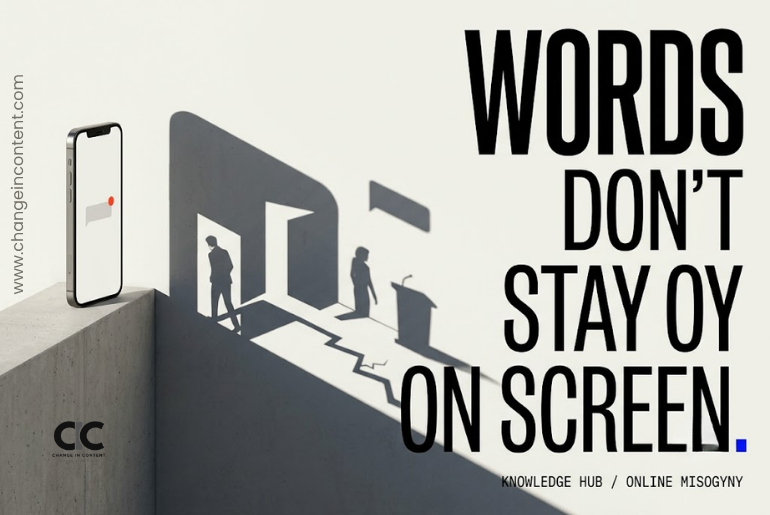
The Quick Read
- Online misogyny refers to hostility, contempt, discrimination or abuse directed at women because they are women, expressed or amplified through digital spaces. It can include sexist hate speech, sexualised harassment, stalking, threats, doxxing, gendered disinformation, image-based abuse, deepfakes and coordinated attacks.
- Its consequences are increasingly offline. In a 2025 global survey, 42% of participating women journalists linked online attacks with offline abuse, harassment or assault, more than double the 20% recorded in the comparable 2020 survey.
- Artificial intelligence is increasing the speed and intimacy of abuse. UN Women reports that an estimated 90–95% of online deepfakes depict women in sexualised ways; UNESCO cites research indicating about 98% of deepfake videos online are pornographic, and roughly 99% of people depicted are women.
- The problem extends beyond individual perpetrators. UN and other research points towards gender norms, economic and social insecurity, misogynistic online communities, algorithmic amplification, anonymity and commercial incentives that reward provocative content.
- Men and boys have to be part of prevention. UN Women is studying how men encounter online misogyny and how healthier masculinities, digital literacy, bystander behaviour and alternative communities can interrupt the route from grievance towards hostility.
- Women should know how to document and report digital abuse, but making women safer cannot depend mainly on women becoming better at avoiding danger. Platforms, employers, schools, law enforcement, governments and communities carry responsibilities too.
Online misogyny: The same feed can change 2 people
On one phone, a woman types an opinion. She looks at it. Remembers what happened the last time. Deletes one sentence. Softens another. Removes the photograph. Posts.
On another phone, perhaps several kilometres or several rooms away, a young man watches something about fitness. Then dating. Then why men are losing. Maybe then why women supposedly have too much power. Then why feminism is responsible, and then someone with a microphone gives his frustration a villain.
Neither person may recognise what is happening as Online Misogyny. She calls it avoiding unnecessary trouble. He calls it content. The algorithm calls it engagement. That vocabulary gap is part of the problem.
When misogyny appears online, we often isolate the visible event: an offensive comment, an ugly meme, a rape threat, a fake nude, an abusive direct message. The wider system is harder to see.
- What came before the comment?
- Who rewarded it?
- Who laughed?
- Who stayed silent?
- What content made the attitude feel normal?
- What happened to the woman afterwards?
- And where did the person posting it take those ideas once the phone went back into his pocket?
Those questions are becoming increasingly urgent because the boundary between digital life and the rest of life barely exists anymore.
More than 5.5 billion people are online. Digital spaces now shape relationships, education, careers, politics, entertainment and identity. UN Women warns that misogynistic online ecosystems have already moved beyond obscure forums into schoolyards, workplaces and intimate relationships.
The internet does not end when we lock the phone. Neither does what we learn there.
What is online misogyny?
Online misogyny is broader than men insulting women on social media.
At its core, misogyny online treats women’s presence, autonomy, sexuality, authority or equality as something deserving hostility, punishment or control.
It can be explicit. For example, “You shouldn’t be here”, or “You deserve to be raped.”
Or coded. For example:
- Women are gold-diggers.
- Women lie about harassment.
- Women receive jobs only because of diversity.
- Successful women are unattractive.
- Feminism has destroyed families.
- Women have acquired too much power.
The internet can package these ideas as memes, humour, dating advice, reaction videos, self-help, political commentary or “hard truths”. People rarely join the internet asking to be radicalised into misogyny. They enter through ordinary concerns, such as:
Loneliness. Dating. Sex. Money. Fitness. Status. Career anxiety. Divorce. Rejection. Fatherhood. Belonging.
UN research describes the manosphere as a decentralised set of online communities linked by opposition to feminism and by narratives that present men as victims of social change. These communities can spread denigrating portrayals of women and false or distorted ideas about gender equality and violence.
Not every male self-improvement influencer belongs to it. And not every men’s forum is misogynistic. Men genuinely need places to discuss loneliness, mental health, fatherhood, relationships and economic uncertainty.
That distinction is essential. The danger begins when real male difficulties are converted into hostility towards women.
The misogyny ladder is much longer than a hateful comment
At the lower end, it may look almost socially acceptable.
- A sexist joke.
- A woman interrupted in a gaming chat.
- Comments about a politician’s appearance rather than her argument.
- A female CEO’s competence dismissed as “DEI”.
- Or a creator told to return to the kitchen.
Then the behaviour can escalate.
- Coordinated harassment.
- Cyberstalking.
- Impersonation.
- Doxxing.
- Sexual threats.
- Non-consensual sharing of intimate images.
- AI-generated sexual imagery.
- Threats to family members.
- Publishing addresses or phone numbers.
- Tracking somebody from digital information into the physical world.
This wider category is increasingly described as technology-facilitated violence against women and girls.
UN Women treats it as part of the same continuum as violence occurring offline, rather than a separate, lesser form of harm.
Change in Content has previously mapped the mechanics of digital violence against women, including cyberstalking, sextortion, doxxing, deepfakes, impersonation and coordinated abuse. The question we are asking here sits one stage earlier: What produces a digital environment in which those behaviours become easier to imagine, perform and excuse?
Understanding that difference changes prevention.
“Just log off” misunderstands what the internet has become
Imagine telling a woman experiencing harassment in an office: “Have you considered quitting work?”
Most organisations would recognise the absurdity. But online, we routinely offer the digital equivalent.
Block him. Make your profile private. Don’t post photographs. Don’t share your location. Leave X. Turn off comments. Ignore trolls.
Women should absolutely use privacy and security tools where they help. But consider what the cumulative advice means.
- The person being abused gradually disappears.
- Her photograph disappears.
- Her location disappears.
- Her opinion becomes milder.
- Her account becomes private.
- Her professional visibility falls.
- Her public participation shrinks.
But the perpetrator keeps posting. This is one reason online misogyny becomes economically important.
LinkedIn, Instagram, YouTube, X and other digital platforms are not merely places where people socialise. They are professional infrastructure.
Women build businesses there. Find clients. Publish expertise. Recruit employees. Network. Sell products. Create audiences. Develop reputations. Apply for work. Speak at conferences because somebody discovered their thinking online.
For women working in the digital economy, visibility can have monetary value.
Change in Content’s examination of women and the future of digital work found that digital platforms can dramatically expand access to employment and entrepreneurship. Those opportunities become less equal when participation carries a gendered safety tax.
A woman withdrawing because of harassment has not simply closed an app. She may have lost economic reach.
We now have stronger evidence that the screen can lead into the street
Women have been saying this for years. The data is becoming harder to dismiss.
UNESCO reported that in its earlier global survey of women journalists, 20% of respondents said online violence had been connected with offline attacks or abuse.
By 2025, in a newer survey, the corresponding proportion among participating women journalists had risen to 42%.
Online violence remained extraordinarily widespread too: 75% of the 354 women journalists surveyed said they had experienced it while doing their jobs.
Journalists are an especially exposed group, so those numbers should not be treated as prevalence figures for all women. They reveal the mechanism exceptionally well.
A digital threat can become:
- someone appearing at an event;
- a home address being circulated;
- harassment of relatives;
- physical stalking;
- fear about travelling alone;
- police involvement;
- security expenditure;
- a decision not to cover a subject;
- a decision not to speak.
Change in Content has already examined how online harassment is pushing women journalists towards self-censorship. When a woman stops investigating, commenting or publishing because violence has made visibility too costly, the loss extends beyond her.
The audience loses her work. Democracy loses a voice. The workplace loses expertise.
Unfortunately, the abuser acquires influence without ever needing formal censorship. That is remarkably efficient silencing.
AI has made misogyny cheaper to manufacture
There was once a practical obstacle to fabricating a convincing sexual image of someone. You needed some technical skill. But generative AI has dramatically reduced that barrier. Now a handful of ordinary photographs can become raw material for non-consensual sexual imagery.
UN Women’s online-safety guidance cites estimates that 90–95% of deepfakes online depict women in sexualised ways. UNESCO’s newer reporting points to research indicating that pornography accounts for around 98% of deepfake videos online, with approximately 99% of depicted individuals being women.
The victim does not have to have been the subject of an intimate photograph. That conceptual shift is enormous.
For decades, women were told, “Don’t send the picture.“ But now, the picture can be invented.
- A LinkedIn headshot can become material.
- A school photograph.
- An Instagram Reel.
- A television appearance.
- A company website.
The old safety advice therefore reaches its limit.
At some point we have to stop asking how perfectly women protected their images and start asking why products capable of generating sexual abuse are permitted to operate with inadequate friction and accountability.
Our earlier analysis of the deepfake and online-abuse crisis looked at the accountability gap once the abusive material exists. The new challenge is designing technology so that some forms of abuse become more difficult to create in the first place.
That is safety by design.
Why does misogynistic content spread so well?
The simplest answer to this is: Because anger is excellent content.
It is emotional. Simple. Repeatable. Shareable. It gives complicated problems a villain. And it keeps people watching.
UN and ISD research increasingly points towards a combination of social and technological conditions rather than a single explanation.
- Young men may be navigating genuine insecurity around employment, relationships, status, masculinity or belonging.
- Rigid gender norms can leave them with a narrow emotional vocabulary for managing those difficulties.
- Digital communities can offer certainty and fraternity.
- Influencers can monetise grievance.
- Algorithms can reward polarising material because polarisation produces engagement.
The result is an uncomfortable business model: somebody’s anxiety becomes somebody else’s audience.
UN Women reports that many boys and young men increasingly turn to online influencers for guidance on dating, fitness and fatherhood. According to UN reporting citing Movember research, around two-thirds of young men regularly engage with masculinity influencers.
Again, masculinity content itself is not the problem.
The fork in the road appears when the answer to: “Why am I lonely?” becomes: “Women.”
Or:
“Why am I struggling?” becomes: “Feminism.”
Or:
“Why don’t I feel powerful?” becomes: “You should control somebody else.”
A healthy response needs to reach the boy before resentment hardens into ideology.
Men need something better to belong to
This may be the most important part of UN Women’s current work.
Engaging men cannot amount to inviting a few already-convinced male allies onto a panel about feminism.
Prevention has to become much more ambitious.
UN Women, Equimundo and the Institute for Strategic Dialogue have been examining men’s online behaviours, exposure to misogynistic ideologies, attitudes towards women and the pathways connecting digital spaces with online and offline harm.
One finding from wider Equimundo research is particularly useful: misogynistic communities often succeed because they provide something people genuinely want. Belonging. Recognition. Explanation. Identity. Status.
A group that says, “We understand what you’re going through.”
We cannot compete effectively with harmful communities by telling boys only what not to become.
- Young men also need credible versions of what they can become.
- Strong without domination.
- Successful without treating women as competitors.
- Masculine without emotional isolation.
- Sexual without entitlement.
- Confident without contempt.
- Able to experience rejection without turning humiliation into revenge.
- Able to disagree with feminism without dehumanising women.
That is not softness. It is social infrastructure.
Equimundo’s research into the manosphere argues that belonging, care and community need to become part of the alternative offered to young men, because misogynistic influencers have been highly effective at occupying precisely that space.
This is why men cannot remain “supporters” standing outside the problem
Most men do not post rape threats. Most men do not create sexual deepfakes. And most men do not stalk women online.
That is important. It is also insufficient.
Misogyny is sustained through social permission as much as individual extremity.
- What happens in the WhatsApp group when somebody shares an intimate image?
- What happens when a colleague makes a sexual joke about a senior woman?
- When a friend calls his ex “crazy” and starts publishing humiliating details online?
- When somebody sends a misogynistic Reel to the boys’ group?
- When a man sees coordinated abuse beneath a woman’s LinkedIn post?
Silence has a social meaning. So does laughter. So does forwarding.
Men have enormous influence over the behaviour of other men because they occupy spaces women do not.
Boys’ groups. Gaming communities. Private chats. Locker rooms. Male friendship circles. Online forums.
The conversations in those spaces can either provide friction against misogyny or lubricate it. Male allyship online can therefore be wonderfully ordinary.
“Delete that.”
“Don’t share her picture.”
“That’s not funny.”
“You don’t know whether that claim is true.”
“Leave her alone.”
“She’s allowed to disagree with you.”
“Mate, this influencer is selling you rage.”
Small sentences. Different norms.
Organisations need to understand that online misogyny can become a workplace issue
Imagine a senior woman is targeted online after appearing at an industry conference.
- Her photograph is sexualised.
- Abusive messages reach her professional account.
- Someone discovers her employer.
- Fake claims appear under company posts.
- Her direct reports are beginning to see the content.
- She stops volunteering for public panels.
Is this a personal social-media issue? The company may initially think so. It is not.
Her professional visibility created the exposure. Her ability to do her job is now being affected.
Employers increasingly need protocols for technology-facilitated abuse involving employees, particularly those in public-facing roles.
That includes executives. Journalists. Researchers. Policy professionals. Creators. Academics. Customer-facing staff. Communications teams. DEI leaders. Recruiters. Anyone whose job requires a visible professional identity.
A mature organisation should know who responds when an employee is doxxed, impersonated, threatened or targeted with a sexual deepfake.
HR alone may not be enough.
- Legal may be needed.
- Cybersecurity.
- Corporate communications.
- Physical security.
- Employee assistance.
- Law enforcement.
- Platform escalation.
The response should already exist before somebody needs it.
Employers should also look inside their own digital spaces
Online misogyny does not require Twitter. It can live perfectly comfortably inside workplace technology.
WhatsApp groups. Slack. Teams. Internal forums. Video-call chats. Anonymous employee platforms. Shared drives. Email. Unofficial groups involving colleagues.
The medium changes. The behaviour does not.
Policies on workplace harassment therefore need to recognise digital conduct, including behaviour occurring outside conventional office hours where there is a clear employment connection.
Training should also move beyond telling employees: “Do not harass colleagues.” That sentence has apparently failed to eliminate harassment. Managers need examples.
- What counts as sexualised digital behaviour?
- What if someone shares a colleague’s photograph?
- What if deepfake material appears?
- What if employees participate in coordinated harassment outside work?
- What evidence should HR preserve?
- When does physical security become involved?
- What support is available to the person targeted?
The more digital work becomes, the less credible it is to maintain separate moral standards for what happens “online”.
Platforms have considerably more power than the block button suggests
For years, safety conversations have been designed around user behaviour.
Report. Mute. Block. Restrict.
Platforms certainly need these tools. But the architecture around them matters more.
- What does the recommender system amplify?
- How quickly does increasingly extreme content appear after someone begins consuming gender-grievance material?
- Can users repeatedly create new accounts after suspension?
- How difficult is doxxing to report?
- Can intimate images be re-uploaded after removal?
- How quickly can someone appeal?
- Are moderation models trained to recognise coded misogyny?
- Does the company assess gendered consequences when designing AI features?
- Are trust-and-safety teams adequately staffed?
ISD recommends more robust trust-and-safety systems, scrutiny of recommender systems, stronger reporting mechanisms and interventions that strengthen boys’ and men’s resilience against misogynistic content.
UN Women’s 2026–2029 strategy similarly places technology companies and digital governance inside the prevention architecture rather than treating platforms as neutral hosts.
The important shift is from: “How quickly did we remove the abusive post?” to: “What did our system do that helped this abuse become scalable?”
Schools cannot wait until misogyny becomes violence
The first misogynistic influencer a boy encounters may reach him before his school has held one serious conversation about gender. That gives the influencer an extraordinary advantage.
Schools increasingly need to teach gender literacy and digital literacy together.
Not a one-hour lecture where students are warned about cyberbullying and given a poster. Real conversations.
- Why do algorithms show us increasingly similar material?
- How do influencers make money?
- How can insecurity be manipulated?
- What does consent mean when images can be copied infinitely?
- What is a deepfake?
- Why are women attacked differently online?
- How should boys respond when friends share degrading content?
- What does a respectful relationship look like?
UN Women specifically recommends helping children and teenagers examine the gender messages embedded in the content they consume rather than treating digital safety purely as passwords and privacy settings. That is a much more useful education.
A secure password cannot protect a society from a harmful worldview.
Parents need curiosity before panic
Telling a teenage boy that everything he watches is toxic is unlikely to produce a fascinating evening of self-reflection. He may simply stop showing you. Adults need to understand the attraction.
- Which influencers does he watch?
- What does he like about them?
- What problem does he think they help solve?
- What do they say about women?
- Does the content become more extreme over time?
- Who makes money when he keeps watching?
- Can he distinguish confidence from dominance?
Parents do not need fluency in every meme. They need enough curiosity to keep the conversation open. And boys need adults who take their problems seriously without accepting misogyny as the diagnosis.
Male loneliness is real. Young men’s mental-health challenges are real. Economic insecurity is real. Dating anxiety is real. Educational struggles are real. And none requires women’s equality to be reversed.
A society capable of holding both truths will do a better job of helping boys than one that makes them choose between contempt for women and contempt for themselves.
Governments face a difficult balance: Safety without digital censorship
Regulation matters. So do human rights and freedom of expression. Those principles need not be enemies.
UN Women said in late 2025 that fewer than half of countries had laws specifically addressing online abuse, while enforcement remained weak even in many jurisdictions with relevant provisions.
The strongest policy response does not criminalise every offensive opinion. It builds clear accountability around conduct such as credible threats; cyberstalking; non-consensual intimate imagery; sexual deepfakes; doxxing; impersonation; coordinated harassment; extortion; and other forms of technology-facilitated abuse.
The Council of Europe moved further in this direction in 2026 with new guidance covering criminal and civil remedies, victim-centred justice, platform accountability and safety-by-design. Change in Content examined that framework in our analysis of the Council of Europe’s response to technology-facilitated violence against women.
India also has the National Cyber Crime Reporting Portal, operated by the Ministry of Home Affairs, through which online and social-media crimes can be reported. The portal includes routes for crimes involving women and children, as well as other cybercrime categories.
The system exists. Awareness, responsiveness, specialist capacity and survivor confidence decide whether people use it.
What should a woman do if online misogyny turns into targeted abuse?
If abuse becomes targeted, threatening or persistent, resist the instinct to delete everything immediately.
Preserve evidence first where it is safe to do so: screenshots, URLs, account handles, timestamps, messages and other relevant records.
Then assess whether there is a physical safety risk. Doxxing, threats mentioning home or workplace locations, stalking or threats involving relatives deserve escalation beyond ordinary platform moderation.
Use the platform’s reporting and blocking tools, but do not assume that platform action is the only available route.
In India, cybercrime can be reported through the Government’s National Cyber Crime Reporting Portal. In an immediate physical emergency, contact the police through 112; the national women’s helpline is 181.
Tell somebody. An employer where the abuse is professionally connected. A family member. Friend. Lawyer. Police. Security team. Relevant support organisation.
Targets of coordinated abuse often have to make dozens of decisions quickly. Nobody benefits from making every one of them alone. The Change in Content’s guide to digital literacy for women also covers practical digital security basics, including account protection, privacy settings, evidence preservation, and reporting impersonation.
But one principle sits above every safety checklist: The existence of precautions does not transfer responsibility for the abuse to the woman who was targeted.
What would serious prevention actually look like?
Imagine the response distributed properly.
- Women know their rights and have accessible reporting systems.
- Men challenge men.
- Boys encounter compelling alternatives to misogynistic influencers.
- Parents understand the digital spaces children inhabit.
- Schools teach gender-aware digital literacy.
- Employers support staff targeted because of their work.
- Platforms examine algorithms, product design and monetisation.
- Police develop technological and gender-sensitive capability.
- Governments modernise laws while protecting legitimate expression.
- Researchers measure what changes.
- Civil-society organisations support survivors and test prevention models.
That is what a safer digital future looks like. Not one perfectly behaved woman with excellent privacy settings. But a functioning ecosystem.
Men may actually gain something important from this too
We have to say this because prevention built purely around guilt rarely travels very far.
Misogynistic masculinity can be brutal towards men. It demands status. Money. Sexual success. Physical dominance. Control. Emotional invulnerability. It tells boys that rejection is humiliation, vulnerability is weakness, and care is feminine.
Failure then becomes not merely disappointment but a threat to masculinity itself.
ISD notes that digital environments promoting hypermasculinity can expose boys and young men to harmful expectations around appearance, fitness, money, coercion and sexual entitlement while discouraging emotional openness and help-seeking.
A healthier digital culture, therefore, does not require boys to surrender something valuable so that girls can be safer. It gives boys more ways to be men. And that may be one of the strongest prevention arguments we have.
We should also stop measuring misogyny only after a woman is harmed
Organisations love incident metrics.
Reports received. Accounts removed. Cases prosecuted. Posts deleted.
Yes, those matter. But a mature prevention system would ask earlier questions.
- Are boys encountering less extreme misogynistic content?
- Are men intervening more often?
- Are women becoming more willing to speak publicly?
- Are platform reporting times improving?
- Are women journalists self-censoring less?
- Are employees confident that employers will support them?
- Are deepfake tools becoming harder to misuse?
- Are repeat offenders prevented from returning immediately?
- Are women from marginalised communities receiving effective protection?
The objective is not a prettier abuse dashboard. It is less abuse. That requires measuring the conditions producing it.
Online misogyny is also a workplace inclusion issue
Imagine spending years encouraging women to build a personal brand; be visible; speak up; network online; publish opinions; become thought leaders; lead publicly; develop authority.
Then, when that visibility produces gendered abuse, telling them: “Perhaps stay off social media for a while.”
Something has gone wrong. Visibility is increasingly part of professional capital.
Women should not have to choose between career visibility and personal safety. That is why the future of women’s digital participation cannot be discussed separately from online misogyny.
A digitally inclusive workplace does not merely provide women with devices, software, and remote-work access. It gives them a credible way to remain visible in their digital professional lives without being abandoned when visibility poses a risk.
That is inclusion after the login.
The Change: Make misogyny socially expensive before it becomes physically dangerous
There is a moment before every online attack becomes serious.
- Before the threat.
- Before the stalking.
- Before somebody creates the fake image.
- Before the woman closes the account.
- Before police become involved.
- Before somebody gets hurt.
There are often dozens of smaller moments.
- A joke receives laughs.
- A stereotype goes unchallenged.
- An angry young man finds an influencer who explains his pain by blaming women.
- A recommender system notices that rage keeps him watching.
- A friend forwards the video.
- A platform monetises another view.
- A private group normalises language none of its members would use in a meeting room.
Somewhere along that chain, intervention was possible. That is where the next generation of anti-misogyny work needs to become much stronger.
Women have been taught to block, report, document and protect themselves. Keep those tools. Now build the other half.
- Teach boys.
- Engage men.
- Interrupt harmful communities.
- Support healthier ones.
- Design platforms differently.
- Train employers.
- Strengthen justice systems.
- Follow the money behind outrage.
Treat digital violence as real violence before it proves the point offline.
The internet has enormous power to provide women with work, audiences, communities, knowledge, and a public voice. A safer digital future should not require women to become quieter to enjoy it.
The ambition should be much larger: make equality easier to belong to than misogyny.
Editorial Note
This Knowledge Hub article draws principally on UN Women’s work on technology-facilitated violence against women and girls, including its 2026 report, Engaging Men, Ending Violence: Pathways to Safer Digital Futures; its 2026–2029 strategy on technology-facilitated violence; and related research from UN and UNESCO. It also considers evidence from the Institute for Strategic Dialogue and Equimundo on online misogyny, masculinities and digital environments. Statistics concerning journalists or specific populations should not be interpreted as prevalence estimates for all women. The article distinguishes misogynistic or abusive conduct from legitimate disagreement and protected expression. Safety and reporting information is general guidance, not legal advice.
Sources
UN Women — Engaging Men, Ending Violence: Pathways to Safer Digital Futures: The 2026 research examines men’s and boys’ digital behaviour, misogynistic networks and opportunities for prevention.
UN Women — Strategy on Preventing and Eliminating Technology-Facilitated Violence Against Women and Girls: Sets out UN Women’s 2026–2029 approach to prevention, accountability, survivor support, data and technology governance.
United Nations — UN Women Sounds the Alarm Over Online Misogyny: Official UN reporting on the manosphere, young men, algorithms and offline consequences.
United Nations Secretary-General — Intensification of Efforts to Eliminate All Forms of Violence Against Women and Girls: Official UN analysis of the manosphere, misogyny and the normalisation of violence.
UNESCO — Global Survey on Online Violence Against Women Journalists: Evidence on online harassment, threats and offline consequences affecting women journalists.
UN Women — Online Safety 101: Current evidence and practical explanation of digital abuse, AI-enabled harms and deepfakes.
Institute for Strategic Dialogue — Fostering Healthy Masculinities: Building Resilience Against Online Misogyny: Research and policy recommendations addressing harmful online environments and interventions for men and boys.
Government of India — National Cyber Crime Reporting Portal: Official mechanism for reporting cybercrime in India.
