
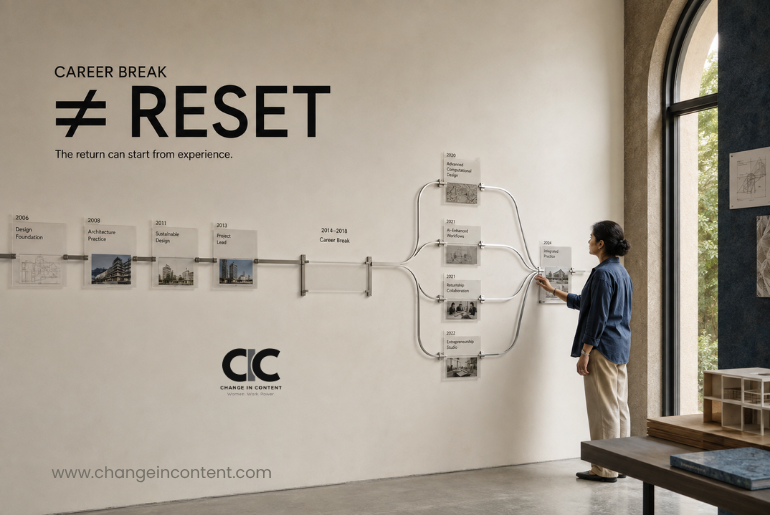
The Brief
- Women returning to work are re-entering a labour market that has changed for everybody. The World Economic Forum expects 39% of workers’ existing skills to change or become outdated between 2025 and 2030. AI and big data are among the fastest-growing skills.
- AI can help returners refresh workplace skills, practise new workflows, build portfolios, research roles and test business ideas faster. It should be treated as working infrastructure, not as a substitute for professional judgement.
- Returnships become more useful when learning and employment are connected. Programmes such as TCS Rebegin and Amazon India’s rekindle already combine re-entry with structured organisational support.
- Employers need to reconsider whether a career gap is still a sensible proxy for current capability. Skills-based hiring can broaden women’s opportunities, particularly as AI changes the nature of jobs.
- A smarter return also leaves room for entrepreneurship, consulting, freelancing and portfolio careers. For some women, the next career may not resemble the one they paused.
Women returning to work need smarter pathways
A woman who left marketing in 2022 may return in 2026 to a job where campaign research is AI-assisted, first drafts appear in seconds, meetings are transcribed automatically, and customer data can be interrogated conversationally.
Her former colleague who never left has had to learn those things too.
That changes something about women returning to work after a career break. The old re-entry question was often framed as: How does she catch up? In an AI-disrupted workplace, almost everybody is catching up with something.
The World Economic Forum estimates that 39% of workers’ current skill sets will be transformed or become outdated by 2030. AI and big data lead the list of fastest-growing skills, followed by networks, cybersecurity, and technological literacy. Employers surveyed for its Future of Jobs Report 2025 identify skills gaps as their biggest obstacle to transformation.
A career break can still widen that gap. It can affect networks, familiarity with new systems, confidence during interviews and the recency employers expect on a CV. But it no longer makes sense to imagine one group of “current” workers standing still while returners scramble towards them.
The ground beneath both is moving. And that gives India an opportunity to rethink what a good return to work looks like.
Start by finding the gap, not assuming one
A woman returning after 3 years may need to learn new software. She may not need to relearn management.
Someone returning to finance may require familiarity with AI-assisted analysis and contemporary compliance systems, while retaining years of judgement around clients, risk and negotiation. A former HR professional might need new knowledge of talent technology without having forgotten how organisations or people work.
Yet return-to-work training can easily slip into an odd form of professional amnesia: treating an experienced person as though the years before the break have expired.
A smarter approach starts with a skills audit.
- What remains current?
- What has changed?
- Which skills are adjacent enough to be refreshed quickly?
- Which genuinely need rebuilding?
- And what new capability would make this person more valuable than she was before the break?
This matters particularly in an AI economy because AI literacy is broader than becoming an AI engineer. LinkedIn and UN Women have found a growing gender gap in both AI engineering and AI literacy skills. Their research also points towards a potential advantage for women: human capabilities such as communication, relationship-building and teamwork remain important as AI enters more jobs.
So the useful training mix is rarely “learn AI” in isolation. It may be: existing domain expertise + contemporary AI tools + judgement + one demonstrable project.
That is far closer to employability.
Change in Content recently examined the broader problem of AI and employment risk for women. The same transition that exposes some female-dominated jobs to automation can create a re-entry opportunity if women are trained to work with changing systems rather than pushed towards increasingly vulnerable tasks.
What can AI actually do for a woman returning after a break?
That is where we should resist overselling technology.
AI cannot decide whether an employer will penalise a 4-year CV gap. It cannot arrange reliable childcare. It cannot make a two-hour commute manageable. And it cannot guarantee that a manager will treat a returner as an experienced professional rather than a risky hire.
What it can do is compress some of the work involved in becoming professionally current again.
1. Rebuild workplace fluency
A returner can use modern AI tools to practise tasks she is likely to encounter in a target role.
A communications professional can compare briefs and create campaign structures. Furthermore, a financial analyst can practise interpreting synthetic datasets. An HR professional can work through recruitment scenarios. A product manager can build requirement documents and analyse mock customer feedback.
The purpose is not producing an AI-generated answer. It is about learning how contemporary work is done now.
That distinction becomes particularly important because the World Economic Forum views GenAI’s near-term impact primarily as the augmentation of human skills. In contrast, nuanced judgement, complex problem-solving and human interaction remain difficult to fully substitute.
2. Turn learning into evidence
A certificate says someone completed a course. A portfolio shows what she can do.
Returners can build small, role-specific projects: an analysis, workflow, prototype, campaign, research note, dashboard, process redesign or customer strategy. AI can speed up parts of this work while the returner provides the domain knowledge, choices and verification.
For employers, that can provide fresher evidence than the date of someone’s last payslip.
For the woman herself, it replaces the vague anxiety of “I need to upskill” with something concrete.
3. Make job preparation less opaque
Job descriptions have become dense with tools and terminology. AI can help candidates decode them, compare their current skills against role requirements, simulate interviews and identify where preparation is genuinely needed.
There is a caution here.
Returners should not allow AI to manufacture experience they do not have or turn their CV into generic keyword soup. A polished fictional candidate will eventually meet a real interviewer.
Use the technology to reveal strengths and gaps, not disguise them.
4. Restore professional experimentation
Career returners are often advised to decide exactly what they want before they begin. That is a high bar after several years away.
AI makes inexpensive experimentation possible.
A woman can explore how her previous skill set maps to five current roles, study a new industry, test a consulting proposition, build sample work or understand what skills an adjacent career requires before committing months of time and money.
The comeback can therefore begin with exploration rather than a single irreversible decision.
Returnships should become laboratories, not waiting rooms
India already has established corporate efforts aimed at bringing experienced women back.
TCS’s Rebegin is open to women professionals across India who are returning after breaks taken for family, health, education, or personal reasons, and explicitly includes reskilling and training as part of reintegration.
Amazon India’s rekindle programme supports women who have taken a break of 12 months or more by providing interview preparation, orientation, mentoring, and on-the-job learning.
These models demonstrate something useful: re-entry becomes easier when it is treated as a transition rather than an ordinary vacancy with sympathetic wording attached.
AI could make this model considerably stronger.
Imagine a 12-week returnship beginning not with generic induction but with an individual capability map.
The participant spends the first phase learning the AI-enabled workflows relevant to her function. She then works on a live project with a manager who evaluates output, judgement, collaboration and learning speed. Mentorship runs alongside it. The returnship ends with a genuine route into an appropriate role rather than an impressive certificate and another job search.
Training companies can play a meaningful role here too. But they should be measured against placement, role quality and retention, not the number of women who completed an AI workshop.
India has already built enormous skilling capacity. Change in Content recently examined the more difficult question of why training does not always lead to formal work for women. A return-to-work programme should therefore connect learning to an identifiable occupational destination from the beginning.
A course without that bridge can leave a woman more qualified and no closer to being hired.
Employers need to update their idea of “recent experience”
AI creates an interesting inconsistency in traditional recruitment.
Companies acknowledge that jobs are changing rapidly. They invest heavily in reskilling existing employees because yesterday’s knowledge is insufficient for tomorrow’s work.
Then a returner applies, and her career gap is sometimes treated as evidence that her experience has become stale.
Both positions cannot comfortably coexist. If capabilities are changing quickly, employers need better ways to measure them now.
LinkedIn and UN Women’s analysis offers a strong argument for skills-based hiring. Their modelling suggests that skills-first approaches could increase female representation by 13% in industries where women are currently most underrepresented.
For returners, this can translate into practical hiring changes:
- Reduce unnecessary emphasis on uninterrupted tenure.
- Test relevant skills through realistic work samples.
- Recognise adjacent skills rather than demanding an exact recent job title.
- Train interviewers to distinguish a knowledge gap from a career gap.
- Offer bridge learning where the missing capability can reasonably be acquired.
- Compare compensation with the role and experience for which someone is being hired, rather than automatically discounting salary because someone took time off.
And once someone returns, stop treating her as a “returner” indefinitely. She is an employee.
The programme should be a door, not a permanent professional label.
The flexibility question cannot be outsourced to AI
There is a tempting argument that AI will help women become more productive and therefore make career return easier. That is only partly useful.
For a woman whose principal obstacle is time, AI may save an hour.
- It cannot create a school pick-up arrangement.
- It may make hybrid work more productive.
- It cannot persuade an employer to offer hybrid work.
- It can help her plan.
- It cannot redistribute care at home.
That is why equity and consideration belong in the design of a smarter return-to-work. Women do not all return from the same break.
One may have a partner who shares childcare equally and significant financial flexibility. Another may be caring for both a child and an ageing parent simultaneously. Someone else may return after relocation to a city where her professional network no longer exists. A woman from a smaller city may have the skills but few suitable employers within commuting distance.
Offering all of them the same six-week AI course is administratively neat and strategically lazy.
Returnship design should consider the factors that determine whether someone can actually stay: flexible or phased hours, where the role permits; predictable scheduling; childcare assistance or partnerships; sensible hybrid policies; psychological safety; manager preparation; mentoring; and a route back to career progression.
Return-to-work success should therefore not be measured at joining. Check again after 6 months. And after twelve.
Hiring creates a comeback story. Retention tells us whether the comeback worked.
The next job may be a business
Corporate employment is only one route back into economic participation.
For some women, a career break changes what they want from work. A rigid full-time job may no longer fit. Their old industry may have contracted. Their location may have changed. Or several years of expertise may lend itself more naturally to consulting, teaching, freelancing or a business.
AI has lowered the cost of testing those possibilities.
- A consultant can research a market without an analyst.
- A trainer can develop course material more quickly.
- A small retailer can create product content, analyse customer feedback and prepare basic campaign variations.
- A service professional can automate parts of administration while concentrating on clients.
- A founder can create an early prototype or test a proposition before spending heavily.
There are genuine risks around accuracy, privacy, intellectual property and overdependence. But used well, AI can provide something returners frequently lack: operating leverage before they have a team.
This connects with a wider shift we are already seeing in female entrepreneurship in 2026, where AI is reducing the cost of experimentation for some women-led businesses.
And entrepreneurship should not be presented as the consolation prize when employment does not accommodate women.
A woman choosing to build should have access to customers, finance, digital skills, networks and growth support that allow her to create a serious enterprise.
A practical comeback plan for women
The most useful return strategy may be shorter than many people expect.
First, choose a direction before choosing a course
Identify two or three roles worth pursuing.
Look at real vacancies.
Study what has changed since you last performed that work.
Do not buy training simply because “AI” appears in the title.
Then divide your skills into 3 buckets
Still strong: experience and abilities you can use immediately.
Needs refreshing: tools, regulations, software or methods that changed during the break.
Worth adding: capabilities that could materially expand the roles available to you.
This immediately turns a career gap into a manageable learning plan.
Learn AI in the context of work
Prompting for its own sake has limited career value.
Learn how AI affects your function.
A lawyer, accountant, HR professional, designer, teacher and sales manager require very different levels of AI fluency.
Produce evidence
Complete two or three projects that resemble the work you want to be hired to do.
Be able to explain what you did yourself, where AI helped, how you checked the output and why you made your decisions.
Use more than conventional applications
Look at returnships.
Reconnect with former colleagues.
Contact specialist return-to-work networks.
Explore project work and consulting.
Approach both smaller employers and large corporates.
An employment gap can become disproportionately powerful when an application is reduced to a CV and an automated screen. A conversation gives the rest of the career room to appear.
Negotiate from the role forward
A break can affect market readiness. It does not automatically erase seniority.
Research current compensation for the work. Understand where you genuinely need a bridge period and where an employer is simply using the gap to reset your value.
For companies and training organisations: 5 questions worth asking
A return-to-work initiative is not thoughtful simply because women are mentioned in its brochure.
Before launching one, organisations could ask:
- What jobs will this programme actually lead to?
- Which capabilities have genuinely become obsolete, and which are we merely assuming have?
- Will participants work on live problems using current tools?
- Have managers been prepared to employ returners, or only recruiters prepared to hire them?
- What percentage of participants are still in meaningful work twelve months later?
Those five answers probably reveal more than the number of registrations.
Change in Perspective: Return Better, Not Back
The language around career return contains a subtle assumption.
“Going back.” Back to work; back to the office; back to a career.
But the workplace a woman left may no longer exist in quite the same form. Her own life may have changed too.
Artificial intelligence makes that divergence even greater. Roles are changing, skills are moving, and organisations themselves are learning how humans and machines should work together.
That creates a better ambition than trying to restore somebody exactly to where she was.
Give women a way to identify what they already know, learn what has genuinely changed and demonstrate what they can contribute now. Build returnships around real work. Judge skills rather than chronology. Make flexibility credible. And allow entrepreneurship to stand beside employment as a serious economic choice.
AI can make parts of the comeback faster. Equity determines whether the comeback is fair. And thoughtful workplace design determines whether she has to make another one.
Editorial Note & Sources
This Knowledge Hub article examines how artificial intelligence may support career re-entry for women while recognising that technology cannot resolve structural barriers related to care, hiring bias, flexibility, workplace design, or access. Labour-market figures and AI trends are based on institutional and primary corporate sources available up to August 2026. Examples of company returnship programmes are illustrative and do not constitute endorsements.
Sources
- World Economic Forum: Future of Jobs Report 2025: The report finds that approximately 39% of workers’ existing skills are expected to change or become outdated by 2030, while AI and big data rank among the fastest-growing skills.
- LinkedIn Economic Graph and UN Women: Women and Future Jobs: Research on gender, AI exposure, AI literacy and skills-based hiring, including evidence that women remain underrepresented in AI skills and could benefit from skills-first recruitment.
- Tata Consultancy Services: Rebegin: TCS’s current return-to-work pathway for experienced women professionals in India.
- Amazon India: Rekindle: Amazon India’s structured re-entry programme for women returning after career breaks of 12 months or longer.
- Ministry of Statistics and Programme Implementation: PLFS, July 2026: The latest monthly PLFS release reported female labour force participation at 34.4% among people aged 15 and above, under the Current Weekly Status measure. This monthly figure should not be directly compared with annual usual-status estimates.
