
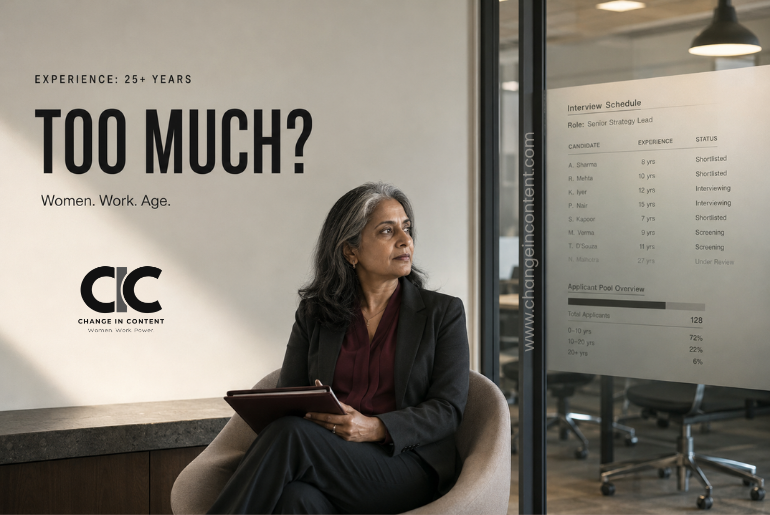
The Brief
- Ageism is a real workplace concern in India. Michael Page’s 2025 Talent Trends research ranked preventing age discrimination as employees’ leading DEI priority.
- Women over 50 may experience a double filter of age and gender, particularly during hiring, promotion and career transitions. OECD research finds that older women can be disadvantaged by both simultaneously.
- A career break can make the problem sharper, but women who remained continuously employed can also encounter assumptions about adaptability, technology, energy, salary expectations or retirement.
- India’s ageing profile makes the discussion increasingly relevant. Women’s careers cannot reasonably be designed around the assumption that professional value peaks decades before life ends.
- There are alternatives: skills-first hiring, flexible roles, returnships, consulting, entrepreneurship and employers willing to judge present capability rather than a birth year.
Somewhere around 50, the CV begins behaving differently
At 50, a woman may have managed teams, raised children, buried parents, survived reorganisations, learned three generations of workplace technology, negotiated budgets, handled clients and recovered from failures nobody mentions on LinkedIn.
Then she applies for a job. Suddenly, someone wants to know whether she has enough “energy”.
That contradiction sits underneath many conversations about jobs for women over 50.
The formal language is ageism. In real life, it is often harder to spot.
Nobody needs to say, “You’re too old.”
It can arrive as:
“We are looking for somebody more dynamic.”
“Would you be comfortable reporting to a younger manager?”
“The culture here is very young.”
“This role might be too operational for you.”
Or simply silence after a recruiter sees how far back the CV goes.
Each sentence can have a legitimate explanation. Together, they start describing a pattern.
Fifty is an oddly inconvenient age in the modern workplace
Too experienced for some junior positions.
Too expensive for employers trying to keep salary bands low.
Not senior enough for the handful of leadership jobs at the top.
Possibly returning after care responsibilities.
Possibly competing against candidates fifteen years younger.
Maybe navigating menopause.
Or possibly supporting both children and ageing parents.
And increasingly expected to prove she has kept up with technology in a way few employers explicitly demand from a 32-year-old.
Ageism in India is difficult to dismiss as a marginal concern.
Michael Page’s 2025 India Talent Trends work found that preventing age discrimination ranked first among employees’ DEI priorities. Among the minority of respondents who reported experiencing workplace discrimination, age was the most commonly cited basis. Employees aged 50 and above reported particularly high exposure to age-related incidents.
An earlier Randstad study of nearly 1,000 employees also found that 31% reported experiencing some form of age bias at work.
Ageism can affect younger employees too. But for an older woman, it arrives carrying considerable historical baggage.
Her CV has already absorbed years of inequality
A woman does not suddenly encounter gender inequality on her 50th birthday.
She may arrive there carrying the consequences of the previous 30 years.
- Career breaks for childbirth.
- Years working around school timings.
- Promotions declined because relocation was impossible.
- Part-time periods.
- Care for parents or in-laws.
- Salary increases missed during absence.
- A late restart after several years outside formal employment.
OECD research on older workers describes exactly this accumulation. Women are more likely than men to experience interrupted career trajectories because of care, which can reduce promotions and lifetime earnings. The gender pay gap can also widen with age. Older women then encounter another layer: discrimination associated with age itself.
Which means a recruiter looking at a 52-year-old woman’s career history is not always looking at pure professional choice.
Sometimes the CV also records who did the unpaid work.
Change in Content has previously explored how career re-entry should be redesigned for women returning to work. But women over 50 deserve a wider discussion because many of them are not returners at all.
Some never left. They simply discover that staying did not make them immune.
The bias often hides inside assumptions about “fit”
There are genuine reasons employers might choose one candidate over another.
Skills matter. Salary matters. Role requirements matter.
So does the ability to work with current technology. But age becomes discriminatory when those questions are answered before they are asked.
Older workers are often assumed to be less adaptable, less technologically capable or less willing to learn. OECD research has documented similar stereotypes and found that older applicants can receive fewer employment opportunities even when qualifications are comparable.
Women may encounter an additional layer built around appearance and gender expectations. Men turning grey can acquire visual authority.
Women turning grey are still sold products promising to hide it. A man in his 50s can be described as seasoned.
An older woman may find herself described as “dated.”
That is not true in every company, profession or hiring room. It happens often enough to deserve scrutiny.
Delhi-based writer Nilanjana Bhowmick described this intersection vividly in a first-person account published by The Guardian in 2025. At 48, she wrote about feeling increasingly replaceable in professional life and connected ageing, menopause and workplace insecurity with the experience of other middle-aged Indian women she encountered.
Her story matters because ageism rarely appears alone. It mixes with health, caregiving, class, salary, appearance and the shape of a woman’s previous career.
Then there is technology
AI has given ageism a convenient new vocabulary.
“Digital native.”
“AI-first.”
“Fast-moving.”
“Tech-savvy.”
None of those phrases inherently excludes older workers. They can become proxies for age when employers assume that younger applicants automatically possess those qualities.
That assumption is particularly strange in 2026.
Generative AI tools used in workplaces today did not exist in their current form when most 25-year-olds were at school either.
Almost everybody has had to learn them.
The World Economic Forum expects a substantial portion of workers’ existing skills to change by 2030. Reskilling is becoming part of normal working life across generations, rather than something uniquely required by older employees.
A 54-year-old who can learn a new system is current.
A 29-year-old who refuses to learn it is not.
Birth year tells an employer remarkably little about either.
The job market also misunderstands ambition after 50
There is another stereotype worth questioning. That older women want less. Some do.
After decades of work, somebody may genuinely want fewer hours, less travel or a role without management responsibility. That is a choice.
Others want the opposite.
- A larger job.
- A board role.
- A business.
- A complete career change.
- A first serious career after years of unpaid care.
The opportunity to finally prioritise themselves once children are older.
Indian Hotels Company Limited’s Second That! programme offers a useful real-world example.
The company’s returnship initiative includes Elizabeth Mooken, who found herself job hunting at 50 after losing her husband. She eventually joined the hotel where she had once celebrated her wedding, taking on a public-facing professional role.
“I never thought that I would get a job at the age of 50,” she told the Tata Group while describing the experience.
The remarkable part is not that a 50-year-old woman could do the job. It is that finding one felt remarkable.
What are good jobs for women over 50?
Perhaps we need to retire this question in its conventional form.
Search for it online, and you quickly encounter familiar lists:
- Tutor
- Consultant
- Writer
- Caregiver
- Receptionist
- Home baker
- Virtual assistant
There is nothing wrong with any of those jobs.
The problem appears when they become a special menu presented to older women, as though ageing has quietly invalidated every occupation they held before.
- A woman who was a finance director at 48 does not become biologically suited to tutoring at 51.
- A software engineer does not automatically need to become a coach.
- A sales leader does not suddenly belong in a hobby business.
The best jobs for women over 50 are the jobs their skills, circumstances and ambitions qualify them to do.
- For one person, that will mean returning to senior corporate employment.
- For another, consulting.
- Someone else may choose a portfolio career made up of two or three projects.
- Another may start a company precisely because traditional hiring has become frustrating.
- Others may deliberately move into education, hospitality, healthcare, advisory work, social enterprise or the non-profit sector.
The point is range. Women over 50 need more doors, rather than a kinder-looking smaller room.
Employers are leaving useful experience on the table
Companies frequently complain about talent shortages while narrowing their definition of desirable talent.
That deserves a rethink.
Experienced workers can bring institutional memory, judgement, client maturity and an understanding of what happens when a plan meets reality.
Those qualities are difficult to assess through an applicant-tracking system. They are also difficult to teach through a two-day leadership programme.
Age-diverse teams can also connect different generations of employees, rather than forcing organisations to choose between experience and new thinking.
The smarter question during hiring is not: How long until this person retires?
It is: Can this person create value during the years she wants to work here?
3 productive years from a 56-year-old may be more valuable than eighteen months from a younger hire who leaves.
Retention calculations rarely appear in ageist assumptions.
Women have decisions to make too
Recognising ageism does not require pretending the labour market will adapt overnight. Women navigating it need options.
A CV may benefit from emphasising the most relevant recent experience rather than documenting every professional year. Current technological fluency should be made visible rather than assumed.
Networks become increasingly important at senior levels because many experienced roles are filled through relationships long before they reach job boards.
Consulting or project work can sometimes reopen a corporate door from another direction. And an older candidate does not have to apologise for wanting flexibility.
Flexibility and ambition can occupy the same career.
Companies should be equally careful not to use this advice as an excuse for shifting responsibility back onto women.
No amount of LinkedIn optimisation can eliminate a hiring manager’s prejudice. We can help women navigate the market while still asking employers to examine it.
India’s workforce is going to get older
There is a demographic reason this conversation will become harder to ignore.
India remains comparatively young, but it is ageing.
UNFPA projects that people aged 60 and above will account for more than 20% of India’s population by 2050. Women tend to live longer, meaning ageing itself will increasingly have a female dimension.
A labour market cannot indefinitely behave as though professional relevance ends somewhere around 45 while lives extend well beyond 70. Nor does economic independence stop mattering because a woman crosses 50.
For some women it may matter more.
- Children may still need support.
- Parents may need care.
- Retirement savings may be inadequate after years outside paid work.
- Divorce or widowhood can change household economics suddenly.
- And women who live longer require economic security that lasts longer.
Work at 55 is therefore not merely a conversation about fulfilment. Sometimes it is financial infrastructure for the next 30 years.
Change in Perspective: Stop Calling Her Past Her Prime
There is a peculiar way we talk about women’s careers.
- At 25, she needs experience.
- At 35, employers wonder about children.
- At 45, she may be managing children and parents.
- At 50, somehow she can already be treated as old.
That does not leave a particularly generous window in which a woman is considered perfectly convenient to employ. Maybe there isn’t one.
Careers are becoming longer, messier and less linear. Technology will keep changing the skills people need. Women will leave, return, pivot, lead, slow down, accelerate and start again at ages that old career models did not anticipate.
Some employers will understand that earlier than others.
And some 52-year-old woman, currently being told that she is overqualified, expensive, or “not the right cultural fit,” will eventually find an organisation that sees the same CV differently. Or she may build something of her own.
The job market does not need to romanticise women over 50. It needs to stop underestimating them.
Editorial Note & Sources
This Mosaic article examines ageism affecting women in mid- and later-career employment, with particular attention to India. Evidence combines labour-market research, employer surveys and documented first-person experiences. Individual stories illustrate experiences rather than establishing population-wide prevalence. Change in Content does not suggest that all women over 50 experience age discrimination or share the same career goals.
Sources
- Michael Page India — Workplace Ageism and Age Discrimination, Talent Trends 2025: Age discrimination emerged as respondents’ leading DEI priority in India.
- OECD Employment Outlook 2025 — Making the Labour Market Work for Older Workers: Research on older-worker employment, career interruptions, ageing, hiring discrimination and the additional disadvantages experienced by older women.
- OECD — Gender Equality in a Changing World: Analysis of how labour-market gender gaps accumulate through women’s lives and interact with ageism later in careers.
- Randstad India — Ageism in the Workplace study: Nearly one-third of respondents in the India study reported age-related workplace bias.
- UNFPA India — India Ageing Report 2023: Evidence on India’s ageing population and the particular economic vulnerabilities experienced by older women.
- Tata Group/IHCL — Second That!: First-hand career-return story of Elizabeth Mooken and other women participating in IHCL’s returnship programme.
- The Guardian — Nilanjana Bhowmick’s first-person account of ageing and work in India: Used as lived-experience reporting on the intersection between age, gender, menopause and employment.
