
The Brief
- India has made substantial progress towards gender parity in school education, and girls now account for 48.4% of enrolment.
- Women now make up 54.9% of India’s schoolteachers, making the staffroom an important part of the gender story too.
- Infrastructure still affects dignity and attendance. NITI Aayog’s 2026 school-education review found that 98,592 schools lacked functional girls’ toilets, based on UDISE+ 2024–25 data.
- Empowerment within schools also depends on subtler signals: who is encouraged to lead, which subjects girls are steered towards, how menstruation is handled, whether boys share responsibility, and how women teachers themselves are valued.
- The long-term outcome of education should extend beyond examination results. Schools help shape how girls see themselves and how boys learn to see women.
Happy Teacher’s Day
There are many ways I could begin a Teacher’s Day article.
I could write about the importance of teachers. About education changing lives. About the people we remember long after we have forgotten what they taught us for an examination.
But when I thought about women’s empowerment in schools, something far more personal occurred to me.
Almost every principal I had through my school years was a woman. So were many of the teachers who shaped me.
There were women wardens. Women seniors and juniors. Female friends with whom I grew up, argued, learnt, competed and laughed.
Some taught me formally. Many never realised they were teaching me anything at all.
Yet when I think about the person I became, women were everywhere in the institutions that helped build him.
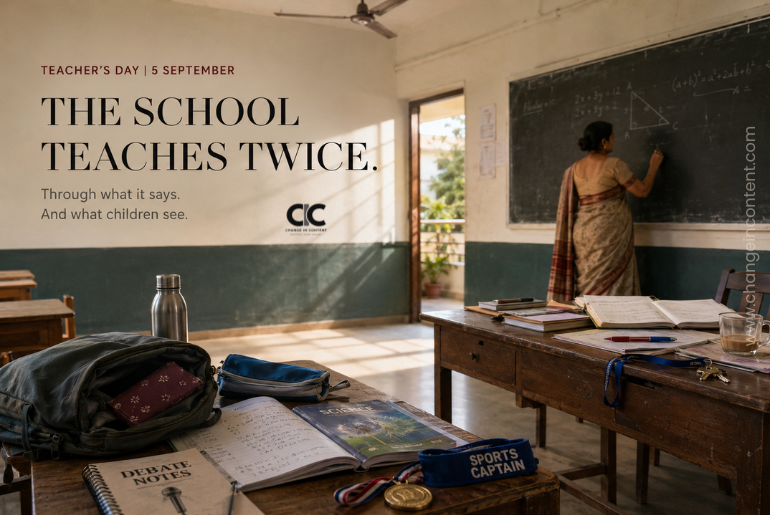
That is why, on this Teacher’s Day, I find myself thinking of school as more than a place where girls receive an education.
A school is also one of the first places where a child learns what a woman looks like when she has authority.
- She can be the person at the front of the class.
- The person signing the report card.
- The principal everyone stands up for.
- The senior student organising the event.
- The girl who tops mathematics.
- The captain.
- The debater.
- The troublesome friend who disagrees with you.
- The teacher who tells you that you are wrong.
Children watch all of this long before anybody introduces them to the phrase “gender equality”. And perhaps that is where empowerment begins.
India has changed the classroom
We should begin by acknowledging how much has changed.
India has largely achieved gender parity across several indicators of school education. NITI Aayog’s recent review notes female-to-male ratios at or above parity across primary and lower-secondary completion, school enrolment and progression to secondary education. UDISE+ 2025–26 data show girls account for 48.4% of total school enrolment.
There has been another quieter transformation. Women now constitute 54.9% of India’s schoolteachers, compared with 52.3% only three academic years earlier.
That figure deserves some thought on Teacher’s Day.
We usually discuss women and education through the girl sitting at the desk. But there is another woman standing beside the blackboard. India’s schools are now among the major workplaces where women are not a marginal presence. They are the majority.
And that gives schools an unusual dual responsibility.
They must create opportunity for the girls they educate. They must also create decent workplaces for the women educating them.
A girl learns from what the timetable never says
A school can have an excellent gender-equality chapter in a textbook and still teach something completely different through everyday behaviour.
- Watch who carries the chairs after an event.
- Who gets asked to decorate the classroom.
- Who operates the projector.
- Who gets sent to fetch something heavy.
- Who is encouraged towards engineering.
- Who is praised for being obedient.
- Who gets forgiven for being loud.
- Who becomes class captain.
- Who is told her skirt is distracting someone.
- Who is expected to clean up.
Children notice these divisions.
- They notice when a male sports coach receives automatic authority while a woman teacher is interrupted.
- They notice whether girls play football on the main ground or around its edges.
- They notice whether leadership positions rotate naturally between boys and girls or whether somebody is quietly thought to be “better suited” to them.
- They notice which careers adults mention to boys and which they mention to girls.
None of this requires a formal lesson. Culture has its own curriculum. That is one reason educational parity on paper, while enormously important, cannot be the final measure of women’s empowerment in schools.
We have already seen the next-stage problem in our analysis of India’s education-to-employment gap for women. Girls are studying, graduating and succeeding academically in large numbers. The transition from educational achievement to economic opportunity remains much less even.
Some of the beliefs that influence that transition begin much earlier.
Sometimes empowerment is a toilet door that locks
This may sound mundane beside subjects such as leadership and curriculum. It isn’t.
A school toilet tells a girl something about how seriously the institution takes her presence.
NITI Aayog’s 2026 review of India’s school education system, drawing on UDISE+ 2024–25 data, found that 98,592 schools still lacked functional girls’ toilets. Nearly 59,829 lacked handwashing facilities, while 14,505 lacked functional drinking-water facilities.
India has improved dramatically on school sanitation over the past decade. That progress deserves recognition.
But a facility listed in a database and a toilet a teenage girl can comfortably use during menstruation are not necessarily the same thing.
- Is there water? Privacy? A working lock? A disposal system? Somewhere to change?
- Does she need to ask a male teacher for permission to leave?
- Will classmates make jokes when she carries a sanitary pad?
- Does the school treat menstruation as ordinary biology or as something girls must conceal?
UNICEF has repeatedly connected separate toilets and menstrual-hygiene facilities with girls’ attendance, dignity and retention in school.
We recently examined this infrastructure gap in our piece on why thousands of Indian schools still lack functional girls’ toilets.
The bigger thought for me is simple. Empowerment is sometimes discussed as though it must always look inspirational. Sometimes it looks like a clean washroom.
The woman teacher deserves to enter the conversation
Teacher’s Day naturally puts teachers at the centre. So we should ask something we do not ask enough: What kind of workplace is a school for the woman working there?
Being numerically well represented does not automatically mean being economically or professionally equal.
Women dominate many parts of education, particularly at earlier stages. UNESCO’s work on India has previously noted how highly feminised private unaided schooling and early-childhood education can be. At the same time, it also points to substantially weaker remuneration in parts of the private sector.
The current school ecosystem itself is extremely varied.
A permanent government teacher with structured pay, pension benefits, and job security occupies a very different labour market from that of a teacher in a low-fee private school.
Then there are contract teachers. Preschool educators. Special educators. Counsellors. Support staff. Hostel wardens. Part-time instructors.
The word “teacher” can mask enormous differences in salary and employment security.
We recently examined the broader question of why female-dominated jobs are often valued less. Teaching illustrates the tension particularly well: society describes the profession as noble, often speaks of women teachers in almost maternal terms. It can simultaneously treat patience and care as qualities women naturally provide rather than professional skills that deserve proper compensation.
The romantic language around teaching should never become permission to underpay teachers. Especially women.
Nor should a woman teacher be expected to mother the entire school
There is another layer that cannot easily be captured in salary data. The invisible jobs.
- Who notices that a child seems upset?
- Who mediates friendship problems?
- Who talks privately to a girl about her first period?
- Who stays behind because a parent is late?
- Who prepares decorations?
- Who remembers birthdays?
- Who accompanies children on trips?
- Who is expected to be approachable because she is a woman?
Care has enormous value inside a school. But when it becomes automatically feminised, a professional role can quietly acquire unpaid emotional responsibilities.
The woman teacher becomes teacher, counsellor, substitute mother, administrator and crisis manager. Sometimes all before lunch. And workload is already a structural issue.
NITI Aayog identified more than 1.04 lakh single-teacher schools serving over 33 lakh students in the UDISE+ 2024–25 data. In those schools, one person may handle multiple grades, records, parent communication, meals, and administrative work.
That number is not female-specific. But in a teaching workforce increasingly made up of women, the quality of teachers’ working conditions is unquestionably part of women’s-work policy.
Girls also need women doing things other than teaching
Here is the counterpoint.
Women teachers are powerful role models. But girls should not leave school thinking teaching is the principal respectable profession available to women. They need to encounter women scientists. Engineers. Police officers. Entrepreneurs. Artists. Electricians. Pilots. Athletes. Technicians. Farmers. CEOs. Researchers. Politicians.
They should encounter them through books, guest sessions, career counselling, curriculum examples and the ordinary language adults use around ambition.
India already has an encouraging foundation. Women represent a substantial share of the country’s STEM students. Our earlier analysis of female STEM enrolment in India explored how strong educational participation still fails to translate proportionately into technical careers.
That conversion problem does not begin at graduation. It begins when a 12-year-old decides which subject she is “good at”. And when the adults around her agree.
Boys belong inside women’s empowerment too
I think we sometimes make a mistake when we talk about empowering girls in schools. We speak almost entirely to girls.
- Confidence workshops for girls.
- Self-defence for girls.
- Menstrual education for girls.
- Leadership programmes for girls.
All of these can be useful. But boys are also growing up inside the same culture. They eventually become colleagues, partners, managers, fathers, teachers and employers.
A school that empowers girls while leaving boys untouched by conversations about respect, equality, consent, domestic responsibility and stereotypes is doing only half the work.
- A boy should grow up seeing a female principal exercise authority without finding it unusual.
- He should learn that the girl who beats him academically has not injured his masculinity.
- He should understand that menstruation is biology, not material for humiliation.
- He should expect women to lead.
- He should see domestic work as a human responsibility rather than a female one.
- He should learn to disagree with a girl without trying to diminish her.
Those are workplace lessons too. They are simply being taught 10 or 15 years before the first appraisal meeting.
A school can give a girl a voice before she needs to fight for one
Academic achievement matters enormously. Voice matters differently.
- Does a girl ask questions in class?
- Does she disagree with a teacher?
- Does she put her name forward?
- Does she speak on stage?
- Does she captain something?
- Does she negotiate?
- Does she learn to say that something made her uncomfortable?
- Does she learn that authority can be questioned respectfully?
Those behaviours eventually travel. Into college, into relationships, into interviews, into salaries, into workplaces, and into boardrooms.
Agency does not appear automatically when someone receives a degree. It is practised.
Schools can create those opportunities deliberately through debating, sports, student councils, theatre, leadership roles, projects, mentoring and the everyday act of allowing girls to take up space.
But there is a nuance here.
We should not demand that every girl become outspoken in the same way. Empowerment cannot become another personality test. A quiet girl can have agency. An introvert can lead.
The goal is not producing one approved version of a “confident woman”. It is giving every student enough safety and possibility to discover her own version.
Colleges have to carry the work forward
The transition from school into higher education often comes with greater freedom. It can also introduce different constraints.
- Hostel curfews that are stricter for women.
- Questions about clothing.
- Safety restrictions that sometimes protect by limiting mobility.
- Gendered student politics.
- Harassment.
- Uneven access to labs late at night.
- Expectations around dating and reputation.
- Placement decisions.
- The familiar argument that certain jobs involve too much travel for women.
A university can educate an adult woman while still policing her like a child. That contradiction deserves scrutiny.
Safety matters. But if every safety solution reduces women’s movement while leaving the unsafe environment intact, the cost of safety is being paid by the person it is supposed to protect.
Educational institutions should increasingly ask:
- Can women use the campus as freely as men?
- Can they access facilities at the same times?
- Are complaint systems trusted?
- Do placement cells challenge gendered assumptions about recruitment?
- Do women researchers receive laboratory access, mentorship, and funding?
- Are student leaders diverse?
- Do young women acquire networks alongside qualifications?
The classroom is only one part of the educational experience.
What would an empowering school actually look like?
I don’t think we need another 20-point checklist. I would look for a handful of ordinary things.
- A girl can use a toilet with dignity.
- She can play on the main field.
- She is encouraged towards mathematics if she loves mathematics.
- Her brother receives the same message about household responsibility.
- A woman teacher is paid fairly for professional work.
- A teacher returning after maternity leave can still see a leadership path.
- The school does not tolerate harassment disguised as teenage humour.
- Career counselling does not quietly divide occupations by gender.
- Girls get opportunities to lead.
- Boys get opportunities to care.
- Female achievements appear in the curriculum without being confined to a special chapter.
- The principal knows what happens to girls after they leave school, not simply how many passed the examination.
None of these requires a school to adopt grand language. Most of it is simply good education.
Change in Perspective: The Teachers I Still Carry With Me
When I think back to school, I don’t remember every chapter. I certainly don’t remember every mark.
But I remember people. I remember the women who corrected me. Encouraged me. Disciplined me. Argued with me. Listened to me. Trusted me.
I remember principals, teachers, wardens, friends, seniors and juniors who, in ways large and small, helped shape my understanding of people and the world.
Some of the lessons were taught at a blackboard. Many weren’t.
And perhaps that is why women’s empowerment in schools means more to me than getting girls through the gate.
A genuinely empowering school allows a girl to imagine a larger life. It allows a woman teacher to have one too. It teaches boys that women’s authority is ordinary. And it provides dignity in places as basic as a washroom and possibility in places as ambitious as a science laboratory.
Eventually, those children leave. They build families. Companies. Institutions. Workplaces.
Society gets back much of what school taught them, including the lessons nobody thought they were learning.
To every teacher who helped shape my own life, and particularly to the women whose influence I understand better as I grow older: Happy Teacher’s Day.
And thank you.
Editorial Note & Sources
This Teacher’s Day commentary combines the author’s personal reflections with publicly available education data. Statistics on school enrolment, teachers and infrastructure use official UDISE+, NITI Aayog and Government of India sources. Discussion of teacher working conditions recognises that salaries, contracts and employment protections vary significantly between government, aided, private, preschool and other education settings. Personal observations are presented as commentary rather than representative evidence of every Indian school.
Primary and institutional sources
- Ministry of Education / UDISE+ 2025–26: Latest data on girls’ enrolment and female representation in India’s school teaching workforce. Women accounted for 54.9% of teachers in 2025–26.
- NITI Aayog — School Education System in India: Temporal Analysis and Policy Roadmap for Quality Enhancement, 2026: Used for gender parity, toilets, infrastructure, single-teacher schools and broader quality context.
- Ministry of Education — UDISE+ 2024–25: Detailed official school-level data underlying infrastructure and teacher indicators.
- UNICEF India — Clean India, Clean Schools: Background on sanitation, menstrual hygiene and why functional facilities affect girls’ participation and dignity.
- UNESCO — State of the Education Report for India: No Teacher, No Class: Used for longer-term context on the feminisation of teaching, distribution of women teachers and conditions in the private unaided sector.
- World Bank Gender Data / UNESCO Institute for Statistics: Recent international data show that women account for 58.6% of India’s primary teachers and 49.3% of secondary teachers in the relevant UNESCO series.
