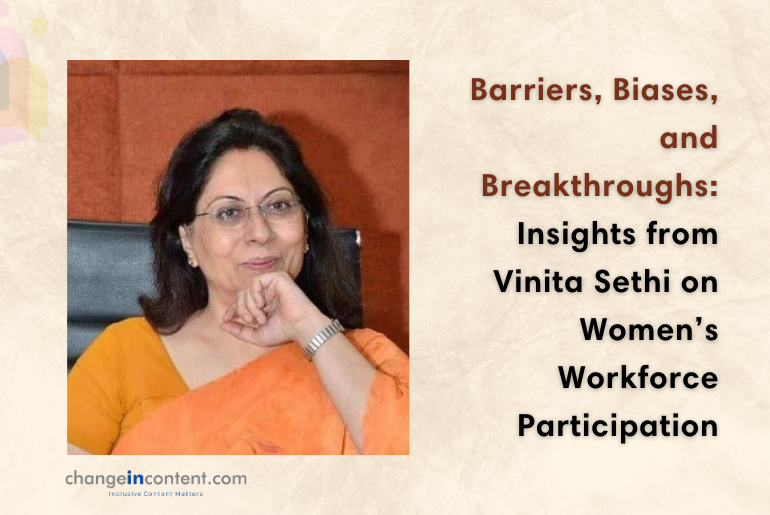
In a world that often grapples with structural inequities, Vinita Sethi, a celebrated public policy and development economist, offers a wealth of experience and clarity on a topic that demands urgent attention: women’s participation in the workforce.
With over 25 years of policy advocacy experience, Sethi has consistently challenged norms and provided actionable insights. In this exclusive conversation with Changeincontent, she discusses the barriers women face, the role of policymakers, and the systemic changes required to bridge gaps in gender equity.
About Vinita Sethi: The Changemaker
Vinita Sethi’s distinguished career spans decades of impactful work in public policy and development. Currently, she is the Chief Public Affairs Officer at Apollo Hospitals Group. She holds several influential roles, including being an independent director certified by the Indian Institute of Corporate Affairs (IICA).
She has served as the Immediate Past President of the Public Affairs Forum of India (PAFI) and held board positions at FIND India and Vidhignya Enterprises. Her tenure at Bharti Enterprises saw her actively shaping telecom policy, and her writings have enriched platforms like UN ESCAP, WEF, and Niti Aayog.
With a master’s degree in economics from the Delhi School of Economics and international relations from IUJ-Japan, Sethi’s academic foundation reflects her commitment to intellectual rigour and global perspectives.
Vinita Sethi on barriers to women’s workforce participation
Despite progress, women remain significantly underrepresented in India’s workforce. Vinita Sethi highlights this glaring disparity:
“For every step women take forward, inertia—or worse, a step back—sets in. Some of these age-old obstructions have calcified, creating huge barriers to entry and contributing to broken rungs in career ladders.“
The numbers tell the story. Women constitute nearly 50% of the population but only 20-30% of the workforce. This imbalance exists across industries and roles. Vinita challenges us to reflect:
“How many times have you entered a workplace and seen more men than women? Be it a hospital, bank, school, factory, or IT company—the picture remains the same. Women are underrepresented despite some improvements.“
Vinita also points to the unacknowledged contributions of women in rural areas:
“Women have always worked in farms, construction, and at home. Yet, this labour often goes unaccounted for in formal statistics.“
The barriers are multifaceted. They include caregiving responsibilities, limited mobility, and a mismatch between skills and job demands. Vinita adds:
“Issues like gender parity force many women to stay home instead of working for low wages. Organisations must normalise equitable benefits like flexible work arrangements and robust maternity support.“
Policy and structural change
Policy frameworks play a pivotal role in addressing structural barriers. Vinita emphasises the importance of creating supportive ecosystems:
“Policy must address women’s day-to-day experiences. Are public spaces safe? Can women relocate for jobs? Is there caregiving support for women solely in charge of families?“
She applauds the Companies Act of 2013, which mandated women directors on boards, but insists on further reforms:
“Incentivising organisations to enhance women’s workforce participation is critical. Interim policy changes can create momentum until we see real transformation.“
Vinita also highlights technology’s potential:
“Tech can level the playing field. It can create access, accelerate capabilities, and allow companies to diversify their talent pools.“
Vinita Sethi’s perspective on unconscious bias and social norms
Unconscious biases often act as invisible barriers for women. Vinita explains:
“Women remain underrepresented despite their education, ethnicity, or race. The ‘broken rung’—the delay in getting that first promotion—cannot be explained by ability but by societal norms and biases.“
She underscores the need for organisations to review hiring practices:
“Roles with profit-and-loss responsibilities often go to men because they can ‘devote more hours’ or ‘network after work.’ These biases limit women’s leadership opportunities and hinder parity goals.“
To tackle these issues, Vinita suggests:
“Debias hiring practices and performance reviews with regular training. Provide flexibility and critical support for all employees—parents, caregivers, or those managing health challenges.“
Balancing careers and caregiving roles
Vinita calls for a shift in societal attitudes toward women’s dual roles as professionals and caregivers:
“Women must stop apologising for their work. Organisations must empower employees to act as agents of change. Mentorship and allyship programs are crucial, and all genders must participate.“
She warns of the toll microaggressions take:
“Microaggressions lead to burnout and push women to quit. Ageism, too, unfairly limits their growth. These issues require systemic changes in attitudes and behaviours.“
Vinita urges companies to make DEI a strategic priority:
“Track promotions and exits with transparency. Invest in women’s skills and create caregiving benefits. Foster allyship within teams.“
Vinita Sethi on the power of data in driving change
Data can shine a light on inequities and guide interventions. Vinita stresses:
“Data provides organisations with timely insights into progress or regression. Transparency in monitoring diversity metrics can illuminate the real picture, identify distress points, and drive evidence-based interventions.“
Intersectionality: Recognising multiple realities
Intersectionality adds another layer to the challenges women face. Vinita explains:
“A woman’s race, class, caste, or education can grant her privileges—or disadvantages. Intersectionalities must be addressed so role models don’t feel out of reach.”
She advocates for highlighting diverse success stories:
“We must ensure that role models don’t remain moonshots. Women from less privileged backgrounds should also find representation in narratives of success. Their journeys hold lessons for all of us.“
Her call to action is clear: organisations must listen to and learn from the lived experiences of women across diverse socio-economic contexts, using these insights to craft inclusive strategies.
Conclusion: A perspective from Changeincontent.com
Vinita Sethi’s insights challenge us to rethink our approaches to workforce inclusion. Her call for systemic change, equitable policies, and conscious allyship resonates deeply with the ethos of Changeincontent. As we amplify voices like hers, we remain committed to establishing dialogues that drive real, measurable change. The journey toward equity is complex, but with leaders like Sethi paving the way, the path becomes clearer.
Disclaimer: The views expressed in this article are based on the writer’s insights, supported by data and resources available both online and offline, as applicable. Changeincontent.com is committed to promoting inclusivity across all forms of content. We broadly define inclusivity as media, policies, law, and history—encompassing all elements that influence the lives of women and gender-queer individuals. Our goal is to promote understanding and advocate for comprehensive inclusivity.