
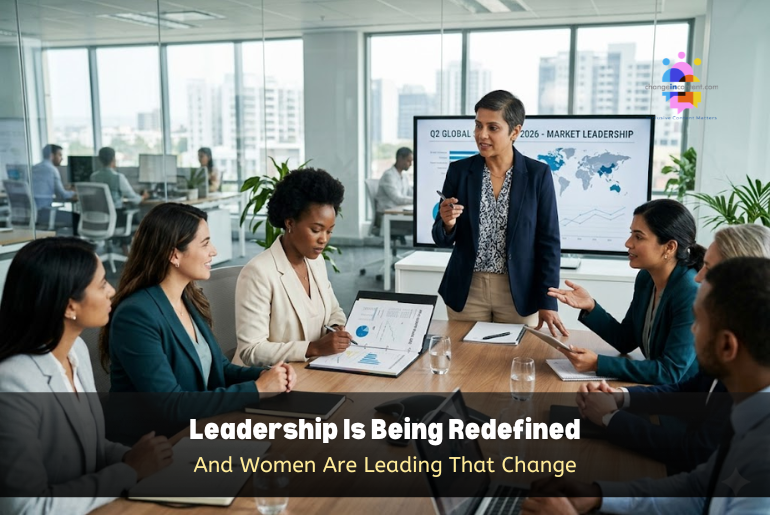
Workplace experience and leadership are no longer separate conversations. In 2026, they are deeply intertwined. Women’s lived experiences at work are quietly redefining what effective leadership actually looks like. Across industries and geographies, the data is clear. Women are not opting out of leadership. They are questioning the cost of it, reshaping its meaning, and exposing the gaps that organisations have ignored for years.
This article is for business leaders, HR professionals, founders, and decision-makers who want to understand what this shift means. It breaks down the data and the patterns behind women’s workplace experiences. It also shares the practical implications for leadership in modern organisations. Titles will not define the future of leadership; experience will.
Workplace experience and leadership: The data behind the shift
The conversation begins with numbers, but it does not end there.
According to the McKinsey & LeanIn “Women in the Workplace 2025” report, the leadership pipeline is still uneven at the very first step.
- For every 100 men promoted to manager, only 93 women get a promotion.
- For women of colour, the number drops further to 74 for every 100 men.
It is not a small gap. It is a structural issue that compounds over time. Fewer women at the first leadership level means fewer women in senior roles, fewer in decision-making positions, and fewer shaping organisational strategy.
At the same time, burnout data reveals another layer.
Nearly 60% of senior women leaders report frequent burnout. That rises to 70% among those new to leadership roles.
These numbers tell a clear story. Women are entering leadership. They are performing. But the system they are operating within is costing them more than it should.
The invisible layer: What workplace experience reveals about leadership
Data captures outcomes. Workplace experience reveals causes. Across organisations, women often navigate a constant layer of invisible decision-making:
- Should I speak up or stay agreeable?
- Will pushing back affect how I am perceived?
- Can I prioritise my personal life without slowing my career?
These are not occasional thoughts. They are daily calculations.
That is where workplace experience and leadership intersect most powerfully. Because leadership is not just about decisions made at the top, it is also about the environment in which those decisions are made.
When high-performing individuals expend energy navigating perception rather than focusing on impact, leadership itself becomes inefficient.
Workplace experience and leadership failures are not about talent
It is easy to label this as a pipeline problem. It is not.
Organisations today have access to highly skilled, qualified women across industries. The issue is not availability. It is an advancement.
Familiarity, proximity, and comfort influence promotions. Leaders often mentor people whose journeys resemble their own. That creates patterns, not progress.
The organisations that are moving ahead have understood one simple truth: Clarity beats assumption.
- They explicitly define what the next level requires.
- They communicate expectations openly.
- They remove the need for employees to “decode” success.
It is not a diversity initiative. It is a leadership discipline.
Burnout and workplace experience: A leadership design problem
One of the most misunderstood aspects of leadership today is burnout. People often frame burnout among women as a matter of resilience. It is not. It is a design issue.
When you build leadership expectations on constant availability, undefined boundaries, and unspoken rules, burnout becomes inevitable. Women experience this more acutely because they are often balancing professional expectations with disproportionate personal responsibilities.
That is where workplace experience and leadership must evolve together. Leaders must ask:
- Are we rewarding output or presence?
- Are we measuring performance or visibility?
- Are we building sustainable careers or short-term productivity?
The answers to these questions define whether leadership is inclusive or exclusionary.
How workplace experience and leadership are already being redefined
While organisations debate policies, many women leaders are already redefining leadership from within.
Some are choosing to step back from traditional leadership tracks to prioritise personal priorities. Others are staying in leadership roles and actively creating opportunities for others.
Both decisions are strategic. Both are forms of leadership.
This shift is important because it expands the definition of success.
Leadership is no longer a single path. It is becoming contextual, flexible, and aligned with individual values. This aligns closely with our earlier work on the evolution of leadership models.
What organisations must learn from workplace experience and leadership trends
The implications for organisations are clear and actionable.
- Make growth pathways visible: Do not assume employees understand what it takes to move forward. Spell it out. Regularly.
- Replace vague feedback with specific guidance: “Good work” is not useful. Clear direction is.
- Track consistency between intent and action: Employees notice gaps between what leaders say and what they do. Trust is built in these moments.
- Design for sustainability, not sacrifice: If leadership requires burnout, it is not leadership. It is a system failure.
- Build leadership cultures, not individual leaders: The strongest organisations do not rely on exceptional individuals. They create environments where more people can lead effectively.
Workplace experience and leadership: The role of HR and founders
HR teams and founders are central to this transformation. They must move beyond policy creation and focus on experience design. At the same time, founders must recognise that culture is not what is written. It is what is experienced daily.
It includes:
- Transparent communication
- Fair evaluation systems
- Accessible mentorship
- Real accountability
Leadership is no longer about authority. It is about alignment.
The Changeincontent perspective
At Changeincontent, we see this shift as one of the most important leadership conversations of our time.
Women’s workplace experiences are not complaints. They are insights. These insights reveal where systems are unclear, where expectations are unrealistic, and where leadership has not evolved with the workforce.
Organisations that listen to these insights will build stronger, more resilient cultures. Those who ignore them will continue to lose talent, not because people lack ambition, but because the cost of staying becomes too high.
The future of leadership will not be defined by who reaches the top. It will be defined by how many people can thrive along the way.
Conclusion: Workplace experience and leadership will define the next decade
Workplace experience and leadership are no longer parallel conversations. They are the same conversation. The organisations that succeed in 2026 and beyond will not be the ones with the most talent. They will be the ones who understand how talent experiences work.
Women have already started redefining leadership. They are questioning it, reshaping it, and in many cases, improving it.
The real question is whether organisations are ready to learn from that shift. Because leadership is no longer about control, it is about creating environments where people can lead, without losing themselves in the process.
Disclaimer: The views expressed in this article are based on the writer’s insights, supported by data and resources available both online and offline, as applicable. Changeincontent.com is committed to promoting inclusivity across all forms of content. We broadly define inclusivity in terms of media, policies, law, and history. It encompasses all elements that influence the lives of women and marginalised individuals. Our goal is to promote understanding and advocate for comprehensive inclusivity.
