
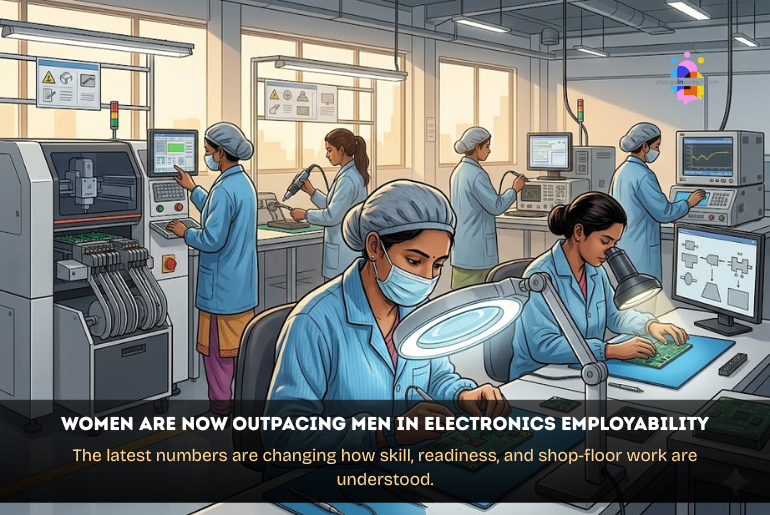
For years, conversations about industrial jobs in India have treated women as underrepresented entrants into manufacturing. The latest data from the electronics sector strikingly complicates that story. Women in the electronics industry are now showing slightly higher employability than men for entry-level shop-floor roles. According to staffing firm TeamLease, 54% of women entering the workforce meet the skill requirements for shop-floor roles, compared to 51.5% of men.
These numbers suggest that readiness, training outcomes, and workforce behaviour are not aligning with old assumptions about who is better suited to factory work. That makes this news worth paying attention to. It is not just a hiring statistic. It is a signal about where women are already outperforming expectations and where the next challenge lies.
If women are entering electronics manufacturing with stronger employability metrics, then the real question shifts from entry to continuity: can the sector build the safety, housing, transport, and care support needed to convert early momentum into long-term careers?
Women in the electronics industry are now outpacing men in employability.
Data from TeamLease shows women’s employability at 54%, ahead of men at 51.5%, with higher enrolment in factory training and better pass rates in apprenticeship programmes.
Government data on the National Apprenticeship Promotion Scheme also supports the trend. Women’s entry-level apprentices rose 14% in FY26 to 42,237 from 37,058 a year earlier. Conversely, the number of male apprentices was nearly flat, slipping from 100,645 to 100,274.
Southern states account for the highest share of women on the shop floor, especially in large electronics units run by companies such as Foxconn and Tata Electronics, where women make up over 80% of the workforce. Employers in these clusters have implemented campus-style facilities that provide accommodation, food, and transport, making it easier for young women to take up factory jobs.
In North India, where such arrangements remain limited, women’s participation stays much lower, often between 25% and 30%. Still, the participation rates are progressing.
Why women in the electronics industry are being seen as a stronger shop-floor fit
Employers in electronics manufacturing are now preferring women for shop-floor roles due to the nature of the work. Assembly lines require precision, repetitive motion, and strict adherence to process guidelines, areas where many companies report better performance from women workers. Tasks such as component fitting, quality checks, and packaging depend on consistency, and hiring managers say women meet these requirements more reliably.
Workforce behaviour also plays a role in hiring decisions. Companies report lower absenteeism and attrition among women employees, along with more stable attendance patterns. Many employers point out that male workers tend to switch jobs for small wage increases, while women are more likely to stay when workplaces offer safe conditions, steady schedules, and basic facilities. This has made retention easier in units with a higher share of women.
In smartphone assembly lines, these factors have pushed female participation close to 90% in some facilities. The preference does not stem from a single reason but from how productivity, retention, and day-to-day operations align more closely with employers’ needs on the shop floor.
But safety and care work still push women out.
Higher hiring numbers do not solve the problem of what happens after women enter the workforce. The retention problem remains serious.
An Ashoka University report has estimated that about 73% of Indian women leave work after childbirth. Among those who return, nearly half drop out again within four months. That leads to a steady loss of trained workers, even as companies continue to hire and train new ones.
Concerns about safety and accommodation continue to affect who can take on these jobs. Many families remain hesitant to send daughters to factory roles when housing and transport are not guaranteed. Women workers also avoid night shifts in the absence of clear safety measures.
While the law has moved ahead through the Occupational Safety, Health and Working Conditions Code, 2020, which allows women to work between 7 PM and 6 AM across sectors, the conditions on the ground have not kept pace in many regions.
Public spending has begun to address some of these gaps, including a ₹10,000 crore plan to build hostels for working women across districts, funded through viability gap funding. But access to jobs does not depend solely on policy. Without reliable housing, transport, and workplace safeguards, the option to work late or relocate for a job remains limited.
The Changeincontent perspective
The most interesting part of this story is that it challenges a lazy assumption still common in conversations about factory work: Men are naturally the stronger default workforce for industrial roles.
The latest electronics data suggests something else. When training, apprenticeship participation, and day-to-day operational fit are measured more closely, women are not only present; they are often better aligned with what employers say they need.
But that is where the conversation has to stay honest. Higher employability is not the same as long-term equality. A sector can praise women’s precision, retention, and consistency while still losing them to childbirth penalties, unsafe transport, weak housing, and the absence of childcare.
That means the next phase of progress cannot stop at recruitment. It has to become an infrastructure story. The sector now has evidence that women are ready. The burden shifts to whether workplaces and policy are ready for women to stay.
Conclusion: Higher employability will matter fully only if women can build long careers
India’s electronics sector is bringing more women into the workforce than before, and the numbers show clear progress in hiring, training, and participation. At the same time, the next phase depends on how well this momentum is supported. Better childcare options, safe housing, and reliable transport can help more women stay and grow within these roles.
The focus now is on making sure more women can build long-term careers once they enter the workforce.
Disclaimer: The views expressed in this article are based on the writer’s insights, supported by data and resources available both online and offline, as applicable. Changeincontent.com is committed to promoting inclusivity across all forms of content. We broadly define inclusivity in terms of media, policies, law, and history. It encompasses all elements that influence the lives of women and marginalised individuals. Our goal is to promote understanding and advocate for comprehensive inclusivity.
