
The Short Read
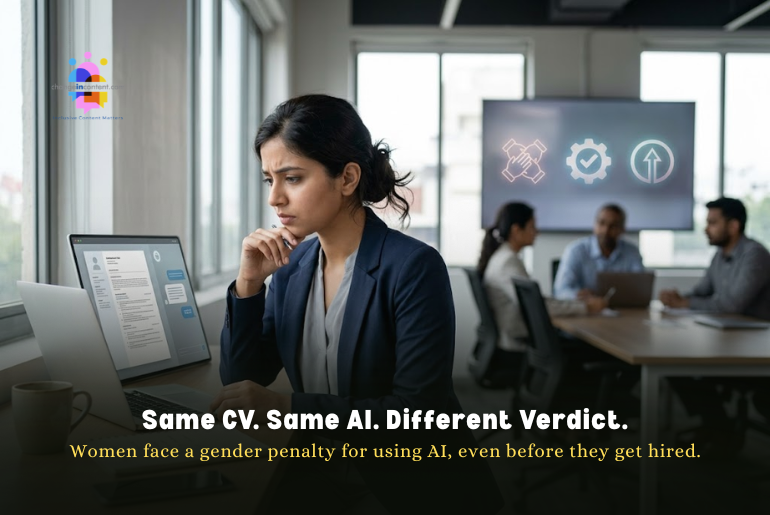
- A study by Zehra Chatoo found that women face a clear gender penalty for using AI, even when their work is identical to men’s.
- In the study, two AI-assisted CVs had the same content, but one listed Emily Clarke as the name and the other James Clarke.
- Reviewers were more likely to question Emily’s trustworthiness and twice as likely to doubt her competence.
- The findings reveal how old gender bias is entering new technology spaces, where people see men’s AI use as efficient, while they treat women’s AI use with suspicion.
The gender penalty for using AI
The gender penalty for using AI is no longer a vague fear. It is showing up in how women face harsh judgments even before they enter the workplace.
People now use Artificial intelligence to write emails, prepare reports, organise tasks, improve presentations, and polish CVs. However, the share of women adopting AI tools is 10% to 40% smaller than the share of men. Yet when women use the same tools as men, they can still be seen as less capable, less trustworthy, or less deserving of credit.
That is what makes new research by Zehra Chatoo, former Meta strategist and founder of Code For Good Now, so important.
The Zehra Chatoo study that reveals the concerning reality
In this study by Zehra Chatoo, 1,000 British adults reviewed 2 identical AI-assisted CVs. One belonged to Emily Clarke, and the other belonged to James Clarke. The work was the same, and the tool was the same. The only meaningful difference was the gender signalled by the name.
When the results were out, they were uncomfortable but not surprising.
Emily’s use of AI was more likely to raise questions about trust and competence, while people were more likely to consider James’s use of AI as practical assistance. The numbers are alarming. Reviewers were 22% more likely to question Emily’s trustworthiness than James’s. Emily’s use of AI was also twice as likely to raise doubts about her competence and ability to perform the job. [Fortune]
The gender penalty for using AI starts before women even get hired
For women who already face higher scrutiny at work, this finding tells a much larger story. The issue is not only whether women are adopting AI. It is whether they are being allowed to use new technology without paying a social and professional price for it.
The feedback highlighted the double standard. Some reviewers commented on Emily’s résumé by saying, “She can’t even write a CV herself—not sure she has the skills to carry out the job.“ In contrast, James’s use of AI was often viewed more sympathetically, with responses such as, “He just needed a bit of help putting it together.”
Reflecting on the findings, Chatoo noted, “When men use AI, we question their effort. When women use AI, we question their integrity. That difference changes the perceived risk of using AI.“ The study suggests that concerns about unfair judgment may be one of the factors contributing to lower AI adoption rates among women.
Why Gen Z men’s reactions make the AI bias even more concerning
The study also shows that the bias against women using AI was not limited to older generations. In fact, some of the strongest negative reactions came from Gen Z men, a group that has grown up with AI and digital technologies.
When evaluating the identical AI-assisted résumés, Gen Z men were 3.5 times more likely to describe Emily’s application as “weak” than James’s. While James’s résumé received a 97% approval rating, only 76% of respondents considered Emily’s résumé to be strong, despite both candidates submitting the same content.
AI familiarity does not automatically remove gender bias
The findings suggest that familiarity with AI does not automatically lead to more equal attitudes about its use. Instead, perceptions about who is using the technology appear to shape how we judge that use.
Why this could widen the AI adoption gap
According to Chatoo, these perceptions can have negative consequences. If a man uses AI to improve a CV, it may be read as smart, practical, or efficient. If a woman does the same, it may be read as a lack of ability. That difference changes how safe the tool feels.
AI is quickly becoming part of career growth. Employees who use AI effectively may move faster, produce more, learn more quickly, and compete more effectively. But if women are more likely to be judged for using AI, the technology could widen existing workplace gaps rather than reduce them.
Chatoo adds that if women expect to face criticism or judgment for being less capable of using AI, they may avoid adopting the technology altogether.
The ChatGPT analysis adds to the concerns.
An analysis of ChatGPT users found that between November 2022 and May 2024, women accounted for only 42% of the platform’s average monthly website users, totalling 200 million. The difference was even more pronounced on mobile devices, where women represented just 27% of total ChatGPT app downloads.
As AI becomes increasingly integrated into education and work, unequal perceptions of who can use these tools without judgment could influence who feels comfortable adopting them.
The problem is not women’s reluctance. The problem is the unequal cost of adoption. Women are being asked to embrace AI while also managing the possibility that their competence will be questioned for doing so.
The Changeincontent perspective on the gender penalty for using AI
The conversation around women and AI often starts with the wrong question. It asks why women are not using AI as much as men. It asks whether women lack confidence, curiosity, or technical comfort. But Chatoo’s research forces us to ask something far more honest: what happens to women when they do use it?
That is where the real story begins.
Women already face enough judgments for asking for help. They face judgments for being ambitious. People also judge them for being too polished, too direct, too careful, too emotional, too assertive, or not assertive enough. AI has now entered the same old courtroom of gendered judgement.
The double standard is familiar. A man using AI is resourceful, while a woman using AI is suspected of not being good enough. A man gets credit for efficiency, while a woman gets interrogated for integrity.
That is not only unfair, but dangerous for the future of work. If AI becomes a career accelerator but women are socially penalised for using it, then the next workplace gap may not stem from a lack of access. It may come from fear, judgement, and unequal permission.
The solution cannot be limited to telling women to “lean into AI”. Workplaces, hiring teams, managers, and educators must examine how they judge AI-assisted work. Clear disclosure norms, fair evaluation criteria, gender-sensitive hiring practices, and AI literacy programmes can help. But the bigger change has to be cultural.
Women should not have to prove that using a tool does not make them less talented. The future of work cannot be fair if the same behaviour is called innovation for men and incompetence for women.
Editorial Note and Disclaimer
This article is part of Changeincontent’s Mosaic section, where we examine social behaviours, cultural signals, workplace patterns, and everyday examples of inequality that often go unnoticed. The article discusses publicly reported research by Zehra Chatoo and Code For Good Now on how identical AI-assisted CVs were judged differently when assigned male and female names.
This article is based on secondary reporting of Zehra Chatoo’s research, including Fortune’s coverage of the study and Chatoo’s public explanation of the findings. The article also draws on broader research on the gender gap in AI adoption to explain why unequal judgement about AI use may affect women’s confidence, workplace behaviour, and career opportunities. Changeincontent has framed the findings through a gender and workplace inclusion lens, while avoiding unsupported claims beyond the reported data.
Sources
Fortune report on Zehra Chatoo’s AI-assisted CV study.
Zehra Chatoo’s public LinkedIn post describing the research and the “AI Judgment Penalty”.
Harvard Business School Working Knowledge on women’s lower AI adoption rates.
The Media Leader article by Zehra Chatoo on the AI judgment penalty.
Lean In research on women and AI adoption at work.
