The Quick Read
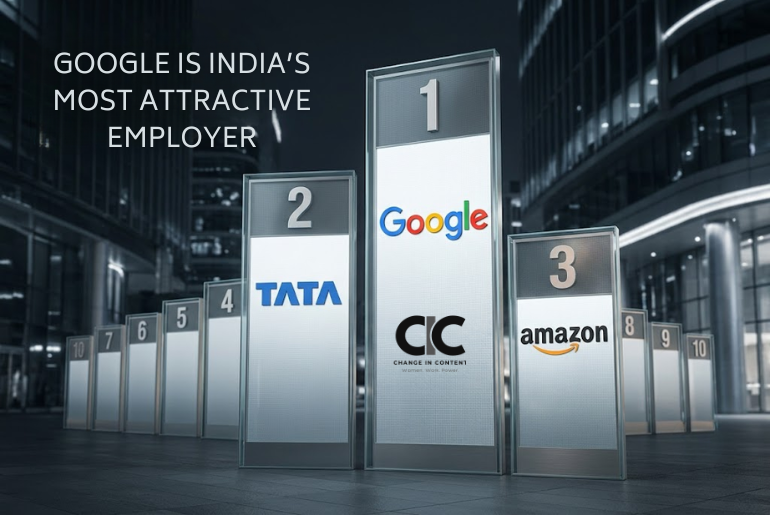
- Google ranks first among India’s most attractive employer brands in REBR 2026, followed by Tata Group and Amazon.
- Samsung India and Infosys complete the top five.
- Work-life balance emerged as the leading reason employees would consider leaving an organisation, cited by 49% of respondents.
- Lack of career progression followed at 42%, while 41% pointed to inadequate compensation.
- Women were somewhat more likely than men to connect work-life balance with flexible working.
- The findings suggest that employer attractiveness is moving towards a broader mix of pay, growth, inclusion, wellbeing and sustainable working conditions.
India’s most attractive employer brands: Google tops the list
Google has become India’s most attractive employer brand for 2026.
The technology company has moved ahead of Tata Group, last year’s leader, while Amazon takes third place in the latest Randstad Employer Brand Research. Together, the top 10 offer an interesting snapshot of what Indian workers currently associate with a desirable place to work.
The REBR 2026 ranking of India’s most attractive employer brands arrives at a time when organisations are competing not merely for skilled people, but for their willingness to stay.
Randstad describes its Employer Brand Research as one of the world’s largest independent studies of employer attractiveness. Its 2026 research draws on more than 166,000 respondents and perceptions of more than 6,400 companies across 34 markets. The India awards were announced on 5 August.
For employers, the ranking provides the headline. The more useful information sits underneath it.
Indian workers appear to be asking a tougher question of companies: What will working here actually feel like once the brand name disappears from the offer letter?
India’s top 10 employer brands in REBR 2026
The 2026 ranking places these companies at the top:
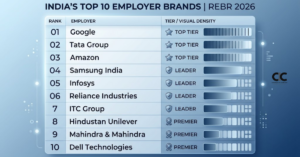 The movement at the top is notable. Tata Group led the 2025 ranking, with Google India second and Infosys third. Samsung India was fourth. This year Google moves into first place, Tata slips to second, and Amazon returns strongly to the top 3.
Several companies remain familiar fixtures. Samsung, Infosys, Reliance and Dell all featured in last year’s top 10 as well. Yet rankings inevitably move. Employer attractiveness is not an award that can be won permanently.
It is perception, and perception responds quickly to what employees see happening inside organisations and across the wider labour market.
Randstad’s 2025 research already showed that Indian workers were placing greater value on work-life balance, equitable treatment and proof that an employer’s stated employee value proposition matched the actual experience.
REBR 2026 takes that movement further.
Why did Google move to No. 1 in India’s most attractive employer brands in 2026?
The report should not be read as a scorecard proving that the first-ranked company has the objectively best workplace in India. REBR measures employer attractiveness. That distinction matters.
Respondents evaluate what they know or believe about major employers. Reputation, career possibilities, salary, innovation, working environment and public perception can all influence that judgement.
Google carries several advantages in this contest.
It operates in a sector strongly associated with innovation and future-facing skills. Its employer brand has been built over many years around high-quality talent, technology, learning and workplace culture. In a labour market increasingly concerned with AI and long-term employability, that association has obvious value.
Google also represents something increasingly important to ambitious professionals: the possibility of building skills that will remain valuable elsewhere.
Employer attraction in 2026 is becoming closely connected with employability. People are not only asking, “Will this company hire me?” They are asking, “What will I become if I work there?”
That difference should interest every organisation outside the top 10.
Work-life balance is becoming a resignation issue
The strongest REBR 2026 finding may have little to do with the ranking itself.
Nearly 49% of Indian respondents identified work-life balance as a reason they would leave an employer.
Limited career progression followed at 42%. Low compensation was cited by 41%.
Salary remains important. It simply shares the stage with several other parts of working life. That is a substantial change in the employer-employee relationship.
For years, organisations often treated balance as an employee benefit. It sat beside wellness programmes, engagement activities and flexible-working policies. Employees increasingly appear to treat it as part of the job itself.
- A high salary can become less attractive when the role regularly consumes evenings, family time, sleep and health.
- A prestigious brand may struggle to retain someone who cannot see a path forward.
- A flexible policy may carry little value when employees who use it become less visible to managers.
The employer brand is therefore being tested against the everyday experience. It is particularly relevant for women.
Women are telling employers something about flexibility
According to the India findings, women were slightly more likely than men to identify flexible working as an important contributor to work-life balance: 37% compared with 33%.
The difference is not enormous. Its context is important.
Women continue to carry a disproportionate share of unpaid care work in India. A working woman may be managing childcare, eldercare, household responsibilities and professional expectations within the same day. Flexibility can therefore affect whether she can continue in a role at all. Yet flexible work has its own inclusion risks.
A woman working from home more frequently can become less visible. She may miss informal conversations, spontaneous opportunities or the everyday relationship-building that influences promotion.
Change in Content has explored this tension in its analysis of the work-from-home gender gap. Flexibility can expand women’s access to employment while reproducing inequality if proximity remains a hidden measure of commitment.
For employers appearing on attractive-brand rankings, flexibility must therefore be judged by more than whether a policy exists.
The stronger question is whether employees can use it without paying a career penalty.
Career growth has become part of the employer brand
REBR 2026 also points towards career progression as a major employee priority.
The report found that lack of growth opportunities could prompt substantial numbers of workers to leave, particularly younger employees. That is where employer branding becomes less about recruitment marketing and more about organisational design.
A company can promise careers on a recruitment page. Employees eventually discover whether those careers are available.
They notice:
- Who receives stretch assignments
- Whose manager advocates for them
- How vacancies are filled
- Whether promotions feel transparent
- Who receives training
- Whether careers slow after maternity or caregiving
- Which employees are considered leadership material
These experiences travel. Employees discuss them publicly. Former employees discuss them even more freely.
A strong employer brand can no longer be separated from internal mobility. The issue becomes sharper for women because career pipelines often narrow as seniority increases.
Our analysis of the KPMG 2026 report on women’s leadership in corporate India found strong leadership ambition among women but weaker conversion into senior positions. Nearly 30% of organisations reported no increase, or a decline, in women leaders over the previous five years.
An attractive employer therefore needs to offer more than entry. It must offer movement.
What does an attractive employer look like in 2026?
Randstad’s global 2026 research shows that a pleasant working atmosphere remains one of the strongest elements of an ideal employer. Career progression has also entered the global top five employer drivers.
The India findings add greater detail.
Employees value career development opportunities highly. Workplace comfort, flexible working, health and wellbeing, and retirement and financial security also rank strongly. For work-life balance specifically, a positive working environment emerges as particularly important. That gives employers a useful reality check.
The workplace people want is not necessarily the workplace with the largest list of benefits. It may be the workplace where several things work reasonably well at the same time.
- People are paid competitively.
- Managers behave well.
- Careers move.
- Health is not sacrificed.
- Flexibility can actually be used.
- Good work receives recognition.
- Communication is credible.
- Employees understand where the business is going.
Randstad refers to this wider model as the “balanced employer”. The description feels appropriate.
Talent appears increasingly unwilling to trade one major weakness for one exceptional strength.
Recognition and transparency now shape job security too
An interesting part of the research concerns what workers interpret as security.
Reliable pay and benefits remain important. Employees also connect job security with performance recognition, career continuity and transparent communication. That is telling.
People may technically have a permanent job while feeling deeply insecure within it.
- A manager who provides no feedback creates uncertainty.
- A company that restructures without communicating creates uncertainty.
- A capable employee who cannot see a future role creates uncertainty.
Recognition therefore carries more value than an award or appreciation post. It helps employees understand whether their contribution has a future inside the organisation.
Transparent communication performs a similar function. During periods of automation, restructuring and rapid technological change, employees need information that allows them to interpret what is happening around them.
The employer brand can suffer when uncertainty is allowed to fill the gaps.
Inclusive workplaces have an employer-brand advantage
Change in Content views this ranking through another lens.
Employer attractiveness cannot be considered independently of inclusion. A workplace may be extremely attractive to one kind of employee and difficult for another.
Women may experience an employer differently depending on caregiving responsibilities, age, disability, marital status, location, seniority or whether they belong to a minority group within the team.
The strongest employers will examine these differences rather than relying exclusively on an overall score.
An inclusive workplace shows itself through practical questions:
- Can women take flexible work without losing visibility?
- Can mothers return from leave without rebuilding their careers from zero?
- Can childfree employees access flexibility without having to justify why they need it?
- Do women receive important operational assignments?
- Can older employees remain part of growth conversations?
- Are promotions understandable?
- Does psychological safety extend beyond employee surveys?
Our recent guide to inclusive work culture examples looked at precisely this gap between visible company culture and everyday behaviour. Inclusive culture becomes believable in meetings, feedback, workload, advancement and access to information. These experiences eventually become employer reputation.
The ranking is useful. It is not a workplace audit.
Any employer ranking needs appropriate context. Randstad’s research measures perception among the wider talent market. Respondents do not necessarily work for every company they evaluate.
An attractive employer brand can therefore reflect:
- Corporate reputation
- Public familiarity
- Perceived career opportunities
- Salary expectations
- Industry attractiveness
- Product reputation
- Media visibility
- Knowledge of workplace practices
That is precisely why the ranking matters for recruitment. It is also why it cannot establish that every employee inside a highly ranked organisation experiences a great workplace.
Employer perception and employee reality overlap, but they are not identical. Organisations should resist using a ranking as a substitute for listening to their own workforce.
Employee retention, promotion outcomes, pay equity, engagement, grievances, attrition and internal mobility can provide the second half of the picture.
What other employers can learn from REBR 2026
Most companies will never appear in the Randstad top 10. They can still compete for talent.
A smaller company cannot match the global recognition of Google or the institutional reputation of Tata. It can offer something equally valuable to an employee: a good working life.
That may involve faster learning, meaningful responsibility, accessible leadership, flexibility, transparent promotions or greater autonomy.
The REBR findings offer several useful priorities.
Make work-life balance operational
Avoid treating balance as a cultural slogan. Examine staffing, meeting hours, manager behaviour, leave use, availability expectations and workload.
Show employees where a career can go
Career progression should be visible before someone threatens to leave. Employees need to understand skills, roles, mobility and promotion requirements.
Train managers to become part of the employer brand
People experience the organisation through their immediate managers. A brilliant corporate EVP cannot compensate indefinitely for poor management.
Build flexibility without creating second-class employees
Measure whether remote or flexible employees receive comparable feedback, assignments, promotions and access to leadership.
Recognise work properly
Recognition needs to be specific, timely and connected with contribution. Generic praise carries limited value.
Examine attraction by gender
If women know the employer but do not want to work there, the gap deserves investigation. Candidate experience, safety, flexibility, advancement, pay and visible female leadership may all influence perception.
India’s diversity-focused hiring is already showing momentum even within a selective labour market. Change in Content recently reported that corporate hiring is becoming more inclusion-focused, with diversity hiring growing despite weaker overall white-collar recruitment.
Attracting diverse talent is one stage. Becoming the organisation they recommend afterwards is harder.
The Change in Content Perspective: The Best Employer Brand is Built After Someone Joins
Google taking the No. 1 position makes the headline. The employee expectations beneath the ranking may prove more important.
People still care about pay, reputation and job security. They also want growth, balance, recognition, flexibility, wellbeing and an environment in which work does not steadily consume everything outside it.
For women, the quality of that environment can determine whether careers continue through caregiving, health transitions and the years when leadership opportunities begin to open.
Employer branding therefore cannot remain primarily a recruitment exercise.
The advertisements bring candidates to the door. Managers, opportunities, policies and everyday culture decide what they tell other people after walking through it.
India’s most attractive employer brands have considerable recognition to protect. Every other organisation has an opportunity to learn from what employees are asking for.
A company becomes attractive when people want to join. It becomes a great employer when the people already there still want to stay.
Editorial Note and Disclaimer
This article is based on findings from the Randstad Employer Brand Research 2026 and official information published by Randstad about the study and its India awards. Employer-attractiveness rankings measure perceptions among surveyed respondents and should not be interpreted as an independent audit of each organisation’s workplace practices, diversity outcomes or employee experience. Rankings and percentages reflect the research available at the time of publication. This article is intended for editorial and informational purposes and does not constitute employment or investment advice.
Sources
- Randstad: Employer Brand Research 2026
- Randstad India: Employer Brand Research Reports
- Randstad India: REBR 2026 Awards