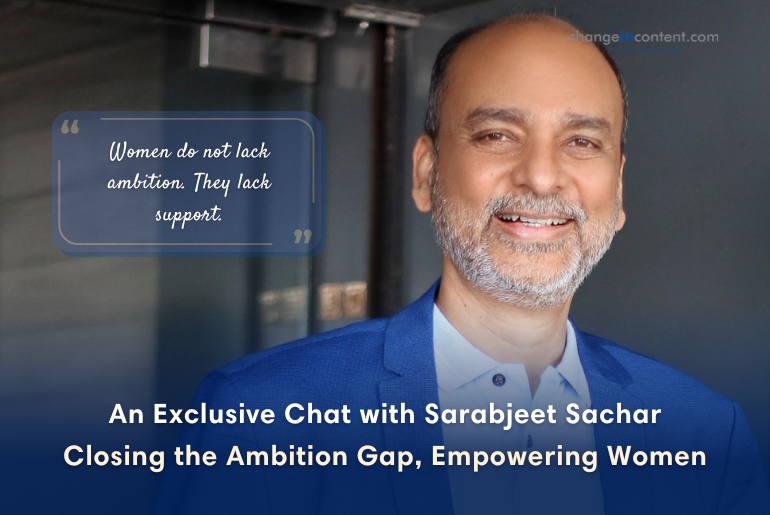
In a candid conversation with Sarabjeet Sachar, Founder & CEO of Aspiration, we explore the challenges women face in leadership, the ambition gap in workplaces, and how organisations can move beyond gendered biases. With decades of experience in recruitment, leadership coaching, and career strategy, Sarabjeet sheds light on why ambition often looks different for men and women, how gendered expectations shape professional decisions, and what real inclusion should look like.
Sarabjeet Sachar: Career transition coach through experience-led guidance
With a professional journey spanning nearly four decades, Sarabjeet Sachar has moved from leading top media companies to guiding people in building their careers. After 18 years in corporate leadership roles at renowned names like Times of India, Indian Express, Living Media, The Hindu, and ZEE TV Network, Sarabjeet took a bold step in 2002 to launch his venture, Aspiration. For over 23 years, Aspiration has grown as a leading executive search and talent solutions firm, helping organisations and professionals navigate career growth and leadership transitions.
Sarabjeet Sachar on the participation of women in the workforce
Sarabjeet highlights that while we have made some progress in women’s presence in frontline roles, the leap into leadership positions remains slow. He points out how societal expectations and outdated corporate mindsets continue to act as barriers.
In your years of experience as a recruiter and career coach, how have you observed the participation of women evolving, particularly in frontline and leadership roles? Based on your experience, how has this shift unfolded?
I recently read a survey in the Economic Times stating that women hold only 8% of leadership roles in Nifty 50 companies. It is surprising, especially when we know the key leadership traits companies value today, such as empathy, emotional intelligence, and managing diverse views, are qualities women naturally exhibit. Whether it’s during recruitment or in day-to-day interactions at the workplace, I’ve seen women excel at creating spaces where everyone feels heard and valued.
Despite this, many of these innate strengths go unrecognised. For example, a leader must build a culture of trust where team members feel comfortable speaking up and sharing concerns. In my years of experience, I’ve seen women demonstrate this ability naturally. Why? Because they manage both home and work life in an integrated way, not just balanced, but deeply connected, and they do so with skill and grace.
Yet, these qualities remain undervalued. That 8% statistic shocked me. There’s a clear gap between the strengths women bring and how they’re recognised in leadership roles.
Women have traditionally done well in sales, marketing, and creative roles. But when it comes to CXO positions, especially in finance and technology within the media industry, have you noticed any progress in their participation? Has it improved over the years?
Women still continue to do well in sales, marketing, and creative roles, but when it comes to areas like technology, finance, or CXO positions, the situation is different. In these roles, companies expect you to pick up the ball and run quickly. The pressure to deliver results is intense, and often, they feel women may not keep up with that pace.
We’re currently in a transition phase. Companies are slowly opening up, but leadership roles in tech and finance remain challenging for women. The pressure at the top, whether you’re a CEO or CFO, is immense. Senior leaders prioritise immediate business outcomes, and in such a fast-changing environment, they hesitate to invest time in grooming or supporting women in these positions.
This isn’t to say change won’t happen. It may take a few more years, but right now, there is still segregation not only in certain roles but also across industries.
With AI on the rise, upskilling has become essential. Yet many women face financial barriers and domestic duties, limiting their chance to upskill. Could this leave women, especially in traditional roles, at a disadvantage or even make them redundant?
The impact on women tends to be greater because, as I mentioned earlier, they often carry a higher level of accountability when balancing home and work. That integration of responsibilities is far more demanding for women compared to men. As a result, many women feel the need to adjust and prioritise domestic duties, which limits their ability to upskill or explore new opportunities in AI and generative technologies.
Women may feel unable to pursue new skills or opportunities, not by choice but because of the practical demands they face. The level of support they receive at home plays a crucial role. A strong, supportive environment can make a difference, allowing women to take on freelance projects or pro bono assignments to stay relevant and build experience in AI-related roles.
However, it all comes down to commitment. Can a woman juggle her domestic responsibilities while still dedicating time to upskilling and growth? That’s where many face limitations, and because of this, the impact of AI tends to affect women more than men.
Gender differences in career ambitions: What Sarabjeet Sachar thinks
While men may focus primarily on financial provision, women juggle additional roles that can overshadow their professional ambitions. Sarabjeet Sachar sheds light on this important issue.
You mentioned that you coach professionals. When coaching women in leadership roles, do you approach it differently compared to coaching men?
When I coach, I adapt my approach to men and women because their challenges differ. What I’ve noticed with women is that they have immense passion and strong values but often don’t know how to present them. So, I guide them to bring these qualities to the surface, whether for LinkedIn profiles, interviews, or success stories.
I once coached a woman who was worried about how to present herself after a career break. I asked her to reflect on her innate, transferable skills. She mentioned being highly organised, not just at work but also in managing her home and planning family trips, even handling last-minute changes and negotiations. Through our discussion, it became clear she had strong negotiation, adaptability, and leadership skills. Often, women overlook these strengths until someone helps them frame them confidently.
So, when coaching women, I focus on two things. Helping them recognise and articulate their transferable skills and guiding them to negotiate confidently. Women often underestimate their value, especially when balancing work and home. But with the right framework and support, they can showcase their strengths and move forward.
From your experience, do men and women in the workplace pursue different personal goals? Do women often choose stability and are usually content with where they are, while men seem more focused on moving up the career ladder without thinking much about domestic responsibilities and children?
Yes, compared to men, women often show a slightly lower fire in the belly when it comes to ambition. Many are content with where they are, well-established in stable roles, and do not always feel the need to push further. I believe this is largely because of practical circumstances. For men, the responsibility often revolves around providing financially and ensuring the household runs smoothly. That is a given.
But for women, the responsibility stretches beyond that. Managing emotions at home, whether it is the children, the husband, or extended family relationships, largely falls on women’s shoulders. While I do think women are emotionally stronger, the accountability they carry is heavier.
In my coaching sessions, too, I see women prioritising stability. They want a fulfilling job, yes, but they often do not aggressively chase CXO roles. It is not about lacking capability. It is just that their focus also lies in ensuring their child is settled and their family relationships are intact. These factors naturally take precedence. Hence, that ambitious drive sometimes takes a backseat. I am not saying there are no ambitious women. There absolutely are. But overall, I still see more women compromising on that front, especially in India.
Sarabjeet Sachar on ageism, career breaks, and biases
As more women enter or return to the workforce, companies are gradually recognising the need to offer better support systems. Sarabjeet Sachar shares how flexible work models, returnship programs, and childcare benefits have improved post-COVID but also highlights where organisations still fall short.
Have companies become more supportive of women entering the workforce? How are companies addressing the challenges women face in balancing professional responsibilities and domestic roles?
I see this change happening gradually. Companies have become more supportive, especially after COVID-19. They recognise that AI has transformed business operations; it moves fast, constantly evolves, and demands real talent. With skill shortages increasing, organisations realise the value women bring, particularly those returning after career breaks.
Many companies now offer flexibility, whether through hybrid work models or adjustable hours, depending on the industry. For example, media professionals like radio anchors can easily record from home, while manufacturing roles may still need a physical presence. Where possible, organisations accommodate these needs.
I also notice that there is more support for childcare. Companies reimburse expenses for household help or creche facilities. These measures ease domestic responsibilities and encourage women to re-enter the workforce.
One key initiative is the rise of returnship programs. These programs, much like internships, help women restart their careers after a break. They provide training, mentorship, and an entry point back into corporate life. However, many companies limit eligibility by capping the career break at five or six years. I believe this approach narrows the talent pool unnecessarily. Instead, companies should focus on skills, adaptability, and potential, not on how long the break lasted. If organisations remove this restriction, they can tap into a wider pool of talented women ready to contribute.
Do you think ageism plays a role in why companies set such limitations, and how can organisations move beyond age-based assumptions to assess real potential?
Ageism exists, especially for women. I’ve noticed this often in my coaching work with senior leaders. Many professionals, both men and women, crossing 49 or 50, approach me with concerns. For women, it’s even more challenging because gender bias compounds the age factor.
But I believe the issue works both ways. Many women internalise this bias, doubting their value as they age. On top of that, balancing family responsibilities creates added pressure. This mindset, combined with external ageism, holds them back. On the employer side, leadership often claims to value skills over age. However, unless companies actively train recruiters to assess candidates without bias, they are not really putting that system in place to ensure that women get a fair chance regardless of age or breaks.
At the same time, industries are evolving fast, especially with AI. Unfortunately, I see many older professionals struggle to stay updated. Today, there are countless micro-certifications, self-paced courses, and online resources. Even understanding the basics of AI or changes in one’s targeted job role can go a long way.
Misogyny in job descriptions is a growing concern. If a company prefers to hire a man, does that bias reflect in the wording of the job post? As a recruiter, can you often tell, just by reading the job description, whether the company leans toward hiring a man or a woman?
In the job description, companies may not directly show any bias, but they do mention certain things that send out a message. For example, they’ll highlight aggressive travel, managing large diverse teams, or working night shifts. It’s not openly saying, “this role is not for women,” but naturally, when a woman reads all that, she might keep it low on priority unless her priorities are very different, and she’s fine with it all.
I don’t think companies will ever clearly state a bias because no one wants to be seen as gender-biased. But still, the way they frame the role, some things are spelled out in a way that might make women hesitate before applying.
Also, even if a woman applies, bias often appears during the interview process. Companies might question whether she can handle travel or irregular hours and use that as a reason to filter candidates out. So, while it’s subtle, there is a bit of a bias there.
Challenging gendered perceptions: Mantra from Sarabjeet Sachar
In many professions, gender bias is deeply embedded in how we perceive certain roles. Sarabjeet highlights the power of storytelling in changing how society views gender and professional roles.
When we talk about bias, certain professions automatically evoke gendered associations. For instance, when we mention a police officer or a plumber, people often picture a man, whereas roles like teacher, nurse, or gynecologist tend to bring to mind a woman. There is clearly an underlying bias at play. In your view, what steps can content platforms like ChangeinContent, as well as other organisations, take to challenge and change these gendered perceptions?
There are certain roles, like nursing, where mindsets are very specific to the role and industry. For example, people often feel a psychological comfort level when a woman is nursing them. I believe that if such mindsets support the role and benefit the patient, they do not necessarily need to change. However, the focus should be on the skills required for the role rather than gender. Content platforms can help shift this view by highlighting transferable skills—such as empathy, adaptability, problem-solving, and creativity—that are not gender-specific.
One way to support this is by sharing success stories or case studies. For example, if there is a male nurse who has been very successful, presenting his story can slowly encourage people to rethink their assumptions. They may begin to say, “Yes, a male with empathy, a strong sense of service, and the competence to manage patients can also be a nurse.” I’m just giving that as an example.
When people see examples where another gender has delivered the role effectively, it can slowly change perceptions. It is a mindset that is deeply rooted, so change will take time. But suppose platforms encourage a focus on transferable skills and present real success stories. In that case, it will gradually build acceptance and make people rethink the gendered lens through which they view certain professions.
So, you mentioned how real-life stories help people resonate and shift perceptions. But since it’s Women’s History Month, we see many campaigns, yet most companies aren’t really showcasing the kind of real case studies you talked about. Why do you think there’s a gap? Why do brands lean more towards token gestures instead of promoting actual stories of impact?
I think companies may resist or lie low when it comes to encouraging real case studies. As a third party, like when I coach someone or when a content platform highlights stories, it becomes easier to approach it objectively. However, for companies, their focus is often elsewhere. They are hard-pressed to meet immediate business goals, especially with the rapid pace of change driven by AI and evolving markets. Leadership teams are already struggling to keep up, so adding another element like building gender-equity case studies might feel like a diversion.
It’s not that they intentionally avoid it, but their processes and systems haven’t fully adapted yet. Unless a company has deeply rooted values at the leadership level and a clear vision tied to inclusion, they may hesitate. Some may feel they simply don’t have the time or resources right now to invest energy in something that doesn’t directly tie into immediate revenue targets or business objectives.
That’s why I feel third parties, like coaches or content platforms, are better positioned at this stage to take the lead in driving these narratives forward.
To learn more about Sarabjeet Sachar and interact with him, click here.
Conclusion: Creating real change in the workplace
At Changeincontent.com, we aim to spark honest conversations around topics often left out of mainstream discussions. Our exchange with Sarabjeet Sachar brought important issues to light, especially the realities women face in balancing professional growth with personal responsibilities.
The ambition gap, where women are less likely to pursue or be given leadership opportunities, continues to persist. Closing this gap requires a fundamental change in how companies view gender roles, career progression, and the support they offer their employees.
Disclaimer: The views expressed in this article are based on the writer’s insights, supported by data and resources available both online and offline, as applicable. Changeincontent.com is committed to promoting inclusivity across all forms of content. We broadly define inclusivity as media, policies, law, and history—encompassing all elements that influence the lives of women and marginalised individuals. Our goal is to promote understanding and advocate for comprehensive inclusivity.