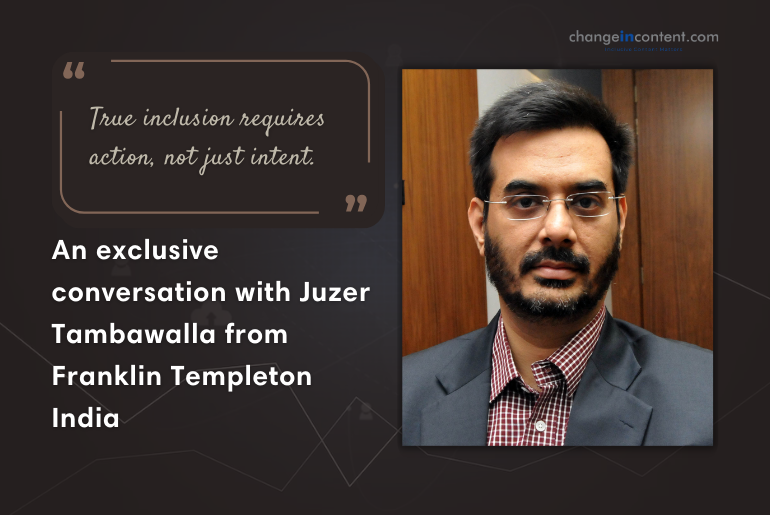
Diversity, Equity, and Inclusion (DEI) in the Banking, Financial Services, and Insurance (BFSI) sector have made significant progress. However, the challenges are far from over. Juzer Tambawalla, a senior leader in asset management and financial services, believes that while progress is evident, the gender divide in BFSI, workplace safety, and ageism in sales roles continue to demand urgent attention.
His insights, shaped by over 20 years of experience in leadership, digital transformation, and customer engagement, highlight how organisations must go beyond policy rhetoric and create tangible solutions for inclusion.
In this exclusive interview, Juzer Tambawalla shares his perspectives on women in sales, inclusive workplace policies, and the role of corporate infrastructure in increasing participation. He also takes a strong stance on ageism, the so-called “boys’ club” in the corporate world, and why companies must invest in people rather than just processes to build a truly equitable workplace.
Meet Juzer Tambawalla: The inclusive leader driving change
With a stellar career spanning over two decades, Juzer Tambawalla is an established leader in financial services marketing, investor education, and business enablement. As the Director of Sales Enablement at Franklin Templeton, India, Juzer has played a crucial role in developing investor awareness programs, strategic sales growth initiatives, and regulatory frameworks for mutual fund advertising. His collaborations with SEBI in shaping financial literacy campaigns and his contributions to industry-wide inclusion efforts have made him an influential voice in BFSI.
Breaking barriers for women in BFSI
The BFSI sector has seen some progress in gender representation, but is it enough? Juzer Tambawalla acknowledges the achievements but urges deeper structural changes.
Q. What are your thoughts on the representation of women in BFSI? According to data provided by Avtar & Seramount, 24.5% of corporate executives in the BFSI sector are women. Isn’t this far from ideal?
A: I think BFSI is leading among other sectors. Look at the heads of organisations, including SEBI. But yes, that does not mean that there is not an enormous scope for improvement. The gender divide in financial services is influenced by the limited number of women entering the industry rather than their capabilities. I see successful gender representation within most teams. If you look at the pool of applicants and the hiring process, we are doing a great job in hiring women. However, within the pool itself, there is a disparity. Unlike in earlier decades, managers are sensitised to hire candidates based on their capabilities and not their gender. For example, you see media and STEM; many women have entered these fields in the last few years. The same is true with BFSI. We see women not only in leadership roles across the industry but across mid to senior levels.
Q. What do you think will attract more participation from women?
A: Creating a safe space for women is the crux of the problem. For example, you can look at the logistical support provided to female employees, such as safe commuting options, as call centres did. That paved the way for so many women to take up those opportunities. There is a learning from this phenomenon. If all industries start offering commuting support, the participation of women will significantly increase.
Q: Please talk to us about women-friendly policies that you feel have impacted the lives of your colleagues and peers.
A: It is vital to improve organisational infrastructure to support women. For example, in the post-COVID era, organisations are open to providing flexible working arrangements to their employees. That makes a great deal of difference in a person’s life when they are navigating situations like motherhood, caregiving responsibilities, health issues, etc. Having a creche within the office premises has been a game-changer for many women.
Shifting workplace culture: Juzer Tambawalla on ageism, gender bias, and employee well-being
Beyond gender diversity, Juzer Tambawalla raises essential concerns about age discrimination in sales, workplace biases, and how companies should invest in employee well-being.
Q. “Maternity changes women. They become less committed to work”- True or False?
A: I don’t agree at all. I am talking about a colleague of mine who came back to work within 4 months after delivering a child. She is one of our best resources. We wanted to make sure that she could meet the new demands life had thrown at her.
So that she could perform efficiently, we decided to create a positive and inclusive space for her. Also, the branch office, being a smaller office with a smaller team, did not have creche facilities. We wanted to make her journey easier by creating a baby room for her in the office. The facility management team converted a cabin into a makeshift room where her baby could be comfortable along with the nanny.
Q. What are your thoughts on the existence of a boys’ club in corporate India? Does it alienate women from being sure-footed on the corporate ladder?
A: I can’t deny its existence. However, I also disagree that it is always done by design. The broader employment challenge is to get more women to apply. Due to the difference in absolute numbers, the cohorts seem tilted towards a specific gender. I will again return to infrastructure and safety. Once we can collectively make women feel safe going to work and convince families alike, women’s participation and growth will be a natural offshoot.
Q. What’s your take on ageism? Is it true that job descriptions in sales roles mention that one above the age of 40 is not eligible for the role, especially in revenue roles in the financial sector?
A: No, I have not encountered any such JD in my entire career. However, specific roles like field sales jobs require a certain amount of physical fitness and mental agility. There also has to be a willingness to learn. Sometimes, an older adult may not conform to this ideal. Some recruiters may consider this a bias, but it is not a universal phenomenon.
Q. With AI and a growing population of middle-aged people in India, dont you think that if ageism keeps one away from work, there is a more significant societal impact in terms of cost and demands on the economy, considering the average life span of a human increasing?
A: This is a great question. Yes, ageism is genuinely gaining momentum in corporate India. We need to understand this well. A business is founded on the very principles of making profits. A company will choose a resource that is efficient and competitively priced and has kept abreast with the needs of the challenging times. It is applicable to human resources as well. Therefore, investing in oneself by being open to exploiting the learning resources available to one, like co-funded academic degrees, online certifications and resources and simply by reading and learning new subject matter, can stop stagnation.
A lot of our drive is individual. We cannot only expect the organisation to take care of us. As discussed earlier, it is a two-way street. If you can show that you have acquired skills, understand technology, and are open to experiencing new challenges, no one can stop you from reaching the heights that you deserve.
Q. A few words to us? How do you find changeincontent.com? Are we bringing up the correct issues?
A: I regularly visit the site. It has some great content, and I urge you and your team to keep up the good work.
The final thoughts: Beyond tokenism, towards real inclusion
Juzer Tambawalla’s perspective on gender, ageism, and inclusive workspaces is a reminder that real change requires collective efforts. Moreover, it needs policy shifts and a deep-rooted cultural shift in corporate India. While companies focus on diversity metrics, it is time to look beyond numbers and focus on real action.
At Changeincontent, we believe that inclusion is not about meeting quotas—it is about reshaping industries to ensure equal opportunities for all. Conversations on inclusion should no longer be an HR exercise but a strategic business imperative that showcases true belonging.
Disclaimer: The views expressed in this article are based on the writer’s insights, supported by data and resources available both online and offline, as applicable. Changeincontent.com is committed to promoting inclusivity across all forms of content. We broadly define inclusivity as media, policies, law, and history—encompassing all elements that influence the lives of women and gender-queer individuals. Our goal is to promote understanding and advocate for comprehensive inclusivity.