
The Short Read
- The National Commission for Women has issued an advisory to all States and Union Territories on stricter implementation of the PoSH Act.
- The advisory calls for mandatory annual PoSH audits for establishments employing 10 or more persons.
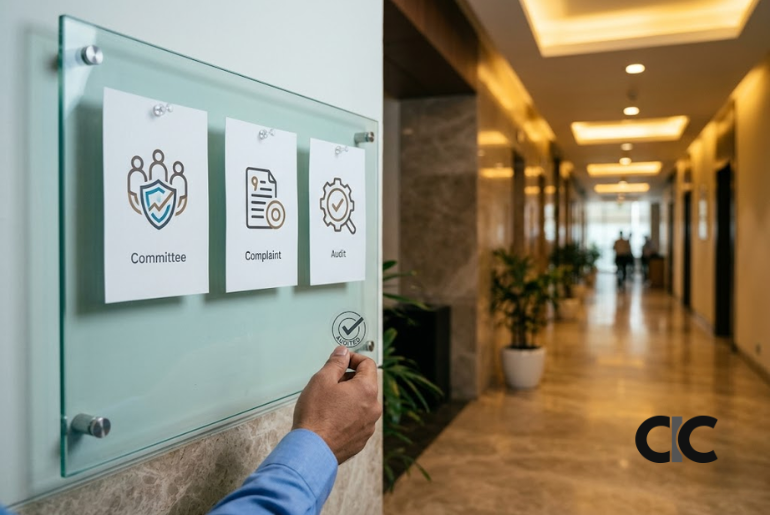
- These audits are expected to assess legal compliance, the functioning of the Internal Committee, complaint disposal, confidentiality safeguards, and awareness efforts.
- NCW has also called for dedicated PoSH monitoring cells, digital compliance dashboards and stronger coordination at district and State levels.
- The advisory places renewed focus on complainant protection, anti-retaliation safeguards, training and proper constitution of Internal Committees and Local Committees.
- For women employees, this could make workplace safety systems more visible, trackable and harder for employers to ignore.
NCW’s new mandatory PoSH audit push puts employers on notice
Mandatory PoSH Audits could become one of the biggest compliance shifts in India’s workplace safety framework if States and Union Territories act on the latest advisory issued by the National Commission for Women.
The NCW advisory calls for annual audits under the Sexual Harassment of Women at Workplace (Prevention, Prohibition and Redressal) Act, 2013, commonly known as the PoSH Act. The proposed audits would apply to establishments employing 10 or more persons. That is the same threshold at which organisations are required to constitute an Internal Committee.
It is a significant moment because PoSH compliance in India has often suffered from a familiar problem. Policies exist, but the experience of women employees can remain uncertain.
Many organisations have a policy document. Some have an Internal Committee. Fewer can confidently say that employees know whom to approach, that committee members are trained, that complaints are handled within timelines, that confidentiality is protected, and that retaliation is actively prevented.
The NCW advisory appears to target that gap. It pushes PoSH from a file-based compliance exercise towards an auditable system.
Mandatory PoSH Audits: What exactly is being proposed?
The advisory recommends mandatory annual PoSH audits for workplaces with 10 or more employees.
An audit would likely look at whether the organisation has met its legal and procedural responsibilities under the PoSH Act. It can include the constitution of the Internal Committee, awareness programmes, complaint-handling mechanisms, timelines, confidentiality, documentation, inquiry processes and reporting practices.
NCW has also called for dedicated PoSH monitoring cells. These cells would help States and district administrations track implementation more consistently, rather than relying solely on employers’ self-declarations.
The advisory also seeks digital compliance dashboards, proper constitution and functioning of Internal Committees and Local Committees, specialised training for committee members, regular awareness programmes and stronger safeguards for complainants.
The direction is practical. The law already exists, but the weak point has often been enforcement. That is why the shift towards audits matters.
India’s PoSH compliance 2026 conversation has already been moving towards stronger scrutiny, especially as courts and regulators continue to question whether institutions are taking workplace sexual harassment seriously. NCW’s advisory adds another layer to that movement.
Why annual PoSH audits matter
A workplace can look compliant from the outside and still fail women in practice.
The Internal Committee may exist only on paper. Employees may not know their members. Training may happen once a year with little impact. Managers may discourage complaints informally. A complainant may be moved, isolated or judged. Witnesses may feel unsafe. Committee members may lack the skill to conduct a fair inquiry.
An audit can expose these gaps. Done well, a PoSH audit can answer direct questions:
- Is the Internal Committee properly constituted?
- Are external members independent and qualified?
- Are employees aware of the complaint process?
- Are complaints being disposed of within required timelines?
- Are inquiry records being maintained?
- Are confidentiality safeguards followed?
- Are complainants protected from retaliation?
- Are Local Committees accessible to women in smaller or unorganised workplaces?
- Are annual reports being filed properly?
These are not decorative questions. They decide whether women trust the system.
What changes for employers?
Employers should read the advisory as an early warning.
PoSH compliance cannot remain a once-a-year training deck or a policy hidden in an employee handbook. If annual audits become standard practice across States, organisations will need documentary proof and functional evidence.
That means employers should immediately review:
- Internal Committee composition
- External member credentials
- PoSH policy visibility
- Employee awareness records
- Training calendars
- Complaint registers
- Inquiry timelines
- Confidentiality processes
- Anti-retaliation measures
- Annual report submissions
- Coordination with district authorities where required
For large companies, the compliance burden may be easier to manage because legal and HR teams are already in place. For smaller companies, startups, factories, schools, hospitals, agencies and local offices, the audit push may expose serious gaps.
That is where the Indian workplace needs honesty. Many women work in places where HR is thin, hierarchy is strong, and complaint systems are unclear. The law may apply, but the woman facing harassment may still have no idea where to go.
Annual audits can make that invisibility harder to maintain.
What women employees should know
Women employees do not need to understand every legal clause to protect themselves better. They should, however, know the basics.
If a workplace has 10 or more employees, it must have an Internal Committee to receive and address sexual harassment complaints. The committee should include a senior woman employee as presiding officer, at least two employee members committed to women’s causes or with relevant legal/social work experience, and one external member from an NGO, association or person familiar with sexual harassment issues.
Women should know who the IC members are. Their names and contact details should be accessible. The complaint process should be clear. Awareness should not depend on whisper networks.
If a workplace has fewer than 10 employees, or if the complaint is against the employer, the matter may be referred to the Local Committee at the district level.
Women should also document incidents carefully. Dates, places, messages, emails, witness names, meeting details and repeated patterns can help establish a clear account. Complaints should ideally be made within the statutory timeline, though the committee can consider extensions in certain circumstances.
The larger point is simple: Women have the right to ask whether their workplace has a functioning PoSH mechanism. That question should never be treated as troublemaking.
The anti-retaliation point is critical.
The advisory’s emphasis on protecting complainants, witnesses and PoSH committee members deserves attention.
Retaliation is one of the biggest reasons women hesitate to report sexual harassment at work. It does not always look dramatic. It can appear as poor appraisals, sudden transfer, exclusion from meetings, withdrawal of responsibilities, gossip, hostility, contract non-renewal or quiet damage to reputation.
If audits examine only documents and ignore retaliation, the system will remain incomplete.
A strong PoSH audit should ask whether complainants are safe after filing a complaint. It should check if witnesses feel protected. The audit should examine whether committee members can function without pressure from leadership. And it should also examine whether managers understand that retaliation itself can constitute a serious workplace violation.
India’s legal blind spots in workplace sexual harassment often sit in this zone between law and lived experience. Women may technically have rights, but fear can still decide whether those rights are used.
The role of monitoring cells and dashboards
Dedicated PoSH monitoring cells could make implementation more consistent across States and districts.
At present, enforcement can vary widely. Some organisations take compliance seriously. Others do the minimum. Local Committees are unevenly visible. Smaller workplaces may escape scrutiny. Women in informal or semi-formal work may have little access to complaint systems.
Monitoring cells can help track which organisations have constituted committees, whether annual reports are filed, whether complaints are pending, whether Local Committees are active, and where awareness efforts are weak.
Digital dashboards could make the system more measurable. They could help authorities detect patterns, delayed cases, missing compliance records and inactive committees.
The challenge will be execution. A dashboard is useful only if the data is accurate, up to date, and acted upon. A monitoring cell is only valuable if it has trained people, authority, and follow-through.
Still, the direction is important. Workplace safety cannot depend only on internal goodwill.
Why this matters beyond compliance
The PoSH Act sits inside a wider framework of women’s rights, labour participation and institutional responsibility.
A woman who feels unsafe at work may leave a job, avoid certain roles, reduce travel, refuse leadership visibility, stay silent in hostile environments or exit the workforce altogether. That has consequences for careers, families, organisations and the economy.
- For employers, safety is now part of talent strategy. Women will not stay in workplaces where harassment is mishandled or complaints become career risks.
- For policymakers, PoSH implementation is tied to women’s labour force participation, dignity and equal opportunity.
- For boards and leadership teams, this advisory should be treated as a governance signal. Workplace safety has moved beyond HR administration. It belongs in risk, compliance, culture and leadership accountability.
The growing body of DEI laws in India already shows that inclusion cannot be separated from legal responsibility. PoSH audits strengthen that connection.
What employers should do now?
Waiting for a State-level notice would be a mistake. Employers can begin with a practical readiness check.
- First, verify whether the Internal Committee is properly constituted. Check representation, external member independence and member tenure.
- Second, update employee communication. IC details should be visible across offices, intranet pages, onboarding documents and employee handbooks.
- Third, train committee members properly. PoSH inquiries require sensitivity, legal understanding, documentation discipline and procedural fairness.
- Fourth, train managers separately. Managers are often the first people employees approach, and a poor first response can damage the entire process.
- Fifth, review complaint-handling timelines and documentation. Audits will require evidence.
- Sixth, build anti-retaliation safeguards. A complainant should not have to pay a professional price for reporting.
- Seventh, include contract workers, interns, consultants, field staff and remote employees in awareness efforts. Workplace safety cannot stop at payroll status.
These steps do not need to wait for enforcement.
Change in Content View
The NCW advisory signals a much-needed shift in how India looks at PoSH compliance.
For too long, many workplaces have treated safety as a policy requirement rather than a working system. A committee exists, a training session happens, and a clause is inserted into the handbook. Then everyone moves on until a complaint exposes how fragile the system really is. Mandatory PoSH Audits can change that rhythm.
They can make employers show proof. Furthermore, they can help women ask better questions. They can push authorities to track implementation. And they can bring Local Committees and smaller workplaces into sharper focus. Most importantly, they can move workplace safety from intention to evidence.
The success of this advisory will depend on State action, district-level seriousness and employer readiness.
A safe workplace is not built when a complaint is filed. You have to build it much earlier, when employees know their rights, committees are trained, managers respond appropriately, retaliation is prevented, and leadership treats dignity as a daily obligation.
Annual audits may not solve every problem. They can, however, make neglect harder to hide.
FAQs
Q: What are Mandatory PoSH Audits?
A: Mandatory PoSH Audits are proposed annual checks to assess whether workplaces comply with the PoSH Act. That includes committee formation, complaint handling, confidentiality, awareness, and reporting.
Q: Which workplaces would be covered?
A: The NCW advisory recommends annual PoSH audits for establishments employing 10 or more persons.
Q: What is the role of an Internal Committee?
A: An Internal Committee receives and inquires into workplace sexual harassment complaints in organisations covered under the PoSH Act.
Q: Why has NCW called for PoSH monitoring cells?
A: PoSH monitoring cells can help States and districts track compliance, committee functioning, complaint status, awareness efforts and enforcement gaps.
Editorial Note and Sources
This article is based on publicly available information on NCW’s latest PoSH advisory, official government communication on the PoSH framework, and legal resources on the Sexual Harassment of Women at Workplace Act, 2013. We have written it as a Policy Pulse news explainer for Change in Content. It is for informational purposes and should not be treated as legal advice.
