The Quick Read
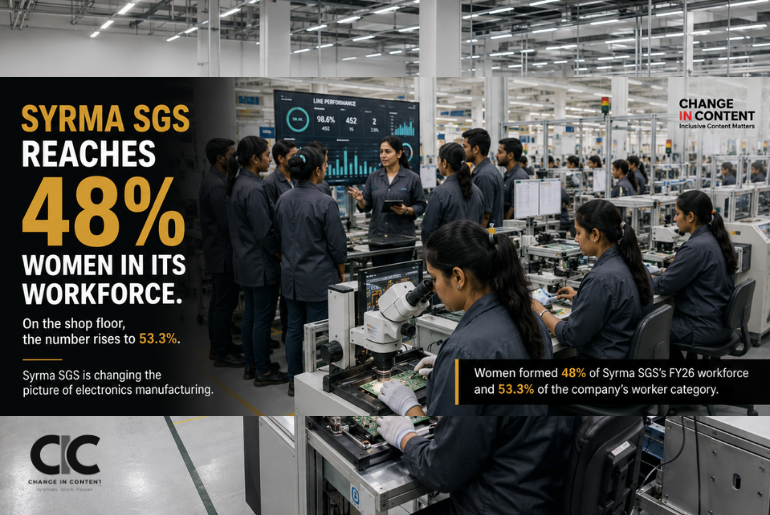
- Syrma SGS reported that women formed 48% of its total workforce as of 31 March 2026.
- The company had 10,046 employees and workers, including 4,819 women.
- Women represented 53.3% of workers but only 20.25% of employees, showing that female representation is strongest on the manufacturing floor.
- Most women workers were in non-permanent roles: 4,417 of the company’s 4,491 women workers fell within this category.
- Women received 34% of the company’s gross wages in FY26, up from 30.11% a year earlier.
- Syrma SGS says it supports women through targeted technical recruitment, safe transport, plant-level Internal Committees, maternity protection and manager training.
- Female turnover among permanent workers stood at 7.1%, below the 17.2% recorded among men.
- The company has one woman among nine directors and no women among the three key management personnel disclosed in its BRSR.
- The achievement deserves recognition because it demonstrates that women can form a substantial part of electronics manufacturing. The next step is translating shop-floor scale into permanent employment, technical advancement and leadership.
Syrma SGS sets an example
When Indian companies discuss gender diversity, the photograph usually comes from the corporate office.
Women appear in a meeting room, around a leadership table or at a technology event. Manufacturing remains in the background, often presented as a sector where finding, transporting and retaining women is unusually difficult.
Syrma SGS offers a different picture.
Women constituted 48% of its total workforce at the end of FY26, according to the company’s latest Business Responsibility and Sustainability Report. Of 10,046 employees and workers, 4,819 were women. The more significant detail lies inside that number.
Women represented 53.3% of the company’s workers. In other words, female participation was not concentrated in a small corporate programme or selected support function. Women formed the majority of the workforce category most directly connected with production.
For an electronics manufacturing services company operating plants across several Indian states, that deserves attention. It challenges an old assumption that industrial scale and gender inclusion must move separately.
Where women are present at Syrma SGS
The company’s reported workforce was divided into 1,620 employees and 8,426 workers.
Among employees:
- 328 were women;
- Women accounted for 20.25% of the category.
Among workers:
- 4,491 were women;
- Women accounted for 53.3% of the category.
These figures make the nature of Syrma SGS’s achievement clearer.
The company has not merely brought women into manufacturing. At the worker level, it has built operations in which women are numerically central.
That matters in an industry producing printed circuit-board assemblies, box builds and electronic components for sectors including automotive, healthcare, telecom, industrial equipment, consumer technology, railways and defence. Syrma SGS reported 14 plants and eight offices in India within the scope of its FY26 sustainability disclosures.
Women’s participation at this scale helps change what an electronics plant looks like, who families imagine can enter technical manufacturing and where companies search for production talent.
Change in Content has previously examined how women in the electronics industry are demonstrating strong employability. The Syrma SGS numbers provide a company-level example of that broader movement.
This did not happen through neutral recruitment alone
Syrma SGS’s BRSR makes an important admission: Sustaining a high ratio of women requires active intervention, not passive non-discrimination.
That is a useful statement for every company claiming that it hires “only on merit”.
A theoretically open factory does not automatically become accessible to women. Recruitment channels, transport, shifts, workplace safety, family confidence and maternity continuity all influence who can enter and remain.
Syrma SGS reports several measures intended to address these barriers.
Recruitment from women’s technical institutions
The company conducts targeted campus drives at women’s engineering colleges and polytechnic institutions. The objective is to widen the female pipeline into technical and manufacturing roles rather than wait for women to appear through conventional recruitment routes. This distinction matters.
Companies often explain low female representation by saying few women applied. A more useful response is to examine where recruitment took place, how the role was presented and which institutions were included.
Transport for early and late shifts
Syrma SGS says it has a structured transport arrangement across its units to provide traceable travel, particularly for women working early-morning or late shifts. In manufacturing, transport is not a peripheral benefit.
A role may exist, and a woman may possess the required skill, but an unsafe or unreliable journey can make the opportunity unusable. Shift-based employers cannot separate workforce diversity from mobility.
Plant-level sexual-harassment systems
The company states that an Internal Committee has been constituted at each plant and that women are informed about their rights and complaint channels when they join.
The presence of a committee does not alone establish employee trust or procedural effectiveness. Still, plant-level access is important in a geographically dispersed operation. A committee located only at a corporate office would be less meaningful to workers across manufacturing sites.
Maternity protection and continuity
Syrma SGS reports compliance with maternity law, including paid leave, protection from dismissal and continuity of role and benefits after return. It also says its managers receive training intended to reduce bias in evaluation and promotion.
These measures move inclusion beyond recruitment.
The company’s longer-term performance will depend on whether women return to roles carrying equal opportunity for progression rather than merely returning to the payroll.
Retention provides another encouraging signal
The turnover rate among permanent women workers was 7.1% in FY26. For permanent male workers, it was 17.2%.
Women workers also recorded lower turnover than in FY25, when the female rate stood at 8.96%.
Turnover can vary for many reasons and one year’s comparison should not be overinterpreted. However, the lower female rate is relevant because manufacturers frequently describe the retention of women as a central operational challenge.
At Syrma SGS, permanent women workers were not leaving at a higher rate than men during the reporting year. It suggests that female participation may be more than a recruitment spike.
It also strengthens the business argument for inclusion. Companies do not need to treat women workers as a difficult or unstable labour pool by default. When work, transport and workplace systems are designed appropriately, women can become a durable part of manufacturing operations.
Women’s share of wages is rising, but it does not yet match representation
Women received ₹89.88 crore in gross wages during FY26, accounting for 34% of the company’s total gross wage expenditure. Their share had increased from 30.11% in FY25.
The upward movement is positive. The gap between women’s 48% workforce representation and their 34% share of wages also requires context.
It does not automatically prove unequal pay for equal work. Aggregate wage shares are influenced by job category, seniority, employment status, working hours, function and leadership representation.
The numbers nevertheless show where the company’s next opportunity lies.
Women are heavily represented among workers and far less represented among employees, permanent roles and senior decision-making positions. As women move into more specialised, supervisory, engineering and managerial work, their share of wages should move closer to their contribution to the workforce.
An inclusive-company story should recognise entry. A stronger inclusion story follows the path from entry to economic mobility.
The important distinction between workers and employees
The overall 48% figure is impressive, but it should not be read without its internal distribution.
Of the 4,491 women classified as workers:
- 74 were permanent workers;
- 4,417 were other-than-permanent workers.
It means the overwhelming majority of women workers were in non-permanent arrangements.
The same is true for much of the company’s worker base overall, so the issue is not exclusive to women. Yet gender inclusion must eventually be assessed through the quality and security of work, not only the total number of women present.
Questions worth following in future reports include:
- How many women move from temporary, contractual or apprenticeship routes into permanent roles?
- What is the average tenure of women workers?
- Are women advancing into technician, quality, maintenance and production-supervision positions?
- Do women receive comparable training and internal mobility?
- How do wages vary after accounting for role and seniority?
- Are women represented across all plants, products and shifts?
A factory can reach gender balance while keeping women concentrated in its least secure layer. The next stage is to build progression above that layer.
Leadership remains the unfinished part of the story
Women formed nearly half the workforce, but the board and senior-management numbers looked very different.
Syrma SGS reported:
- One woman among nine directors;
- No women among three key management personnel;
- Women forming 20.25% of the employee category.
The shop floor is therefore substantially more gender-balanced than the rooms where the organisation’s highest-level decisions are made.
It does not diminish the achievement of employing thousands of women in manufacturing. It identifies the next frontier.
Women who begin in production should be able to see credible routes towards:
- Team leadership;
- Line supervision;
- Process engineering;
- Quality control;
- Operations management;
- Plant leadership;
- Business and executive roles.
Change in Content’s wider analysis of women in industry leadership has highlighted this national gap. Women are becoming more visible on factory floors, yet industrial authority remains far more male-dominated.
Syrma SGS now has the scale to help change that pattern.
Why the Syrma SGS story matters to Indian manufacturing
India wants to become a larger global electronics-manufacturing hub. That ambition will require talent at considerable scale. Restricting recruitment, whether deliberately or through poorly designed work, would leave half the potential labour market underused.
Syrma SGS demonstrates three important points.
Women are available for manufacturing work
The idea that companies cannot find women for industrial roles becomes harder to defend when one electronics manufacturer reports more than 4,800 women across its workforce.
The pipeline may require deliberate outreach. It is not absent.
Operational design affects representation
Transport, plant-level grievance systems and targeted recruitment may sound like support measures. They are also production systems. They determine whether employees can reach work, complete shifts and remain with the organisation.
Scale changes workplace culture
When only a handful of women enter a plant, they may be treated as exceptions.
When women form more than half the worker population, their participation becomes part of how the operation functions. Facilities, policies, supervision and workforce planning must respond accordingly.
That is how inclusion moves from accommodation to normality.
What should Syrma SGS measure next?
The company’s BRSR offers substantial workforce information, which makes a more meaningful assessment possible.
Future disclosures could build on this by reporting:
- Women’s representation by plant and function;
- Permanent conversion rates;
- Promotions among workers and employees;
- Women in supervisory and engineering roles;
- Gender-adjusted pay analysis;
- Maternity return and retention beyond the first year;
- Use and availability of childcare;
- Women’s participation in technical training;
- Safety and harassment outcomes;
- Representation in plant and corporate leadership.
The FY26 report shows an 80% return-to-work rate and 50% retention rate among permanent female employees who took parental leave. The small underlying group size is not disclosed in the table, so the percentages should be interpreted carefully.
This is another area where closer reporting can support improvement.
A company that has succeeded in attracting women at scale should become equally ambitious about keeping them through motherhood, care transitions and career advancement.
Inclusive Companies: Why Syrma SGS belongs in the conversation
The purpose of an Inclusive Companies feature is not to issue a certificate of perfection. It is to identify measurable practices and results that other employers can learn from.
Syrma SGS deserves attention because:
- Its female representation is unusually high for a manufacturing operation;
- Women form the majority of its worker category;
- The company identifies specific interventions behind the number;
- Female permanent-worker turnover is comparatively low;
- Women’s share of gross wages is increasing;
- The data is publicly disclosed through a BRSR subjected to reasonable assurance.
The reporting boundary is important. The workforce figures apply to Syrma SGS Technology’s Indian factories and offices on a standalone basis, not all subsidiaries across the group. The company’s BRSR Core disclosures received reasonable assurance from Grant Thornton Bharat.
Transparency strengthens the story because it allows celebration and scrutiny to coexist.
The Change Ahead
Syrma SGS has already answered one question facing Indian manufacturing: Can women become a substantial part of the industrial workforce?
Its FY26 numbers say yes.
Women formed 48% of the overall workforce and more than half of its workers. That is large enough to challenge the idea that manufacturing inclusion must remain confined to pilot lines, selected plants or publicity campaigns.
The next questions are more demanding.
- Will temporary work become secure employment?
- Will women move from production lines into supervision and engineering?
- Will their wage share rise with their representation?
- Will maternity cease to interrupt advancement?
- Will the boardroom begin to resemble the workforce that powers the company?
Syrma SGS has built an unusually strong base. Its most important contribution may now be showing that women’s participation in manufacturing can lead not only to jobs, but to durable careers, technical authority and industrial leadership.
The shop floor has moved first. The rest of the organisation has an opportunity to catch up.
Editorial Note
This Inclusive Companies feature is based primarily on Syrma SGS Technology Limited’s FY2025–26 Business Responsibility and Sustainability Report. The reported 48% female workforce covers employees and workers within the company’s standalone Indian reporting boundary. It does not cover all group subsidiaries. Workforce categories such as “employee”, “worker”, “permanent” and “other than permanent” follow the classifications used in the company’s statutory report.
The feature recognises an unusually high level of women’s participation while also examining differences in employment category, wage share and leadership representation. Inclusion should be assessed through access, work quality, progression, safety, retention and authority rather than any one statistic.
Principal Sources
- Syrma SGS Technology Limited: Business Responsibility and Sustainability Report, FY2025–26.
- Syrma SGS Technology Limited: Investor relations page and FY2025–26 annual report listing.
- Syrma SGS Technology Limited: Official business overview covering its electronics manufacturing and engineering operations.