
The Quick Read
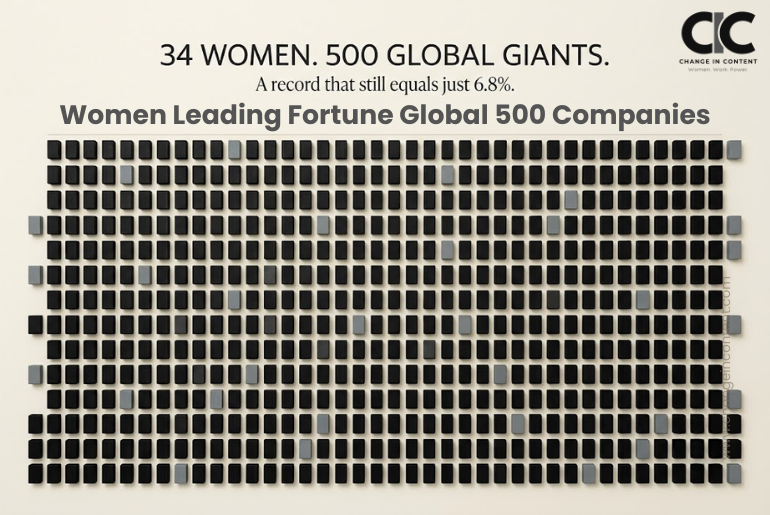
- A record 34 women are leading Fortune Global 500 companies in 2026, up from 33 in 2025 and 28 in 2024.
- Women still hold only 6.8% of the CEO positions on the list.
- Elevance Health CEO Gail Boudreaux leads the highest-ranked woman-led company, which appears at number 33.
- By comparison, women run 11% of companies on the 2026 Fortune 500, which covers the largest US companies.
- The gap reflects weak promotion pipelines, uneven progress across countries and the small number of women given responsibility for the largest businesses.
Women leading Fortune Global 500 Companies
34 is a record. Put it beside 500, and the celebration becomes more complicated.
The number of women leading Fortune Global 500 companies has reached its highest level in the ranking’s history. Women now run 34 of the world’s largest businesses by revenue, according to Fortune’s 2026 list. That amounts to 6.8% of all chief executives on the ranking.
The number has risen from 28 in 2024 and 33 in 2025. The direction is positive. The pace remains slow. At the current level, nearly 14 men are running Global 500 companies for every woman who does so.
The imbalance becomes even more visible near the top. Gail Boudreaux, CEO of US health insurer Elevance Health, leads the highest-ranked woman-run company. Elevance appears at number 33. No woman leads one of the 30 largest companies in the world.
This is a story about progress. It is equally a story about the size of the power gap that remains.
What is the Fortune Global 500?
The Fortune Global 500 ranks the world’s 500 largest companies by revenue. Unlike the Fortune 500, which covers companies based in the United States, the Global 500 includes businesses headquartered around the world.
Amazon took the top position in the 2026 ranking, ending Walmart’s 12-year run at number one. Together, the listed companies generated $43.1 trillion in revenue in 2025, earned $3.39 trillion in profits and employed 70.2 million people. That scale gives the gender figure its significance.
The chief executives on this list influence investment, employment, technology, supply chains, healthcare, energy use, wages and consumer markets across countries. These are not simply prestigious appointments. They are among the most powerful operating roles in the global economy. Women occupy 34 of them.
How does 6.8% compare with previous years?
Women’s representation has improved over the past three Global 500 rankings
| Year | Women CEOs | Share of Global 500 |
| 2024 | 28 | 5.6% |
| 2025 | 33 | 6.6% |
| 2026 | 34 | 6.8% |
The five additional women in 2025 produced a noticeable rise. This year brought one more.
A record should not be dismissed simply because it falls short of equality. Each appointment can alter assumptions about who is qualified to lead a major global enterprise. It can also strengthen the pool of women with experience in capital allocation, international operations, mergers, regulation and large workforces. Yet a movement from 33 to 34 is too small to indicate a broad transfer of corporate power.
Records in women’s leadership often emerge from a very low base. The headline rises while the underlying structure changes far more slowly.
Why does the Global 500 trail the US Fortune 500?
Women run 55 companies on the 2026 Fortune 500, representing 11% of the largest US businesses. Their 6.8% share on the Global 500 is considerably lower. Part of the explanation lies in the size of the companies that qualify.
The smallest business on the 2026 Global 500 reported approximately $33 billion in annual revenue. The revenue threshold for the Fortune 500 was $7.47 billion. Women may be reaching CEO positions more frequently in large American companies, but they remain less likely to lead businesses big enough to enter the global ranking.
Geography also plays a role.
The United States, Greater China and Japan together account for 61% of Global 500 companies and more than two-thirds of their combined revenue. Progress in women’s executive leadership differs widely across these markets. A global ranking therefore brings together countries with very different corporate cultures, labour markets, governance rules and expectations of women leaders.
The comparison exposes another issue. Women may be making gains in some national business environments without gaining equivalent control over the largest pools of corporate revenue.
Size remains a gendered part of the leadership story.
The path to CEO narrows long before the final appointment
A chief executive is rarely selected from the workforce at large. Boards usually consider candidates who have already led major business units, managed profits and losses, handled international operations or served as chief financial or operating officers. Women remain underrepresented at many of those earlier stages.
McKinsey’s 2025 Women in the Workplace research found that women held 29% of C-suite roles among participating companies in corporate America, unchanged from the previous year. It also reported a continuing “broken rung” at the first promotion into management, limiting the number of women who can progress through the leadership pipeline.
Globally, the Corporate Women Directors International study of 500 major companies found that women occupied 21.1% of executive officer positions and 28.9% of board seats in 2025. The gap between those figures matters. Board representation has advanced faster than women’s access to operational executive authority.
A board seat can influence oversight. A senior operating role builds the experience most often considered necessary for a CEO appointment. Companies may therefore improve the gender composition of their boards while leaving the route to chief executive largely intact.
Our earlier analysis of the 2026 CWDI report on women CEOs found that women-led companies tend to have more women on their boards and executive teams. Yet only 6.7% of the blue-chip companies examined were headed by women.
The scarcity at the top is produced across an entire career, not during one boardroom vote.
Women still receive fewer of the roles that lead to the top
Executive experience is not distributed evenly.
Women are often concentrated in functions such as human resources, legal affairs, communications, sustainability and marketing. These roles can be influential, but boards frequently favour candidates who have run major revenue-generating divisions or held direct profit-and-loss responsibility. That creates an uneven contest.
A woman may hold a senior title without being given control of the operations that boards later treat as evidence of CEO readiness. Men are more likely to be placed in positions that involve business ownership, international expansion, restructuring or large budgets.
Informal sponsorship compounds the difference. Future chief executives are frequently identified years before a formal succession process begins. They receive critical assignments, exposure to directors and opportunities to lead through difficult periods.
Mentorship can offer advice. Sponsorship puts a name forward when a consequential role is being filled.
When senior leadership networks remain male-dominated, women may be known as strong performers without being viewed as obvious successors.
That helps explain why the pool of women considered for the largest CEO roles remains small even after years of corporate commitments to diversity.
Being appointed is not the end of the scrutiny
Women who reach chief executive positions may face a different leadership environment from their male peers.
They often attract greater attention as symbols of gender progress. Their decisions are assessed not only as business choices but also as evidence about women’s leadership more broadly. A struggling male CEO is usually treated as an individual executive. A struggling woman can find her performance drawn into a wider debate about whether women are suited to the role.
Women may also be appointed during difficult periods, when a company needs restructuring or reputational repair. This pattern is commonly described as the “glass cliff”. Such appointments can provide genuine authority, but they may arrive with higher risks and less time to show results.
The burden becomes heavier when the group is so small. With only 34 women on the Global 500, every departure can move the annual percentage. A few appointments or resignations can create the appearance of rapid progress or sudden retreat.
Corporate equality cannot depend on a small number of exceptional women holding their positions indefinitely.
The record tells us something encouraging
The 6.8% figure is inadequate. The women behind it should not be reduced to evidence of failure.
Running a Global 500 company involves responsibility for businesses with vast revenues, complex regulations and workforces spread across countries. The presence of 34 women in these roles confirms that women are leading at the highest levels of commercial scale. It also weakens the familiar claim that boards cannot find qualified women.
Women already run major organisations in healthcare, finance, manufacturing, retail, energy, technology and consumer goods. Their careers demonstrate that the experience exists. The question is whether companies are creating enough opportunities for more women to build it.
There can be a tendency to discuss women CEOs only as rare pioneers. That framing recognises achievement but can preserve the idea that each appointment is unusual.
Normalisation requires repetition. One woman’s appointment may break a barrier. A steady flow of appointments changes the system.
What would move the number beyond an annual record?
A larger share of women CEOs will require companies to work much earlier in the leadership cycle.
Give women responsibility for core businesses
Women need more opportunities to lead high-revenue divisions, international markets, operations and transformation programmes. These assignments create credible CEO candidates.
Treat succession as a multi-year process
Boards should examine the gender composition of succession pools before a vacancy arises. Waiting until the final search begins leaves little time to repair a narrow pipeline.
Track promotions, not only representation
A company can employ many women while advancing few of them. Promotion rates, access to key assignments and movement into operational leadership show whether the pipeline is functioning.
Make sponsorship accountable
Senior leaders should be expected to sponsor talent beyond familiar networks. Sponsorship should result in assignments and visibility, not simply encouragement.
Protect progress when corporate priorities change
Women’s advancement cannot remain dependent on whether DEI is enjoying a favourable political or corporate moment. Leadership development is part of workforce planning and business continuity.
Expand the ownership pipeline
Women founders also need access to the capital, markets and acquisitions that allow businesses to grow into global companies. Changing who builds the largest businesses is another route to changing who leads them.
Change in Content has examined how women remain rare in India’s chief executive positions despite their growing workforce presence. Only around 5% of Indian listed companies are led by women CEOs, with representation narrowing sharply between the workforce, senior management and executive directorships.
The geography changes. The pattern travels well.
The Change Ahead: A Record Should Raise the Expectation
34 women leading Fortune Global 500 companies is significant because the number has never been higher. It is disappointing because 466 of those companies are still led by men. Both responses can coexist.
Progress loses credibility when every small increase is presented as a breakthrough. It also loses momentum when genuine gains are treated as meaningless because equality has not yet arrived. The more useful response is to raise the expectation.
The world no longer needs proof that women can lead companies of extraordinary size. It needs boards, investors and leadership teams to make that outcome less exceptional.
Next year’s number may rise or fall by a few appointments. The deeper measure will be whether women are gaining control of larger businesses, entering stronger succession pipelines and reaching the CEO role across more markets and industries.
A record of 34 marks movement. A share of 6.8% shows how much corporate power has yet to move with it.
Editorial Note and Sources
This article draws on the 2026 Fortune Global 500 ranking and publicly available research on women’s representation in corporate leadership. Percentages reflect the leadership and company data available at the time of publication and may change following CEO transitions. Change in Content does not endorse any company or executive mentioned in this article. This content is intended for editorial and informational purposes and should not be treated as investment or professional advice.
Sources
- Fortune: A Record 34 Women Now Run Fortune Global 500 Companies
- Fortune: 2026 Global 500 Explorer
- McKinsey & Company: Women in the Workplace 2025
- MSCI: Women on Boards and Beyond 2025
- Corporate Women Directors International: Women Leading Fortune Global 500 Companies
