
The Brief
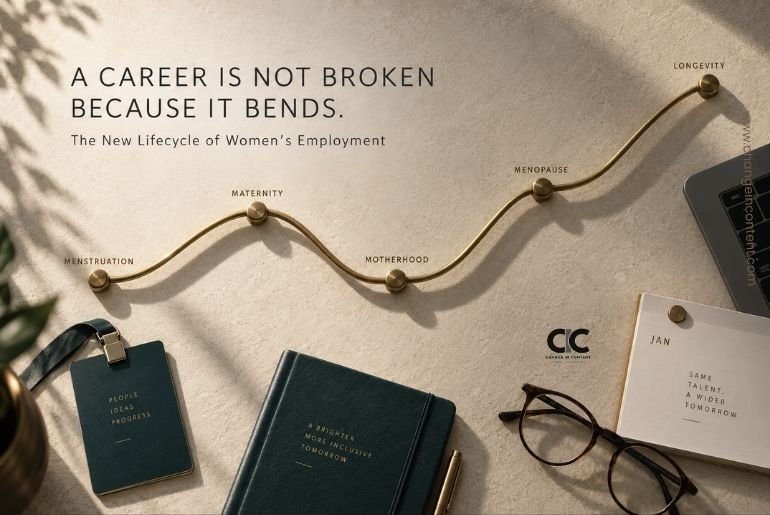
- The new lifecycle of women’s employment recognises that women’s working lives often move in rhythms rather than straight lines, shaped by health, care, family formation, longevity and re-entry, not by a simple uninterrupted climb.
- New research and long-running scholarship suggest that many organisations still evaluate women against an outdated ideal worker model: continuously available, continuously rising, and largely untouched by bodily or care-related realities.
- That creates a structural penalty. Menstruation, maternity, motherhood, menopause and longer working lives are often treated as interruptions, when they are, in fact, foreseeable phases that workplaces can plan for.
- This matters beyond gender fairness. In ageing, low-fertility societies, it is economically short-sighted to design careers that push experienced women out, slow them down unnecessarily, or make return difficult.
- Organisations do not need softer rhetoric. They need sharper design: better leave, re-entry pathways, flexible work without penalty, health-aware management, fairer evaluation and career models that reward lifetime contribution.
The new lifecycle of women’s employment begins with a simple correction.
Women are not suddenly entering work. History tells us that they have always worked. They have worked in farms, households, factories, schools, offices, shops, labs, hospitals and informal economies. What has changed is the architecture around their work: how paid employment is organised, how careers are measured, when people form families, how long people live, and how much organisations still expect workers to fit a model built for a different life.
That model remains remarkably familiar. Join early. Climb steadily. Stay visible. Stay available. Do not pause for too long. Do not dip, or return needing adjustment. And do not ask the institution to recognise the body, care, or time. It is a model that flatters the straight line.
Women’s lives, however, are rarely lived that way.
The problem is not women’s careers. It is the template used to judge them.
Much of corporate life still treats continuity as a sign of seriousness. A clean upward line is read as commitment. Any bend in that line is quickly translated into reduced ambition, weaker leadership potential, or lower reliability.
That is where the trouble starts.
A growing body of research is pointing to something more useful: women’s careers often unfold in rhythms. They expand, contract, pause, recover, and re-accelerate. These movements are not random. They are often tied to predictable phases of life, including menstruation-related health burdens, pregnancy, childbirth, caregiving, and menopause. Furthermore, they are also tied to the fact that women now work across much longer lifespans than older employment systems were built to accommodate.
Seen that way, the real mismatch is not between women and work. It is between women’s lived careers and the narrow design of organisations.
The old idea of a career is growing less convincing
Economists have, for years, described a shift in women’s employment patterns. Among many educated women, the old profile of early labour-market exit has weakened.
Employment is flatter and stronger across the life course than in earlier generations. But the middle of the career often sags, especially through the thirties, before participation strengthens again later.
That middle matters. It is often the phase when women are building expertise, handling care, navigating childbirth or fertility decisions, carrying disproportionate mental load, and making the choices that shape long-term earnings.
Organisations frequently read this stage as a talent problem. In many cases, it is a design problem. The employee has not suddenly become less capable. The institution has remained too rigid.
A straight-line career was always a selective idea
The so-called ideal worker was never neutral. The model assumed someone who could remain fully committed to paid work without major interruption, someone whose domestic responsibilities were either lighter, outsourced, or made less visible.
That worker was easier to imagine because somebody else, often a woman, was absorbing the invisible labour behind the scenes.
Today, when more women are fully present in professional life, that old arrangement no longer hides as neatly. The contradiction is out in the open. The workplace says it wants retention, leadership diversity, and long-term performance. Its underlying career model still favours uninterrupted linearity.
That gap explains why many women are welcomed at entry level, praised for resilience in mid-career, and quietly filtered out from the most rewarded tracks.
The new lifecycle has five visible rhythms
This is where the discussion becomes more practical. The new lifecycle of women’s employment is not a slogan. It is a way of seeing how careers actually unfold.
1. Menstruation enters work long before leadership does
The working life often begins while women are still navigating menstrual symptoms, pain, stigma and silence. Many workplaces continue to treat this as too personal to mention and too minor to consider.
That assumption is lazy. If a recurring health experience affects concentration, attendance, comfort, scheduling, travel or confidence, it is a work issue. Silence does not make it disappear. It simply pushes the cost onto women alone.
2. Maternity is still treated as a detour instead of a transition
Pregnancy and childbirth remain among the clearest examples of a predictable life phase being treated like an exception. Maternity leave may be protected in policy, yet the professional narrative around it often remains punitive. Visibility drops. Assumptions shift. Career momentum is reinterpreted.
Too often, organisations still behave as if maternity temporarily moves a woman outside the serious stream of work, rather than as part of a normal working life that good systems should absorb.
3. Motherhood creates a long, uneven middle
Motherhood is not a single event. It is a prolonged restructuring of time. School schedules, sick days, care logistics, emotional labour, ageing parents, household management and second-shift work all pile into the same years that careers are supposed to deepen.
That is where the “sagging middle” becomes most visible. Many women remain in the workforce, but their careers are made harder, slower and more exhausting than they need to be. The answer is not to applaud their endurance. The answer is to redesign work so endurance is not the price of staying.
4. Menopause is still badly understood inside organisations
By midlife, many women are at or near the height of their expertise. Yet menopause remains one of the least discussed phases of working life, even though it can affect sleep, energy, concentration, confidence, and physical comfort.
Organisations that ignore menopause are not being professional. They are wasting senior talent by pretending a real life stage does not exist.
5. Longevity changes the whole picture
One of the most overlooked shifts in women’s employment is that careers are longer. Women are living and working longer, often with decades of contribution still ahead after midlife. This changes the entire logic of career planning.
A temporary slowing in one decade should not define a forty-year working life. A return after a break should not be seen as a concession. A late-career reinvention should not be unusual. Once longevity enters the conversation, lifetime contribution becomes a far better measure than uninterrupted continuity.
The new lifecycle of women’s employment is not about essentialising women
A necessary caution belongs here.
Not every woman will experience every phase in the same way. Not every woman becomes a mother. And not every woman wants children. Menstruation, fertility, caregiving and menopause differ across bodies, class, disability, health, geography and access to support. Some men and gender-diverse workers also live through non-linear careers and intense care responsibilities.
Even so, women continue to encounter these rhythms in structurally concentrated ways. That is why the issue is not individual preference. It is institutional design.
The point is not that all women follow one path. The point is that organisations still reward one narrow path as if it were universal.
Why this matters in ageing, low-fertility societies
The implications go well beyond workplace wellbeing.
In ageing, low-fertility environments, labour supply becomes tighter, care needs rise, and the pressure to sustain productivity intensifies. In such settings, pushing experienced women to the margins is not merely unfair. It is economically self-defeating.
Societies that need more skilled workers cannot keep operating as though the most predictable phases of women’s lives are inconvenient surprises. Firms that want leadership depth cannot keep losing trained women in the middle and then discussing pipelines as though the leak is mysterious.
Policymakers concerned about growth, pensions, care infrastructure and social sustainability should be looking closely at how work is designed across the female life course.
This is one reason the conversation matters in India as well. Our debates on labour-force participation, care, menopause, women’s health, return-to-work pathways and formal employment are often treated separately. They belong in the same frame.
The real shift is philosophical
Once you accept the new lifecycle, the language around work begins to change.
- Career dips stop looking like personal weakness and start looking like phases requiring institutional intelligence.
- Re-entry stops looking like a favour and starts looking like talent recovery.
- Flexibility stops being a women’s perk and starts becoming a modern productivity tool.
- Menopause support stops sounding niche and starts sounding like common sense.
The most important change, however, is this: Evaluation moves from short-term continuity to lifetime contribution.
That is the real intellectual shift. A woman’s value to an organisation should not be measured only by whether she remained on one smooth curve from age 24 to 44. It should be measured by what she builds, leads, learns, returns with, and contributes across a much longer horizon.
What organisations should redesign now?
If companies want to take the new lifecycle of women’s employment seriously, they need less sentiment and more systems.
Here is where to begin:
Build career lattices, not just ladders
Allow movement sideways, slower, paused or reconfigured without turning that shift into a silent demotion.
Protect flexibility from penalty
Hybrid work, flexible hours and part-year adjustments only matter if they do not quietly remove people from promotion tracks.
Create strong return pathways
Returnships, structured re-onboarding, confidence rebuilding, re-skilling and sponsor-led reintegration should become standard practice.
Treat women’s health as a work issue
Menstrual health, pregnancy, fertility treatment, postpartum recovery and menopause should have practical policy support, manager education and respectful language.
Measure outcomes over presenteeism
If visibility remains the hidden currency of advancement, women with rhythmic careers will keep paying more for progress.
Train managers to interpret rhythm correctly
A temporary contraction in availability should not automatically be read as reduced ambition.
Redesign benefits across life stages
Childcare support, eldercare assistance, preventive health cover, mental-health support and phased return options should sit inside mainstream workforce strategy.
Stop wasting midlife talent
That is where many organisations lose extraordinary women. Mid-career and midlife support should be treated as leadership strategy, not accommodation.
What policymakers and HR leaders should take from this
The article’s argument is simple, but its implications are large. If women’s working lives are rhythmic, then public policy and HR design must become life-course aware.
That means:
- stronger childcare and care infrastructure
- more secure parental and caregiving leave
- social protection that does not punish interrupted contribution histories
- skilling and re-skilling pathways for returners
- workplace guidance on menstruation and menopause
- formal employment systems that allow phased participation without permanent career damage
In other words, the challenge is not getting women to fit old institutions more efficiently. The challenge is getting institutions to fit reality better.
So what exactly is new here?
The newness lies less in women’s lives than in our willingness to describe them honestly. For too long, careers were narrated around a masculine default and then adjusted at the margins for everybody else.
What 2026 is making clear is that the margins are no longer marginal. They describe a huge share of the workforce.
Women’s careers are not broken because they bend. They bend because life is lived in phases, bodies are real, care is real, health is real, and time does not move in one professional register alone.
The organisation that understands this will not be more charitable. It will be more intelligent.
The new lifecycle of women’s employment deserves attention
The future of work will not be decided only by AI, policy or pay. It will also be decided by whether institutions can finally accept a basic truth: people do not live in straight lines, and careers never really did either.
The organisations that redesign work around that truth will keep better talent, build stronger leadership, and create workplaces that match the century they claim to belong to.
FAQs
Q: What is the new lifecycle of women’s employment?
A: It is a way of understanding women’s careers as long, rhythmic and phase-based rather than strictly linear. It recognises that health, care, family formation, menopause and longevity shape employment patterns over time.
Q: Why should organisations care about it?
A: Because outdated career models cost them talent. When firms treat predictable life phases as disruption, they create avoidable exits, slower progression, and weaker retention of experienced women.
Q: Does this apply only to women?
A: No. Many workers have non-linear careers. But women are more likely to experience certain embodied and care-related phases in ways that institutions have historically ignored or penalised.
Editorial Note
This article builds an original Change in Content argument using academic work on women’s labour-force participation, career rhythms, embodied life stages, and the long-run redesign of careers. The framework here is interpretive and editorial, but the underlying discussion is grounded in published research rather than trend commentary.
Sources
Lidia Cruces: A Quantitative Theory of the New Life Cycle of Women’s Employment. Journal of Economic Dynamics and Control, 2024. DOI: 10.1016/j.jedc.2024.104960
Maren Wright Voss, Justin Marcus, Barbara Fritzsche, Heike Schroder: Career Rhythms Across the Lifespan: An Age-Graded Perspective on Women’s Careers. Academy of Management Proceedings, 2026.
Claudia Goldin and Joshua Mitchell: The New Life Cycle of Women’s Employment: Disappearing Humps, Sagging Middles, Expanding Tops. Journal of Economic Perspectives, 2017.
Alicia A. Grandey, Allison S. Gabriel, Eden B. King: Tackling Taboo Topics: A Review of the Three Ms in Working Women’s Lives. Journal of Management, 2020.
Rebecca Mitchell, Anna Carmella Ocampo, Kerry Sherman, Jun Gu: Menstruation, Maternity, Motherhood, and Menopause: Milestones That Shape Women’s Careers and Work Experiences. In Elgar Encyclopedia of Occupational Health Psychology, 2024.
