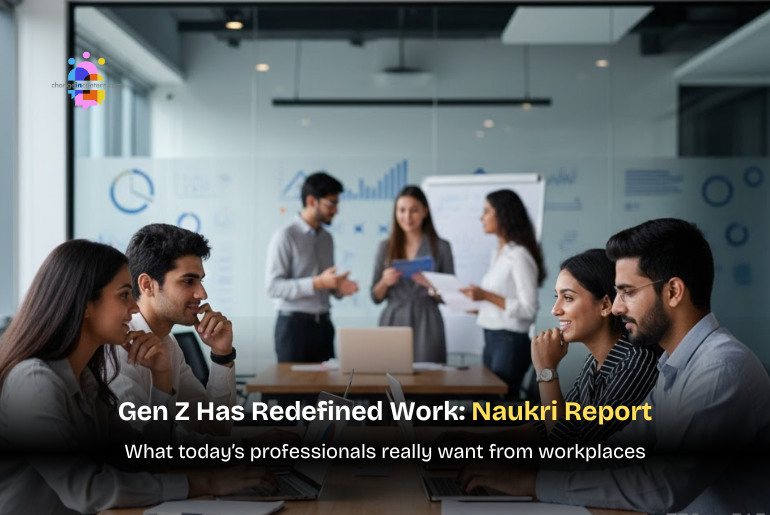
The Priorities of Gen Z Professionals are shaped by more than traditional ideas of success. Salary still matters, but it no longer dominates the conversation. According to Naukri’s newly released report, The Gen Z Work Code, India’s youngest working generation is asking harder questions about balance, learning, transparency, and mental health.
Based on insights from over 23,000 Gen Z professionals across 80+ industries, the report offers a rare, unfiltered look at what actually drives, engages, and retains this generation in corporate India.
What emerges is not a “difficult” workforce, but a deeply practical one. This workforce is clear about what it wants and is unwilling to settle for performative policies.
Background: Why this report matters now
Gen Z has entered the workforce amid overlapping crises: economic uncertainty, shrinking job security, rapid AI adoption, and visible burnout among older generations. Unlike previous cohorts, Gen Z has witnessed firsthand the costs of overwork.
Naukri’s report, released under its Voices @ Work series, captures this moment honestly. Instead of romanticising hustle or loyalty, it asks Gen Z what actually keeps them committed to work. The answers challenge many long-held corporate assumptions.
The-Gen-Z-Work-Code-Report-2026
The Priorities of Gen Z professionals: What the data reveals
Here is what the report reveals about the priorities and demands of Gen Z professionals.
Work-life balance is a deal-breaker
Half of Gen Z respondents report that work-life balance is the most crucial factor when evaluating a job offer. It is second only to salary. Among Gen Z professionals with 5–8 years of experience, this number rises to 60%.
It is not appropriate to view this as a matter of working less. It is about making working without exhaustion the norm. Long hours, blurred boundaries, and constant availability are no longer read as commitment. Instead, they showcase poor organisational design.
Career growth means learning (Not just climbing titles)
One of the most striking insights in the report is how Gen Z defines growth.
57% report that career growth means learning new skills on the job, not promotions or pay increases
Only 12% associate growth with promotions, and just 21% with salary increases. In creative fields such as design, animation, and advertising, the number rises to 78%, signalling a generation that values relevance over hierarchy.
It directly challenges organisations that still use titles as their primary retention tool.
Recognition must translate into opportunity
For Gen Z, appreciation without progression feels hollow.
81% prefer growth opportunities as a form of recognition, while only 9% value public or private praise alone.
Interestingly, higher-earning Gen Z professionals (₹15–25 LPA) show slightly greater interest in monetary rewards, yet learning and exposure remain central. Recognition, for this generation, is an investment, and not applause.
Mental health: The real stressors are structural
Contrary to popular belief, micromanaging bosses are not Gen Z’s biggest stressor. Only 16% cite this as their top mental health concern.
Instead, the biggest triggers are:
- No work-life balance (34%)
- Lack of growth (31%)
- Toxic colleagues (19%)
These numbers matter because they shift responsibility away from individual managers and towards organisational systems. Gen Z is not fragile. It is simply unwilling to normalise dysfunction.
How long will Gen Z stay? The answer depends on growth
The report indicates that 14% of Gen Z professionals are willing to leave within a year if growth appears stagnant. However, among those earning higher salaries or seeing consistent skill progression, willingness to stay for five years or more increases sharply.
This directly links retention to clarity, learning pathways, and transparent career conversations. Gone are the days when loyalty campaigns were enough.
Transparency is the new trust currency
When asked about company values, 65% of Gen Z ranked transparency and fairness above diversity statements, social impact, or environmental policies.
As experience grows, tolerance for opacity drops. Among professionals with 5–8 years of experience, 71% prioritise transparency. Gen Z wants honesty about pay bands, promotions, performance expectations, and leadership decisions.
What this means for women and marginalised professionals
For women, especially early-career professionals, these findings carry extra weight. The demand for flexibility, clarity, and learning intersects directly with issues like unpaid care work, safety, and slower promotion cycles.
When organisations fail to provide structured growth or transparent evaluation, women pay a higher price. Gen Z women, in particular, are showing early signs of disengagement when systems feel stacked against them.
What must workplaces do now?
If organisations want to attract and retain Gen Z talent, they must go beyond cosmetic fixes. The report makes it clear that policies must translate into lived experience.
Workplaces need to:
- Redesign work-life balance as a policy, not a privilege. Flexible hours, protected weekends, and realistic workloads must be non-negotiable.
- Build visible upskilling pathways linked to roles, not titles. Workplaces must embed learning into daily work.
- Replace symbolic recognition with real investment, such as sponsored courses, certifications, and exposure to meaningful projects.
- Normalise transparency around pay bands, growth criteria, and performance reviews.
- Address burnout structurally rather than outsourcing resilience to individuals.
That is where platforms like Changeincontent work closely with organisations. We help them audit policies, redesign people practices, conduct inclusion diagnostics, and run workshops that go beyond surface-level DEI conversations.
The changeincontent perspective
The Priorities of Gen Z Professionals are not unrealistic. They are deeply rational. This generation has watched older workers burn out, stall, and quietly disengage. Their demands are not about comfort; they are about sustainability.
If organisations fail to respond, the cost will not be attrition alone. It will be relevance.
The priorities of Gen Z professionals: The closing thoughts
Gen Z has made its position clear. It wants work that respects time, rewards learning, values honesty, and supports mental well-being. The question is no longer whether companies can adapt. It is whether they are willing to listen.
Because Gen Z already is.
Also Read: Gen Z demands diversity and inclusion, and they are not compromising.
Disclaimer: The views expressed in this article are based on the writer’s insights, supported by data and resources available both online and offline, as applicable. Changeincontent.com is committed to promoting inclusivity across all forms of content. We broadly define inclusivity as media, policies, law, and history. It encompasses all elements that influence the lives of women and marginalised individuals. Our goal is to promote understanding and advocate for comprehensive inclusivity.