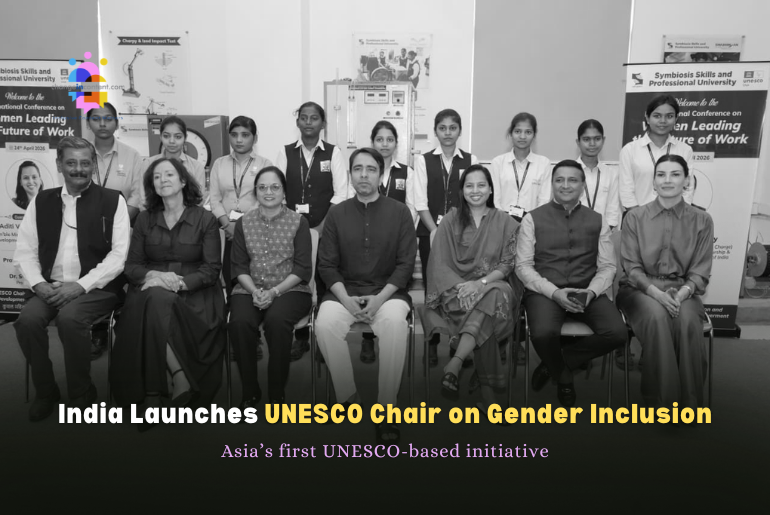
The launch of the first UNESCO Chair on Gender Inclusion in Pune marks a defining moment in India’s approach to workforce transformation. Announced by Union Minister Shri Jayant Chaudhary, this initiative places gender inclusion at the centre of skill development, particularly in emerging and high-growth sectors.
That is not just another institutional announcement. It is a structured attempt to bridge the gap between education, employability, and gender equity. Positioned within a global collaboration framework, the initiative reflects India’s ambition to lead conversations around inclusive workforce development rather than merely participate in them.
What is the UNESCO Chair on Gender Inclusion?
The UNESCO Chair on Gender Inclusion has been established at Symbiosis Skills and Professional University (SSPU), Pune, as part of an international collaboration with UNESCO. (Source: PIB)
It is:
- Asia’s first UNESCO Chair focused on Gender Inclusion and Skill Development
- A platform designed to integrate gender equity into technical education and skill ecosystems
- A long-term institutional mechanism to influence policy, research, and implementation
The Chair aims to ensure that women are not just included, but actively prepared for roles in emerging sectors that will define the future economy.
UNESCO Chair on Gender Inclusion: Why this matters now
The timing of this initiative is critical. India is:
- Rapidly expanding into sectors like AI, semiconductors, robotics, and advanced manufacturing
- Building a global workforce pipeline
- Positioning itself as a leader in future-of-work conversations
However, gender participation in these sectors remains uneven. The UNESCO Chair on Gender Inclusion directly addresses this gap by aligning:
- Skill development
- Industry demand
- Gender inclusion
In his address, Shri Jayant Chaudhary highlighted this clearly:
“India’s growth trajectory will be defined not only by scale but by how inclusively we empower our people.”
This statement sets the tone. Growth without inclusion is no longer acceptable.
Inside the launch: Policy, global collaboration, and institutional backing
The initiative was launched during the International Conference on “Women Leading the Future of Work”, organised in collaboration with UNESCO at SSPU, Pune.
Key dignitaries present:
- Shri Jayant Chaudhary, Minister of State (I/C), Skill Development and Entrepreneurship
- Ms Aditi Tatkare, Minister for Women and Child Development, Maharashtra
- Ms Monica Nagelgaard, Consul General of Norway
- Dr Swati Mujumdar, Pro-Chancellor, SSPU
Global participation:
The conference brought together:
- Policymakers
- Industry leaders
- Academic institutions
- International organisations
Notable global voices included:
- Ms Mary Overington (Trade and Investment Commissioner, South Asia)
- Mr Gabriel Bordado (International Labour Organisation)
- Ms Soledad Patiño (UNESCO Global Skills Academy)
- Ms Priscilla Wanjiku Gatonye (UNESCO-UNEVOC, Germany)
This level of participation signals that the initiative is not local. It is globally aligned.
Focus areas of the UNESCO Chair on Gender Inclusion
The Chair is not symbolic. It is built around concrete focus areas.
1. Emerging sectors
The initiative prioritises women’s participation in:
- Artificial Intelligence
- Semiconductor industry
- Robotics and Industry 4.0
- Defence technology
- Global Capacity Centres
These are sectors where gender gaps are currently the widest.
2. Industry-aligned skill development
The Chair aims to ensure:
- Training aligns with real industry needs
- Women are equipped for high-value roles
- Skill-building leads to actual employment outcomes
3. Inclusion beyond urban centres
A key emphasis is on:
- Reaching women from underserved communities
- Creating access to opportunities that are otherwise inaccessible
- Building confidence and independence through skill development
As Ms Aditi Tatkare noted, such initiatives are essential for:
- Long-term empowerment
- Economic participation
- Social transformation
The bigger policy signal
The UNESCO Chair on Gender Inclusion is not an isolated move. It reflects a broader shift in policy thinking:
- From women’s participation to women’s leadership in future industries
- From skill training to skill ecosystems
- From inclusion as a goal to inclusion as a measurable outcome
It aligns with global trends where countries are:
- Linking gender equality with economic growth
- Building inclusive pipelines for emerging industries
- Treating workforce diversity as a strategic advantage
India’s position in the global gender conversation
India’s move comes at a time when global data continues to show mixed progress on gender equality. If you look at our earlier analysis on public perception. You will notice a pattern:
- Awareness is rising
- Acceptance is improving
- But structural change is still catching up
The UNESCO Chair on Gender Inclusion attempts to close that gap.
Challenges that will define its success
While the initiative is ambitious, its success will depend on execution. Key challenges include:
- Industry absorption: Training must translate into jobs. Without industry hiring, impact will remain limited.
- Rural accessibility: Scaling beyond urban centres will determine true inclusivity.
- Cultural barriers: Social norms still restrict women’s participation in technical fields.
- Long-term measurement: Success must be measured through:
- Employment rates
- Career progression
- Leadership representation
The Changeincontent perspective
The launch of the UNESCO Chair on Gender Inclusion is a strong step. But it also raises a larger question.
Are we preparing women for the future of work?
Or are we redesigning the future of work to include women?
Because the difference matters. True inclusion will not come from training alone. It will come from:
- Hiring practices
- Workplace cultures
- Leadership pathways
If this initiative can influence all three, it will not just be successful. It will be transformational.
Conclusion: UNESCO Chair on Gender Inclusion is a starting point, not the finish line
The UNESCO Chair on Gender Inclusion signals intent. A strong one. But intent must evolve into impact.
Because conferences or collaboration will not measure the real success of this initiative. It will be measured in:
- Women entering high-growth industries
- Women staying and growing in those roles
- Women leading those sectors in the future
And when that happens, India will not just be part of the global conversation. India will lead it.
Disclaimer: The views expressed in this article are based on the writer’s insights, supported by data and resources available both online and offline, as applicable. Changeincontent.com is committed to promoting inclusivity across all forms of content. We broadly define inclusivity in terms of media, policies, law, and history. It encompasses all elements that influence the lives of women and marginalised individuals. Our goal is to promote understanding and advocate for comprehensive inclusivity.