
The Quick Read
- Helping women to stay in work requires looking beyond recruitment and training. India’s 2024 Time Use Survey found that women participating in unpaid domestic work spent 289 minutes a day on it, more than three times the 88 minutes recorded for men.
- Among Indians aged 15–59 who provided unpaid care, women spent about 140 minutes a day, compared with 74 minutes for men. Women were also almost twice as likely to participate in caregiving.
- The ILO estimates that 708 million women worldwide were outside the labour force in 2023 due to caregiving responsibilities. In South Asia, 56% of women outside the labour force cite care as the primary reason.
- India’s latest NITI Aayog skilling strategy acknowledges that caregiving, safety, mobility, cost and weak links between training and employment can prevent women from converting skills into sustained work. It recommends flexible programmes, transport support and employment pathways built around real-life constraints.
- Retention should therefore become a core outcome for CSR programmes, universities, training providers and employers. Track whether women are still working after six months, one year and three years, whether earnings improve, and what makes them leave.
- The strongest programmes will increasingly combine skills + jobs + care infrastructure + mobility + flexibility + manager support + career progression, rather than treating each as a separate problem.
Everyone loves the photograph at the beginning
25 women hold certificates. Someone from the company stands in the middle. There are smiles. And a banner behind them contains words such as empowerment, livelihood, future, perhaps transformation.
The CSR report has its photograph. A training provider has its completion number. The college has placed another batch. And the organisation has reached its diversity target.
For helping women to stay in work, however, the useful photograph would probably be taken 12 months later.
- Who is still working?
- Who is earning more?
- Who left?
- Who never joined the job she was trained for?
- Who moved home after marriage?
- Who could not manage the commute?
- Whose child fell ill?
- Who began caring for a parent?
- Who discovered that an entry-level salary would barely cover childcare and transport?
- Who received an offer for a night shift her family would not allow?
- Who returned from maternity leave and found that her role had quietly shrunk?
- Who was promoted?
That second photograph is much harder to organise. It is also where women’s economic participation actually lives.
India is getting better at opening doors
We cannot understate that progress.
- Women are entering higher education in large numbers.
- Women are enrolling in vocational programmes.
- Government skilling initiatives have expanded.
- Corporate foundations fund scholarships, entrepreneurship programmes, digital literacy, STEM education and self-help groups.
- Companies are recruiting women into manufacturing, logistics, finance, technology, and other occupations that were once overwhelmingly male.
- And India has also seen a significant rise in female labour-force participation.
There are good reasons for optimism. But participation and continuity are different measurements.
Our recent analysis of women in formal jobs explored NITI Aayog’s uncomfortable finding that only 3% of women across the segments examined in its skilling framework were in formal employment. The report’s larger message was equally important: skills do not automatically become sustained economic participation.
Somewhere between capability and career, women keep encountering friction. We need to become much more curious about that middle.
A 4-hour training session can sit on top of a 5-hour unpaid shift
India’s Time Use Survey 2024 makes the arithmetic difficult to ignore.
Among people actually performing unpaid domestic services, women spent an average of 289 minutes a day on those activities. Men spent 88 minutes.
Women participating in unpaid caregiving spent 137 minutes, compared with 75 minutes among men.
Among the working-age 15–59 group, the caregiving figures were about 140 minutes for women and 74 for men. 41% of women participated in caregiving, compared with 21.4% of men.
Now place a skilling programme on top. 2 hours of class. An hour each way on public transport. Assignments. An internship. An 8-hour job after placement.
The programme may technically be available equally to men and women. Their available day is not necessarily equal. That is where programme design often fails.
We ask whether women are motivated enough to attend. We do not ask how many competing hours their day already contains.
And care is not an Indian footnote
Globally, the ILO estimates that 748 million people were outside the labour force due to caregiving responsibilities in 2023.
Of them: 708 million were women. Only 40 million were men.
Among women aged 25–54 who were outside the global labour force, two-thirds cited care responsibilities. In Asia and the Pacific, more than half of women outside the labour force identify care as the main reason; in South Asia the share rises to 56%.
That turns care from a personal-family matter into labour-market infrastructure.
If hundreds of millions of women cannot participate because somebody must look after children, older people, persons with disabilities, homes and families, then childcare and eldercare are not peripheral “women’s issues”.
They are economic systems.
The training industry has a conversion problem
NITI Aayog’s August 2026 Reimagining Skilling for Viksit Bharat@2047 report is remarkably frank about this.
India has trained more than 7.67 crore people since 2014–15. Yet outcomes remain uneven.
The report identifies barriers including caregiving responsibilities, safety, mobility, affordability, foregone income, weak career guidance and insufficient links between learning and real workplace demand.
It also recommends something that should become standard in programme design: shorter, more flexible formats that explicitly recognise women’s caregiving responsibilities.
That sounds straightforward. It represents a significant conceptual change.
For years, programmes have often asked: How can we get women into training?
A stronger programme asks: What would allow this particular woman to complete the training, take the job and still be there a year later?
Different question. Different intervention.
Because the dropout may happen before training even starts
Consider a 28-year-old woman in a tier-two city. She wants to train in data analytics. The programme is free.
Excellent.
- But sessions run from 4 pm to 7 pm.
- Her child returns from school at 3.30.
- The nearest centre is 45 minutes away.
- Her husband works until 8.
- Her mother-in-law needs medication in the evening.
- There is no reliable childcare nearby.
The programme reports: Candidate did not enrol.
What caused the failure? Motivation? Awareness? Digital skills? No.
The curriculum could be excellent. The constraint was care architecture.
Now consider another woman who completes the same programme.
She receives a job 23 kilometres away.
Salary: ₹16,000. Commute: ₹3,000. Childcare: ₹5,000. Travel time: 3 hours.
Her family asks why she is “doing all this” for the remaining money. She leaves.
The programme reports: Placed successfully.
Again, what exactly succeeded?
Placement is much too early to declare victory
This deserves becoming a permanent rule for women’s skilling.
Placement is an intermediate outcome. Retention tells us considerably more.
Our earlier coverage of the Skill Impact Bond provides a good example of why.
Women formed more than 70% of enrolments in the programme. Certification among women reached 92%, placement climbed to 81%, and three-month retention rose from 48% to 66%, eventually matching men’s retention in the cohort reported.
That programme deliberately linked financing to outcomes beyond enrolment. It is an important direction.
Now go further. 3 months. 6 months. 12 months. 24 months.
What happens to wages? What happens after marriage? After childbirth? After relocation? And after the first promotion cycle?
If a woman is trained, placed and gone within nine months, the learning should feed back into programme design.
Otherwise we are repeatedly funding entry into the same revolving door.
College education has the same blind spot
Higher education frequently prepares women exceptionally well for examinations. It prepares them less consistently for the negotiation between work and life that arrives afterwards.
Career services usually focus on: CVs. Interviews. Aptitude. Placement preparation. Technical skills. Communication.
All worthwhile. But consider what women graduates may also need to understand.
- How do you assess whether a job’s commute is sustainable?
- What should you ask about night shifts?
- How do you understand maternity benefits?
- What does a career break do to earnings?
- How do you negotiate relocation with a family?
- What does financial independence actually require?
- How should partners discuss unpaid work before marriage?
- What workplace policies matter when evaluating an employer?
- How can you plan childcare before a crisis?
- How do you return after a break?
- How do you keep learning while caregiving?
These are not finishing-school topics. They are career-continuity skills.
A college that celebrates women’s placement but never prepares them for predictable points of workforce exit has done only part of the job.
Career counselling needs to stop pretending careers happen in laboratories
The classic counselling question is: What do you want to become? Engineer. Doctor. Designer. Banker. Entrepreneur.
Wonderful. The next generation of counselling should ask a few more questions.
- Where are those jobs located?
- What do they pay at entry?
- What hours are typical?
- What transport exists?
- Does the occupation require migration?
- How flexible is it?
- What happens after a career interruption?
- Can the skill travel across employers?
- What are the future progression routes?
- Can somebody return after three years away?
NITI Aayog’s 2026 skilling report calls for continuous career guidance spanning education, work and re-entry rather than isolated counselling at transition points. That is especially relevant for women because many women’s careers are not linear.
A break does not mean capability disappeared. But our employment systems often behave as if it did.
Change in Content’s earlier guide to women returning after career breaks explored exactly this penalty: women frequently re-enter smaller roles, with lower pay or biased recruitment processes, despite retaining valuable experience.
Preparing women to enter work without preparing institutions to recognise re-entry is an incomplete intervention.
CSR has an opportunity to move beyond “empowerment”
Corporate social responsibility programmes have done important work around women’s economic participation.
Scholarships matter. Skills matter. Credit matters. Entrepreneurship matters. Self-help groups matter. Digital literacy matters.
But there is a danger when the programme theory stops at: give women capability → woman becomes economically empowered.
A capability only becomes economically useful when circumstances allow it to be exercised.
- A sewing machine cannot solve eldercare.
- Coding skills cannot solve unsafe transport.
- A microloan cannot collect a child from school.
- Financial literacy cannot make a husband’s unpaid-care contribution materialise.
- Entrepreneurship training cannot create six uninterrupted hours in somebody’s day.
We need to stop asking women’s programmes to solve structural problems through individual capability alone. That is too much weight to place on training.
What would a retention-led CSR programme look like?
Start with the outcome.
Instead of: Train 10,000 women.
Try: Help 6,000 women establish and sustain income for at least 18 months.
Immediately, programme design changes.
Now the CSR team must care about: job quality; salary; distance; care; transport; family support; digital access; working hours; retention; employer behaviour; and progression.
Suddenly, partnerships look different too.
- A training provider may need to work with childcare providers.
- An employer.
- A transport partner.
- A women’s hostel.
- A local government.
- A career coach.
- A health provider.
- Community organisations.
- Perhaps husbands and families.
The programme becomes harder to describe in one neat brochure. It may also become much more useful.
Ask every programme one uncomfortable question: What happens at 5 pm?
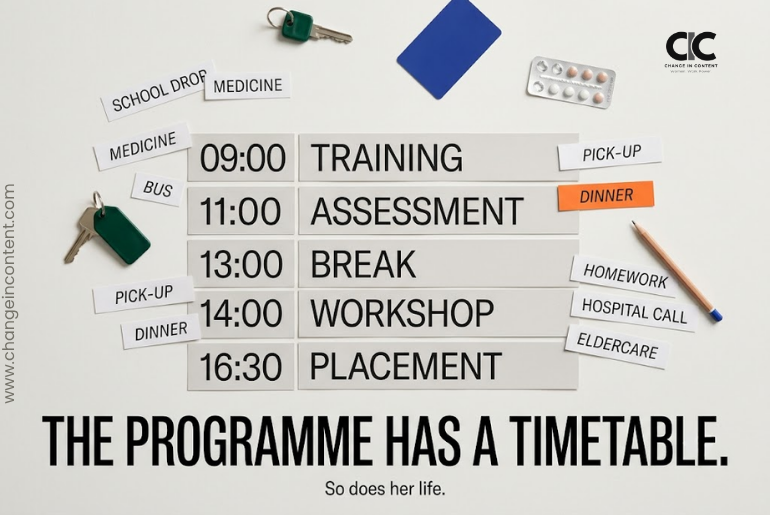
Programme design loves the formal day. 9 am to 5 pm. Class begins. Class ends. Work begins. Work ends.
Women’s care responsibilities often live in the margins around that timetable. 6 am breakfast. 7 am school preparation. 8 am elder medication. 5 pm school pickup. 7 pm dinner. 9 pm homework. 10 pm household administration.
A working day is not experienced only as paid hours. India’s Time Use Survey helps make the invisible schedule visible. Women who participated in unpaid domestic work were still spending nearly five hours a day on it in 2024.
So ask:
- What happens before the training starts?
- What happens when it ends?
- Who takes over her existing work?
Often, nobody. The opportunity is simply added. That may explain why empowerment programmes can occasionally look like workload expansion programmes from the woman’s side.
Families are infrastructure too
This is the part formal programmes often avoid because it feels too personal. It is nevertheless unavoidable.
If a woman receives training but her family expects her to remain solely responsible for cooking, cleaning, children and older relatives, the programme has changed her economic opportunity without changing her time.
Some interventions therefore need to involve households. Not because a woman’s employment requires family permission. Because gender norms around care are produced and maintained inside homes as well as workplaces.
- Programme orientation can include spouses.
- Schools can teach boys domestic competence.
- Community campaigns can present care as a shared responsibility.
- Paternity and parental leave can normalise fathers as caregivers.
- Men can be included in caregiving skills programmes.
NITI Aayog’s new care strategy itself calls for redistribution of responsibilities and wider recognition of caregiving, alongside greater access to formal care services.
This is not about “helping women at home”.
The language matters. Cooking for your own household is not helping your wife. Looking after your own child is not helping the mother. It is participating in family life.
Childcare is employment infrastructure
We tend to place childcare in the benefits column. Perhaps it belongs beside roads, transport and broadband.
A woman cannot participate consistently in paid work if a young child has nowhere safe and affordable to go.
The problem is particularly acute for women in informal, shift-based, manufacturing, retail and service jobs where remote work is impossible.
Accessible childcare can take many forms: workplace crèches; shared childcare centres in industrial clusters; community childcare; extended-hour centres; subsidised private care; school-linked aftercare; emergency backup care; childcare allowances.
One size will not work. What matters is whether the care matches the employment.
A crèche that closes at 5 pm is of limited value to a nurse whose shift ends at 8.
And the next care crisis may involve a parent, not a child
Retention programmes also need to stop assuming caregiving ends when children grow older.
India is ageing. Families are becoming smaller. Young adults migrate for work.
NITI Aayog’s August 2026 Reimagining Care report explicitly warns that changing family structures and increasing longevity will increase demand for formal care services. It says India’s present system remains heavily reliant on unpaid family caregiving, much of it performed by women.
That matters enormously for women in their 40s and 50s. They may finally have older children and greater professional seniority. Then ageing parents require care.
Our recent Sunday feature on the Sandwich Generation explored exactly this collision: experienced women carrying leadership responsibilities at work while simultaneously managing children and elderly parents.
If employers think care policy means maternity leave and crèche access, they are designing for one chapter of a much longer working life.
Respite care deserves to enter the workplace vocabulary
This concept is still unfamiliar in many employment discussions.
Respite care gives a caregiver temporary relief. It can be a few hours. A day. A weekend. Short-term professional support.
NITI Aayog’s new care strategy specifically recommends expanding access to affordable, high-quality caregiving services and respite-care programmes as part of reducing women’s disproportionate care burden.
For employers, eldercare assistance could eventually sit alongside childcare benefits.
That might include:
- care-navigation services;
- verified caregiver networks;
- emergency care support;
- paid caregiver leave;
- respite-care subsidies;
- geriatric consultation;
- hospitalisation support.
Midlife talent retention may increasingly depend on it.
Flexible work helps. Badly designed flexibility can hurt.
Flexibility has become the most obvious answer to women’s care responsibilities. It is useful. But organisations need to watch what happens after somebody uses it.
- Does the employee working remotely get fewer high-visibility assignments?
- Does the mother leaving at 5.30 get labelled less ambitious?
- Does flexible work mean she completes the same workload at 11 pm?
- Is the person requesting flexibility quietly removed from promotion discussions?
Our recent piece on work-life balance for contemporary women made the point that women do not need better calendar management so much as greater control over time, work and care.
Good flexibility reduces friction. Poor flexibility simply moves paid work into the hours after unpaid work finishes.
Managers are retention infrastructure too
Many women do not resign from policies. They resign from what happens when life collides with policy.
“My child is unwell.”
“My father has been hospitalised.”
“I need to move this meeting.”
“I cannot travel this week.”
“My childcare has fallen through.”
The manager’s response matters.
A technically generous policy can become unusable if the manager communicates:
Again? Will this affect the deadline? Can your husband not manage it? You know this role requires commitment.
No prohibition has occurred. The message has landed. Employees learn quickly which benefits are safe to use. Therefore, manager training should include caregiving. Not as sensitivity training. But as workforce management.
- How do you plan around temporary constraints without assuming permanent lack of ambition?
- How do you distribute assignments fairly?
- How do you avoid penalising flexibility?
- How do you discuss performance separately from availability theatre?
Those are management skills.
Job quality decides whether staying makes economic sense
Sometimes a woman leaves because the arithmetic is rational.
- Salary: ₹18,000.
- Childcare: ₹6,000.
- Commute: ₹4,000.
- Meals and work costs: ₹2,000.
- 3 hours of travelling.
- 5 hours of domestic work remain when she reaches home.
Then someone asks: Why did she “drop out”?
Because an opportunity can exist and still offer too little return for the cost of participating. That is where wage quality becomes inseparable from retention.
The Skill Impact Bond story illustrates the problem from a different angle. Women matched or surpassed men on several training and retention outcomes while still reporting lower earnings.
Training a woman for low-paid work and then blaming care when she leaves would miss half the equation.
The job itself has to be worth staying in.
Women’s health also belongs inside retention
A woman may leave because of care. She may also leave because her own body becomes harder to fit around work.
- Menstruation.
- Pregnancy.
- Fertility treatment.
- Postpartum recovery.
- Endometriosis.
- Mental health.
- Perimenopause.
- Menopause.
- Chronic illness.
A programme aimed at “women’s retention” cannot assume the participant remains physically constant for 30 years. That is another reason career continuity needs a life-course approach.
The objective is not to design special treatment at every stage. It is to build enough adaptability that a temporary health or care constraint does not automatically become a permanent career interruption.
Employers should measure exits differently
Most organisations know their attrition rate. Far fewer understand their care-related attrition.
Exit interviews often record personal reasons, family reasons, relocation, work-life balance, and career breaks.
These broad categories conceal valuable information.
- Was childcare unavailable?
- Was eldercare the issue?
- Did shift timing matter?
- Did the commute become impossible?
- Was there a manager problem?
- Did flexibility exist but feel unsafe to use?
- Was the salary insufficient to cover the cost of paid care?
- Could the employee have stayed with a six-month reduced schedule?
The organisation cannot redesign what it refuses to diagnose. Confidential, aggregated retention analysis can reveal where women are being lost.
Then compare by career stage; role; location; shift; salary band; parental status where voluntarily disclosed; manager; promotion history; flexibility use.
Patterns appear.
Universities should measure something after placement season
Educational institutions also have a role.
Imagine universities reporting: Women’s placement: 91%.
Then adding: Still employed after 12 months: 74%.
Average wage growth after two years: 18%.
Women returning after first career interruption: 63%.
Now education begins seeing itself as part of a labour-market journey rather than a placement machine. Alumni networks can become particularly useful here.
A woman who leaves work at 29 should not disappear from the institution’s career ecosystem forever.
Universities could provide:
- return-to-work counselling;
- short refresher modules;
- employer re-entry partnerships;
- alumni mentoring;
- career-break credentials;
- continuing access to placement networks.
Education does not have to expire at graduation.
Training providers need a “retention interview”
We have admission interviews. Placement interviews. Why not retention interviews?
At 3 months: What is making the job difficult?
At 6: What might make you leave?
And at 12: What helped you stay?
Those conversations could reveal issues training curricula cannot. Commute. Manager. Pay. Care. Harassment. Shift timing. Housing. Health. Family opposition. Mismatch between promised and actual job.
Once programmes collect that data systematically, their definition of employability becomes much richer.
A provider may discover that the skill was never the problem. That is useful knowledge.
Helping women to stay in work: CSR funding should reward continuity
Funders shape behaviour through what they pay for. If grants reimburse training providers based largely on enrolment and completion, enrolment and completion will dominate.
If contracts reward placement, 6-month retention, one-year retention, income improvement, formalisation, promotion, and successful return after interruption, providers will begin designing for those outcomes.
Outcome financing is not appropriate everywhere, and poorly designed targets can lead to gaming or exclusion. But the underlying principle is useful.
Pay attention to the outcome you actually care about.
For women’s economic programmes, surely that outcome is not receiving a certificate. It is greater agency and a more durable livelihood.
Governments can make staying easier without creating “women-only” economies
Public policy sits underneath all of this.
Care services. Public transport. Safe streets. Affordable housing near employment centres. School timings. Health infrastructure. Social protection. Portable benefits. Parental leave. Skills systems. Formal care employment.
These systems determine the cost of women’s participation.
The ILO’s care-economy framework is useful because it addresses the recognition, reduction, and redistribution of unpaid care while also rewarding and representing paid care workers.
That helps avoid another mistake. We should not solve unpaid care by transferring badly paid care work to poorer women.
Domestic workers. Anganwadi workers. Childcare workers. Elder caregivers. Nurses.
Care infrastructure must expand, and care work must become decent work. Otherwise one woman’s labour-market participation is subsidised by another woman’s underpaid labour.
The care economy can itself become an employment strategy
There is an opportunity here too.
- India needs more childcare.
- More eldercare.
- More disability support.
- More home-based care.
- More long-term care.
- More trained caregivers.
NITI Aayog’s new care report calls for a trained caregiving workforce and proposes standardised certification, specialised training and stronger institutional systems.
The ILO is already supporting care-cooperative models in India that aim to turn informal and unpaid care into organised livelihoods while expanding affordable care services. In 2026, women in Madhya Pradesh and Bihar were among those participating in emerging cooperative care models.
That creates a virtuous possibility. Invest in care.
- Women gain time.
- Some women gain jobs.
- Families gain services.
- The economy gains workers.
Care stops being treated as whatever women somehow manage after everything else.
A practical framework: Design for STAY
For organisations, colleges, funders and training providers, I would make the guide memorable by using a single framework.
S: Start with the life around the learner
Before designing training, understand care responsibilities, transport, income constraints, digital access, health, family circumstances, geography, and working hours.
Segment participants rather than assuming all women need identical support.
T: Track beyond training
Do not stop measurement at enrolment, completion, and placement.
Track:
- 3-month retention;
- 6-month retention;
- 12-month retention;
- earnings;
- formalisation;
- career progression;
- reason for exit;
- return after interruption.
A: Add the missing infrastructure
Depending on the population, this can include:
- childcare;
- eldercare;
- transport;
- safe accommodation;
- hybrid learning;
- flexible schedules;
- stipends;
- health support;
- digital access;
- respite care.
Do not assume training itself is the intervention.
Y: Yield power, time and choice
The final goal is not to keep every woman in every job forever.
- People should leave bad jobs.
- Change careers.
- Take breaks.
- Care for family when they choose.
- Study again.
- Start businesses.
The success measure is whether she has real choice.
- Does she control enough money?
- Enough time?
- Enough mobility?
- Enough information?
- Enough bargaining power?
- Can she leave and return without destroying her economic future?
That is a far more meaningful version of empowerment.
What leaders should ask on Monday morning
- If you run CSR: How many women we trained last year are still earning today?
- If you run HR: Why did women leave us, beyond the phrase “personal reasons”?
- If you run a university: What happens to women graduates five years after placement?
- If you run a skilling organisation: Which non-skill barrier causes the most dropouts after placement?
- If you manage people: Can employees use our flexibility without paying a career penalty?
- If you design public policy: What unpaid work is currently subsidising women’s participation in this programme?
- If you are funding women’s entrepreneurship: Who takes over her care responsibilities when her business grows?
Those questions move the conversation forward quickly.
Helping women to stay does not mean trapping women in work
This is an important distinction.
A successful retention strategy should never become: Women must remain economically productive regardless of circumstances.
- Care is valuable.
- Motherhood is valuable.
- Looking after parents is valuable.
- Time outside paid employment can be valuable.
Women are allowed to want different lives.
The policy failure occurs when somebody wants paid work and loses access because the surrounding systems make continuation unnecessarily difficult.
The objective is choice. A woman should be able to care without destroying her economic future. And work without abandoning everybody who depends on her. Men deserve that possibility too.
A better care system ultimately creates healthier working lives for everyone. Women simply have more to gain because they currently carry more of the cost.
The Change: The door was never the whole problem
For a long time, women’s empowerment programmes had an understandable mission.
- Open the door.
- Get the girl into college.
- Get the woman into training.
- Give her a loan.
- Help her start a business.
- Recruit her into the factory.
- Put her name on the payroll.
Much of that work was necessary. It still is. But perhaps we have reached the next question. What happens after she walks through?
- Does her unpaid workload shrink?
- Can she afford childcare?
- Can she reach the workplace?
- Is the job worth the commute?
- Will her husband take parental leave?
- Can she care for an ageing mother without resigning?
- Can she work flexibly without becoming invisible?
- Will a three-year break permanently reduce what employers think she is worth?
- Can she remain ambitious while somebody depends on her?
- Can she leave and come back?
The answers determine whether opportunity becomes economic power.
Women do need skills. Capital. Education. Mentors. Networks. Jobs. But sometimes what keeps a woman working is considerably less glamorous.
- A bus.
- A crèche.
- A father who does school pickup.
- A manager who says yes.
- A reliable eldercare worker.
- A programme scheduled at the right hour.
- A wage high enough to make work viable.
- A workplace that remembers her potential while life becomes complicated.
For years we have invested in helping women start.
The next great women’s economic programme may be the one designed around helping them continue.
Editorial Note
This Knowledge Hub guide draws on the latest available evidence through August 2026, including India’s Time Use Survey 2024, NITI Aayog’s August 2026 reports on skilling and caregiving, and current International Labour Organisation research on unpaid care and women’s labour-force participation. Time-use figures refer to participants who performed the specified activity and should not be interpreted as time spent by every woman or man. Care responsibilities are one important determinant of women’s economic participation alongside job availability, wages, education, social norms, health, safety, mobility and individual choice. The recommendations in this guide are intended as programme-design principles rather than a universal template.
Sources
Ministry of Statistics and Programme Implementation — Time Use Survey 2024: India’s latest national evidence on paid work, unpaid domestic work and caregiving.
NITI Aayog — Reimagining Skilling for Viksit Bharat@2047, August 2026: Identifies caregiving, mobility, safety and affordability among barriers affecting learners and recommends flexible and employment-linked pathways.
NITI Aayog — Reimagining Care: Strategies for Empowering Caregivers in Viksit Bharat@2047, August 2026: Examines India’s reliance on unpaid family caregiving and proposes a stronger formal care ecosystem, respite care, training and redistribution.
International Labour Organisation — The Impact of Care Responsibilities on Women’s Labour Force Participation: The ILO estimates that 708 million women globally were outside the labour force due to unpaid care responsibilities in 2023.
ILO India — Building Resilient Societies Starts With Strengthening the Care Economy, April 2026: Current South Asian analysis connecting care infrastructure with female labour-force participation and economic development.
