
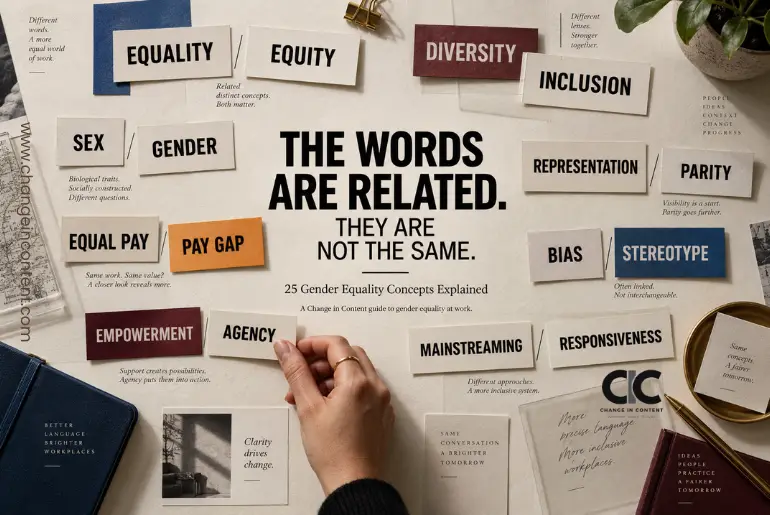
The Brief
- Gender and sex are related but different. Sex concerns biological and physiological characteristics; gender includes socially constructed roles, behaviours and expectations.
- Equality is the destination; equity is one way of getting there. Identical treatment can sometimes reproduce disadvantage when people begin from different circumstances.
- Representation does not automatically produce inclusion. An organisation can hire more women while leaving decision-making, promotion and workplace culture unchanged.
- Gender mainstreaming means considering gender before a policy is designed, rather than adding a “women’s component” afterwards. The approach has been part of the global gender-equality framework since the 1995 Beijing Platform for Action.
- Gender equality is not a project for women to solve. UN Women explicitly treats it as an issue that concerns and requires the participation of both women and men.
- The Sustainable Development Goals make the breadth of the issue clear: SDG 5 covers discrimination, unpaid care, leadership and economic rights, while SDG 8 includes equal pay for work of equal value.
Key gender equality concepts matter in 2026
A curious thing happens when organisations begin talking about gender.
Everybody seems to know the vocabulary.
Equality. Equity. Inclusion. Empowerment. Bias. Intersectionality. Representation. Allyship.
The words appear in annual reports, leadership speeches, HR policies, employee surveys and International Women’s Day posts.
Ask 10 people what they actually mean, however, and the definitions begin drifting.
- Equality becomes diversity.
- Diversity becomes inclusion.
- Equity gets described as giving women “special treatment”.
- Empowerment becomes a confidence workshop.
- Gender becomes another word for women.
And somewhere along the way, language that was supposed to make inequality easier to understand starts making it more confusing.
That is why Change in Content wanted to return to the basics. This is our guide to the gender equality concepts people encounter in workplaces today: what they mean, what they do not mean, why the distinctions matter, and where perfectly good ideas can go wrong when organisations use the terminology without understanding the underlying logic.
There is one principle running through the whole guide: Gender equality should expand people’s choices, not create another set of rules about how women or men are supposed to behave.
Women do not need to be portrayed as permanently disadvantaged. Men do not need to be portrayed as the problem.
Systems, expectations and decisions are what we need to examine. Let’s start there.
The key gender equality concepts
Let’s look at the key concepts.
1. Sex and gender: related, but not interchangeable
These are often the first two terms to separate.
What is sex?
In the technical sense, sex refers to biological and physiological characteristics, including chromosomes, hormones and reproductive anatomy. WHO also recognises natural variations in sex characteristics, including intersex variations.
What is gender?
Gender refers to the socially constructed characteristics, roles, behaviours, norms, and relationships associated with women, men, girls, and boys.
Unlike biological characteristics, these expectations can differ between cultures and change over time.
That difference becomes easy to see at work.
There is nothing biological about believing: women are naturally better at administrative work; men are naturally better negotiators; mothers will be less ambitious; fathers should prioritise earning over caregiving; women communicate better with children; men should not take long parental leave; or women are better suited to HR while men fit operations.
Those are gendered expectations. And because they are socially produced, they can also be changed.
Workplace takeaway
When an organisation attributes a behaviour or capability to someone’s sex without evidence, a biological distinction has probably been turned into a gender stereotype.
2. Gender roles: The jobs society quietly assigns before HR does
Gender roles are expectations about how women and men are supposed to behave or what responsibilities they are expected to assume.
They are visible everywhere.
- Women care. Men provide.
- Women organise. Men decide.
- Women support. Men lead.
Fortunately, real human beings are far more interesting than those categories. Yet gender roles matter professionally because careers do not develop separately from life outside work.
If a heterosexual couple has a child and both have equally demanding careers, but everyone automatically assumes the mother will adjust her working hours, the workplace eventually sees the effect of a social gender role.
Her travel reduces. Her availability changes. She may decline a relocation. Promotion may slow.
The employer then sees a career outcome and calls it an individual choice. But the choice was made inside a set of expectations.
That is why gender analysis often needs to look beyond the office door.
3. Gender stereotypes: When an expectation becomes an assumption
A gender role says women are expected to care. But a gender stereotype turns that expectation into a judgement about an individual woman.
“She probably won’t want the assignment because she has young children.”
“She may not be aggressive enough for sales.”
“He won’t want flexible work. He’s a man.”
“She will probably be good at people management.”
Notice something important. Stereotypes do not have to sound hostile. Some appear complimentary.
- Women are more empathetic.
- Women are better listeners.
- Women are naturally nurturing.
The problem is that “positive” stereotypes can still restrict people.
If women are naturally nurturing, society can justify placing more unpaid care upon them. If men are naturally assertive, organisations may reward their leadership style more readily.
Good intentions do not make a stereotype harmless.
4. Gender equality: What are we actually trying to achieve?
Gender equality means that people’s opportunities, rights, responsibilities and choices should not be restricted by gender.
UN Women emphasises that equality requires the interests, needs and priorities of both women and men to be considered, while recognising diversity within those groups. It also makes an important point that Change in Content strongly shares: Gender equality is not a women’s issue.
Imagine a workplace where:
- women and men can compete for the same positions;
- their work is valued using the same standards;
- parenthood does not automatically damage the mother’s career;
- men can take caregiving leave without stigma;
- harassment policies protect everyone;
- leadership is not coded around masculinity;
- and people can make career decisions without being pushed towards “appropriate” roles because of gender.
That is closer to gender equality.
Equality does not mean women and men are identical. Nor does it require identical lives. It means differences should not become a hierarchy of opportunity.
5. Equality versus equity: Probably the most misunderstood distinction
This deserves more than a definition.
Equality asks: Are people being given the same thing?
Equity asks: What does each person require to have a fair chance?
Suppose a company schedules a leadership programme from 7 pm to 9 pm. Every employee can apply. That is formally equal.
But imagine that women in the organisation carry substantially more evening caregiving responsibilities.
The programme may be technically open to everyone, yet practically less accessible to some.
An equitable response might be to:
- move the programme into working hours;
- offer multiple schedules;
- provide remote participation;
- or rethink why career development requires unpaid evening availability at all.
The objective is not to favour women. It is to remove an unnecessary barrier between talent and opportunity.
WHO describes gender equity similarly: different treatment or support may sometimes be required to secure equality of opportunity because people’s circumstances differ.
We have explored this distinction separately in our guide to equity versus equality in the workplace.
So, is equity better than equality?
Not automatically. This is where slogans can mislead.
For rights, we usually want equality.
- Equal protection.
- Equal access.
- Equal dignity.
For pay, we want equal remuneration for work of equal value.
And for opportunity, we may require equity to remove barriers that prevent equal participation.
A useful formulation is: Equality is the promise. Equity asks what is required to make the promise real.
Where equity can go wrong
Equity becomes problematic when organisations stop assessing actual disadvantage and begin making permanent assumptions about people.
- Not every woman wants flexibility.
- Not every mother is the primary caregiver.
- Not every man has fewer family responsibilities.
- Not every woman comes from the same socioeconomic circumstances.
Equity should respond to barriers. It should not manufacture new stereotypes.
6. Gender equity: Correcting the starting conditions
Gender equity applies the fairness principle specifically to inequalities connected with gender. That may involve temporary or targeted measures intended to overcome an established disadvantage.
Examples could include:
- returnships for people whose careers were interrupted by caregiving;
- targeted leadership development where women are severely underrepresented;
- safe transport for night-shift employees;
- maternity-related workplace accommodation;
- focused recruitment in professions where women have historically had little access;
- or sponsorship programmes addressing documented gaps in promotion.
These measures sometimes provoke the argument: “Why should women receive something men don’t?”
The correct organisational response is not ideological. It is evidentiary. What barrier are we trying to correct?
If there is no identifiable barrier, the intervention may deserve reconsideration. And if a barrier is well documented, treating unequal circumstances identically may simply preserve the inequality.
Equity works best when organisations can explain the problem, the intervention, the objective and how success will be measured.
7. Diversity: Who’s in the room?
Diversity refers to the differences within a group or organisation. Gender diversity concerns the presence of people of different genders.
A company moving from 10% women to 40% women has become more gender diverse.
That is valuable. It tells us very little, however, about what happens after the women enter.
- Are they distributed across departments?
- Are they managers?
- Do they leave faster?
- Are they promoted?
- Do they speak in meetings?
- Do they earn comparably?
- Are they concentrated in support functions?
- Can they influence decisions?
That is where diversity and inclusion separate.
8. Inclusion: What happens after people enter the room?
A workforce can be diverse without being inclusive.
Inclusion concerns whether people can participate, contribute, belong and influence what happens.
Here is an example
A leadership committee has 5 men and 5 women. Perfect numerical gender balance. But every major decision is taken informally by three senior men before the meeting begins.
The committee has representation. It does not have equal influence.
That is why Change in Content has increasingly treated inclusive hiring as only the beginning of an inclusive workplace. Diversity-focused recruitment can widen the talent pool; systems governing progression, voice and retention determine what happens next.
Here is a useful distinction:
- Diversity asks: Who is here?
- Inclusion asks: Who can participate?
- Equity asks: Who encounters barriers to participation?
- Equality asks: Where should we ultimately arrive?
4 related ideas. 4 different jobs.
9. Representation: Numbers matter, but where the numbers sit matters more
Representation refers to the extent to which a group is present within an organisation, profession, or level of power. If women are 50% of employees, their overall representation is 50%.
But aggregate numbers can be deceptive.
Imagine an organisation with:
- 60% women overall;
- 70% women at entry level;
- 35% in middle management;
- 15% in senior leadership;
- and one woman on the executive committee.
Calling that company “60% female” is technically accurate and analytically incomplete.
Representation must be examined both vertically and horizontally.
- Where are women?
- Which jobs?
- Which pay bands?
- Which business functions?
- Which locations?
- Which decision-making levels?
Our reporting on women CEOs in Indian listed companies illustrates precisely why presence elsewhere in a workforce does not automatically translate into power at the top.
10. Gender parity: When the numbers become equal
Gender parity is usually a numerical concept.
Roughly 50:50 representation between women and men.
It can be useful in education, employment, leadership and political participation. But parity and equality are not the same.
An organisation can achieve 50% women employees while retaining:
- a gender pay gap;
- unequal promotion rates;
- more women in insecure work;
- male-dominated leadership;
- or unequal care penalties.
Parity tells us about quantity. Equality requires us to examine conditions and outcomes too.
That is why hitting 50% should sometimes begin the next round of questions rather than end them.
11. Equality of opportunity versus equality of outcome
Another distinction worth understanding.
Equality of opportunity
People have a fair chance to compete. For example: any qualified employee can apply for a promotion.
Equality of outcome
We examine what happened afterwards.
- Who actually received promotions?
- Who received salary increases?
- Who entered leadership?
- Who left?
An organisation can insist it provides equal opportunity while repeatedly producing highly unequal outcomes. That does not automatically prove discrimination.
Different outcomes can have many causes. But persistent patterns should prompt investigation.
If 45% of eligible employees are women but women receive only 12% of promotions year after year, “everyone was allowed to apply” is not sufficient analysis.
Good organisations examine both the process and its results.
12. Unconscious bias: When the judgement arrives before the evidence
Unconscious bias refers to assumptions or associations operating without deliberate awareness.
At work, this might affect how people interpret:
- confidence;
- competence;
- leadership potential;
- commitment;
- appearance;
- parenthood;
- age;
- or communication style.
A manager may genuinely believe they evaluate everyone purely on merit and still interpret identical behaviours differently.
Assertiveness becomes leadership in one employee and abrasiveness in another.
- A father’s children humanise him.
- A mother’s children make somebody wonder about availability.
- A man negotiating salary demonstrates confidence.
- A woman doing the same may be perceived differently.
We have covered the consequences of these patterns in our earlier examination of barriers and bias facing women at work.
The danger of the term “unconscious”
There is a weakness in how organisations sometimes use this concept. It can become an excuse.
“I didn’t realise I was biased.” Fine.
Once evidence reveals the bias, what happens next?
Awareness training has limited value if hiring criteria, promotion processes, calibration meetings and compensation systems remain unchanged.
The point of naming unconscious bias is to improve decision-making. Not to give prejudice a softer name.
13. Intersectionality: There is no single experience of being a woman
This term can sound academic. The underlying idea is extremely practical.
Intersectionality asks us to recognise that people experience the world through several dimensions of identity and circumstance simultaneously.
Gender can intersect with age; class; caste; race or ethnicity; disability; geography; sexual orientation; gender identity; education; migration status; parenthood; or economic background.
WHO similarly describes gender inequalities as intersecting with socioeconomic status, ethnicity, disability, age, geography and other sources of inequality.
Consider the phrase: “women employees”. Which women?
- A 25-year-old graduate in Bengaluru?
- A 52-year-old returning to work after caregiving?
- A disabled woman commuting into Mumbai?
- A rural worker without independent smartphone access?
- A senior executive?
- A contractual factory worker?
Their gender connects them. It does not make their experiences identical. That is why one “women’s policy” cannot solve everything.
Our earlier discussion of DEI in India’s highly diverse social context similarly argued for inclusion strategies that recognise caste, class, disability, geography, and other realities rather than importing a single standard template.
Where intersectionality can go wrong
When used badly, the concept becomes an endless exercise in categorisation.
The purpose is not to reduce every employee to a collection of labels. It is to improve analysis.
Ask: Who is our policy failing to reach? That is often enough to begin.
14. Patriarchy: A system, not shorthand for “men are bad”
Few gender terms generate more heat. So precision matters.
Patriarchy generally refers to social arrangements in which authority, property, public power, and decision-making have historically been disproportionately concentrated among men.
- That does not mean every man possesses power.
- It does not mean every woman lacks it.
- It does not mean individual men intentionally constructed the system they inherited.
- And it certainly does not mean discussing patriarchy requires treating men as villains.
Its usefulness is structural.
Consider an old workplace model built around an “ideal worker” who:
- can work late at short notice;
- relocate freely;
- travel constantly;
- has no major daytime caregiving duties;
- experiences no career interruption after childbirth;
- and has somebody else handling domestic life.
Nobody needs to say “this policy is for men”. Yet historically that model fitted men’s lives far more easily because women were expected to absorb much of the unpaid work at home.
That is a patriarchal structure in practice.
Gender systems can also constrain men. The expectation that men must always earn, never show vulnerability or avoid caregiving leave restricts them too.
A fairer gender system creates room for both women and men to live less scripted lives.
15. Empowerment: Power to choose, not permission to cope
Women’s empowerment is one of the most overused phrases in public and corporate language.
Everything seems to empower women.
A workshop, an app, a credit card, a motivational speech, and a job opening.
But empowerment is about agency and power.
- Can a woman make meaningful choices?
- Does she control resources?
- Can she act on those choices?
- Can she influence the conditions around her?
This makes empowerment different from assistance.
Giving an employee resilience training may help her personally. Changing a promotion system that repeatedly disadvantages women alters the environment in which she exercises agency.
Both can be useful. They are not the same thing.
The empowerment trap
Women are frequently taught how to survive systems that organisations could redesign.
Be more confident. Negotiate harder. Network better. Speak louder. Build executive presence. Ask for the promotion.
All sensible advice in some circumstances. But if an organisation keeps “empowering” women while leaving biased promotion systems untouched, the intervention begins resembling adaptation rather than empowerment.
A strong empowerment strategy works on agency and structure simultaneously.
16. Gender mainstreaming: Ask the gender question before launching the policy
This is one of the least understood and most useful concepts in the guide.
The UN definition of gender mainstreaming dates to the global strategy established after the 1995 Beijing conference.
In practical terms, it means examining the implications of a policy or programme for women and men during its design, implementation, monitoring and evaluation. The objective is to stop treating gender as an afterthought.
Suppose a manufacturing company introduces night shifts.
A non-mainstreamed approach might be:
- Launch policy.
- Discover that women are not taking the shifts.
- Run a women-empowerment session.
A gender-mainstreamed approach asks before launch:
- Is transport safe?
- Are toilets appropriate?
- Do workers have caregiving constraints?
- Is consent genuinely voluntary?
- How does scheduling work?
- Will supervisors be trained?
- Does the harassment system function at night?
- What happens during pregnancy?
We examined many of these exact questions in our reporting on women working night shifts under India’s changing labour framework.
Gender mainstreaming, properly understood, is simply better policy design.
17. Gender-neutral, gender-sensitive and gender-responsive: 3 approaches that are not the same
These phrases deserve separation.
Gender-neutral
A policy does not explicitly distinguish by gender.
Example: “Every employee receives the same late-night transport allowance.”
This sounds fair. It may be. But gender neutrality can hide unequal effects.
Gender-sensitive
The organisation recognises that gender differences or inequalities may influence people’s experience.
Example: “We know women report greater safety concerns during late-night commuting.”
Awareness has entered.
Gender-responsive
The organisation changes its design to address the identified difference.
Example: “We provide verified door-to-door transport, tracking, escalation protocols and scheduling safeguards because our workforce data shows transport safety affects participation.”
WHO describes gender-responsive policies as those that recognise gender inequality and take steps to reduce its harmful effects.
A useful progression is:
- Neutral: same policy.
- Sensitive: sees the difference.
- Responsive: acts on it.
Neutrality is not always fairness. Context decides.
18. Equal pay and the gender pay gap: Not the same statistic
These terms are constantly confused.
Equal pay
Equal pay for work of equal value concerns whether remuneration is set without sex discrimination. Importantly, it is broader than paying a man and woman the same salary for exactly the same job.
The ILO principle recognises that different jobs can still be of equal value when assessed objectively through factors such as skills, effort, responsibility and working conditions.
This matters because women and men are often concentrated in different occupations.
Gender pay gap
The gender pay gap measures broader differences in average or median earnings between women and men within a population or workforce.
A company can pay every man and woman equally for equivalent roles and still have a gender pay gap if men hold most senior, high-paying jobs.
Conversely, discovering a pay gap does not by itself tell you exactly where discrimination occurred. You need to investigate.
The ILO links persistent pay differences to occupational segregation, representation in senior positions, part-time employment and discriminatory pay practices, among other factors.
Our earlier Knowledge Hub work on equal pay and work of equal value goes deeper into this distinction.
19. Affirmative action and special measures: Correcting exclusion without lowering standards
Sometimes a group has been excluded so consistently that passive neutrality will take decades to change the outcome. That is where targeted or temporary measures can enter.
Examples might include:
- women-only leadership cohorts;
- recruitment targets;
- returnships;
- scholarships;
- board requirements;
- targeted technical training;
- or supplier programmes for women-owned businesses.
Critics sometimes interpret such measures as abandoning merit. That debate becomes more useful when we ask two questions.
First: what prevented merit from being recognised previously?
- Was access equal?
- Were networks equal?
- Were career interruptions treated equally?
- Was recruitment unbiased?
Second: Is the intervention improving access or guaranteeing an outcome regardless of capability?
Those are different things.
Removing a barrier to competition can strengthen meritocracy. Ignoring barriers and declaring the existing result meritocratic can simply legitimise the status quo.
We explored this tension directly in our earlier discussion of meritocracy and diversity in Indian workplaces.
20. Tokenism: Representation without power
- One woman on a panel.
- One woman on a board.
- One woman in a leadership photograph.
- One woman engineer used in every recruitment campaign.
Representation can become tokenism when somebody is included mainly to demonstrate diversity rather than because the organisation has genuinely widened access and influence.
The problem is not being “the only woman”. Somebody will inevitably be first. The question is whether the organisation treats that person’s presence as evidence that the problem has been solved.
Tokenism can also burden the person included.
She may be expected to:
- represent all women;
- sit on every diversity committee;
- speak on Women’s Day;
- mentor every junior woman;
- and comment on every gender issue.
A woman hired as CFO should be allowed to spend most of her time being CFO. That, too, is inclusion.
21. Allyship: Equality cannot be outsourced to the people experiencing inequality
Allyship means people who are not directly affected by a particular form of inequality actively contributing to reducing it.
In gender equality, men have an important role.
Not as rescuers. Not as people granting women permission. But as colleagues, managers, partners, and decision-makers who help create fairer systems.
A male manager can:
- challenge an interruption in a meeting;
- take parental leave and normalise caregiving;
- sponsor capable women;
- question a gendered assumption during hiring;
- share domestic responsibilities;
- or simply notice when an informal network excludes someone.
We previously described feminist allyship as something demonstrated through everyday workplace behaviour, rather than applause from the sidelines.
Women can be allies to other women too. And women, like men, can hold gender biases.
Equality is not produced automatically by someone’s identity. Behaviour matters.
22. Agency: The concept hiding underneath many others
Agency is the ability to make choices and act upon them. It deserves a place in workplace language because an opportunity that cannot realistically be exercised is weaker than it appears.
A company offers women night shifts.
- Can they safely take them?
- An employer offers international postings.
- Can employees with care responsibilities compete?
A woman earns money. But does she control how it is used?
An organisation offers flexible work. But can employees use it without being considered less committed?
Agency asks whether the person can convert an available option into a real choice. That is why agency is closely connected to empowerment.
23. Gender gap: Describe the difference before explaining the cause
A gender gap is simply a measurable difference between genders in an outcome.
Examples include:
- employment gap;
- pay gap;
- leadership gap;
- digital-access gap;
- education gap;
- promotion gap.
The phrase describes a difference. It does not automatically explain why the difference exists.
This distinction is crucial for responsible reporting and management.
If women have lower promotion rates, possible causes could include:
- bias;
- career interruptions;
- occupational concentration;
- different tenure patterns;
- unequal access to stretch assignments;
- managerial decisions;
- or several factors working together.
Good gender analysis does not jump from: “There is a gap” to “We know exactly who caused it.” It investigates the mechanism.
That is one reason our analysis of the gender promotion gap focuses on the processes connecting entry-level access, bias, sponsorship and advancement rather than treating the final number as the entire explanation.
24. Gender lens: Ask what changes when you separate the data
Applying a gender lens simply means examining whether a policy, product, workplace, or outcome affects people differently because of gender.
This can begin with something very basic: Disaggregate the data.
Overall attrition: 12%. Fine.
Women: 19%. Men: 8%. Now you have another question.
Or: Training completion: 75%. Women returning from maternity leave: 41%. Another question.
The gender lens does not predetermine the answer. It makes certain questions visible. That is why data matters so much in serious gender work.
25. DEI: Diversity, Equity and Inclusion are 3 different promises
DEI is sometimes spoken as one word. It is actually three ideas:
- Diversity: Who is represented?
- Equity: What barriers affect their ability to participate?
- Inclusion: Can they contribute and feel a sense of belonging once they are there?
Some organisations add Belonging to create DEIB. Others use different terminology. The acronym matters less than the behaviour underneath it.
A company can abolish the DEI label tomorrow and still:
- audit pay;
- design accessible workplaces;
- remove biased hiring criteria;
- provide parental leave;
- prevent sexual harassment;
- measure promotions;
- support workers with disabilities;
- and build fair leadership pipelines.
Conversely, having a large DEI department does not prove that any of those things happen.
Language is useful. Outcomes are more useful.
Where does SDG 5 fit into all this?
The United Nations Sustainable Development Goals help explain why gender equality cannot be reduced to representation alone.
SDG 5: Achieve gender equality and empower all women and girls
Achieve gender equality and empower all women and girls includes targets covering:
- discrimination;
- violence;
- harmful practices;
- unpaid care;
- participation and leadership;
- economic resources;
- technology;
- and policies and legislation supporting equality.
For workplaces, two targets are particularly relevant.
SDG 5.4: Unpaid care
The goal explicitly calls for recognising and valuing unpaid care and domestic work, including through infrastructure, services and shared household responsibility.
That is why childcare, parental leave and flexibility are economic issues.
SDG 5.5: Leadership
It calls for women’s full and effective participation and equal opportunities for leadership in political, economic and public life. And gender equality does not sit only inside SDG 5.
SDG 8, concerned with decent work and economic growth, includes equal pay for work of equal value. The ILO links this directly to its longstanding Equal Remuneration Convention.
That interconnectedness is useful.
Gender equality touches education. Health. Work. Poverty. Technology. Institutions. Care. Economic growth.
That is precisely why a once-a-year women’s initiative can never be enough.
A quick workplace translation guide
Here is the version that must be pinned inside every HR or leadership team.
| Term | The simplest workplace question |
| Gender | What expectations are attached to being a woman or man here? |
| Equality | Do people have equal rights and opportunities? |
| Equity | Does anyone require different support to access that opportunity fairly? |
| Diversity | Who is represented? |
| Inclusion | Who can participate and influence? |
| Representation | Where in the organisation are different groups present? |
| Parity | Have the numbers reached balance? |
| Intersectionality | Who experiences several barriers at once? |
| Bias | Are assumptions influencing decisions? |
| Empowerment | Does the person have real power to choose and act? |
| Agency | Can an available opportunity actually be exercised? |
| Mainstreaming | Did we consider gender before designing the policy? |
| Gender-responsive | Did we act on the difference we identified? |
| Gender gap | What outcome differs, and by how much? |
| Allyship | Who helps change the system besides those affected by it? |
| Tokenism | Does influence accompany representation? |
What gender equality should not become
With all these concepts, there is also value in saying what Change in Content does not advocate.
Gender equality is not a competition between women and men
Progress for women does not require professional decline for men.
- Better parental leave can help fathers.
- Flexible work can help everyone.
- Less rigid masculinity can allow men to care, seek help and choose different lives.
- Fairer hiring improves access to talent.
An equitable workplace can expand freedom across genders.
Gender equality is not an assumption that every difference is discrimination
Sometimes different outcomes have legitimate explanations. The responsibility is to examine the evidence rather than decide the explanation in advance.
Gender equality is not lowering standards
If a job requires a skill, require the skill. Equity asks whether irrelevant barriers are preventing capable people from demonstrating it.
Gender equality is not treating women as one group
Age, class, caste, disability, geography, care responsibilities and profession can profoundly change someone’s experience.
Gender equality is not fixing women
There is nothing progressive about repeatedly telling women to become more confident while leaving the system that penalises them untouched.
Gender equality is not villainising men
Men participate in gendered systems. They can benefit from some expectations and be constrained by others. They are also necessary participants in changing them.
And gender equality is not a vocabulary contest
An employee does not need to know the definition of gender mainstreaming to recognise that a policy is unfair.
The concepts are useful only if they help organisations make better decisions.
What should an organisation actually do with this knowledge?
Start by replacing broad declarations with specific questions.
Instead of: “We support gender equality.”
Ask:
- What are our hiring rates by gender?
- Where does representation decline?
- Do promotion rates differ?
- What happens to employees after parental leave?
- Are our highest-paid functions gender balanced?
- Who uses flexibility?
- Who receives sponsorship?
- What are attrition rates by level?
- Are women concentrated in particular job families?
- Does our pay system objectively value different types of work?
- Who participates in leadership development?
- What prevents employees from taking opportunities?
- Which workplace policies produce different outcomes once care, safety or mobility are considered?
Then decide whether the problem requires: equality, equity, redesign, representation, accountability or some combination of them.
The ILO’s guidance for workplace gender equality similarly spans equal pay, prevention of violence and harassment, work-life balance, representation in management and investment in a future of work that includes women.
There is rarely one intervention. Because there is rarely one gender problem.
Change in Content: Learn the Words. Then Look Beyond Them.
Language matters.
A concept gives us something to recognise.
- Once we know what unconscious bias is, a hiring decision can look different.
- Once we understand equity, identical treatment no longer automatically looks fair.
- Once we understand intersectionality, “women employees” no longer sounds like a homogeneous group.
- Once we understand gender mainstreaming, we stop designing a policy first and asking about women afterwards.
But there is a point at which language has done its job. Then action has to begin.
At Change in Content, we see gender equality as a practical reality.
- It is a woman being paid according to the value of her work.
- A father taking parental leave without embarrassment.
- A manager examining promotion data instead of assuming the process is fair.
- A workplace recognising that care affects careers.
- A woman entering a room without being expected to speak for her entire gender.
- A man being able to choose care without being told he is less ambitious.
- A policy designed around real people rather than an imaginary employee with no responsibilities outside work.
That is why understanding these concepts matters. Not because everybody needs to speak the language of DEI. But because the better we understand the words, the harder it becomes to mistake good intentions for fair outcomes.
Editorial Note & Sources
This Knowledge Hub guide synthesises definitions and frameworks from the United Nations, UN Women, the World Health Organisation, and the International Labour Organisation and translates them into contemporary workplace examples. Terminology can vary across institutions and disciplines. Change in Content has therefore prioritised practical meaning over the verbatim reproduction of technical definitions. The article treats gender equality as encompassing women, men, and gender-diverse people, while retaining particular attention to women’s workplace experiences, in keeping with the publication’s editorial focus.
Sources
- World Health Organisation — Gender and Health: Definitions of sex, gender, gender identity and intersectionality.
- UN Women — Gender Mainstreaming: UN framework and ECOSOC definition of gender mainstreaming, originating in the Beijing Platform for Action.
- UN Women — Gender Equality Results: Used for the principle that gender equality concerns women and men and should engage both.
- United Nations — Sustainable Development Goal 5: Targets on discrimination, unpaid care, economic rights, participation and leadership.
- International Labour Organisation — Equal Remuneration Convention No. 100: Authoritative basis for equal remuneration for women and men for work of equal value.
- ILO — Empowering Women at Work: Workplace framework covering remuneration, violence and harassment, work-life balance, leadership and the future of work.
